
J-MIN-Seed: Reversing the Logic of Viral Marketing for Minimal Cost
Minimizing Seed Set for Viral Marketing
The paper introduces J-MIN-Seed, a novel viral marketing task aimed at minimizing the seed set size while ensuring at least users are influenced. It proposes a Greedy Algorithm framework with theoretical error guarantees and a specialized Decompose-and-Pick algorithm for full-network coverage.
TL;DR
While most research focuses on maximizing "bang for your buck" (Influence Maximization), this paper addresses the "minimum buck for a specific bang." The authors propose J-MIN-Seed, a problem aimed at finding the smallest set of initial users (seeds) to influence at least individuals. They provide a greedy framework with a multiplicative error bound of and a highly efficient SCC-based solution for total network coverage.
Background Positioning
In the landscape of social network analysis, this paper is a seminal pivot. It formalizes the "Target-driven" marketing strategy, moving away from the classic -MAX-Influence problem established by Kempe et al. (2003). It treats social influence not just as a maximization target, but as a constraint in a cost-minimization optimization task.
Problem & Motivation: The Business Reality
Existing algorithms are designed for companies with a fixed budget. But in reality, a marketing manager often says: "I need 50,000 people to know about this product by Friday. What is the cheapest way to do it?"
The technical challenge is that while the influence function is submodular (diminishing returns), the function to find the minimum seeds is not submodular. This means we cannot simply use local optimizations and expect global guarantees without a new theoretical framework.
Methodology: Greedy Refinement and SCC Decomposition
1. The Greedy Framework
The authors propose an iterative approach. In each step, they choose a node that maximizes the marginal gain . Unlike -MAX algorithms that stop at seeds, this one stops only when the expected influence .
2. Full-Coverage (The Decompose-and-Pick)
When the goal is to influence the entire network (), the authors move beyond greedy selection to a deterministic graph approach:
- SCC Decomposition: Groups nodes into Strongly Connected Components.
- Condensation Graph: Represents each SCC as a single node.
- Zero In-Degree Selection: Identifies "source" components that cannot be influenced by anyone else. Selecting one seed from each source SCC guarantees full coverage in a deterministic setting.
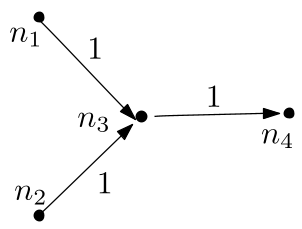 Figure 1: A basic example of the Independent Cascade (IC) model where ADA is the most efficient seed.
Experiments & Results
The researchers tested their methods on large-scale datasets like Amazon and DBLP.
- Quality: Greedy1 and Greedy2 consistently returned the smallest seed sets compared to Degree-heuristic or Random selection.
- Efficiency: Greedy2 (which performs sampling once at the start rather than at every step) proved to be significantly faster than Greedy1, making it viable for million-node networks.
- Theoretical vs. Empirical: While the theoretical additive error bound is , the actual performance on small datasets showed the error is often negligible, approaching the absolute mathematical optimum.
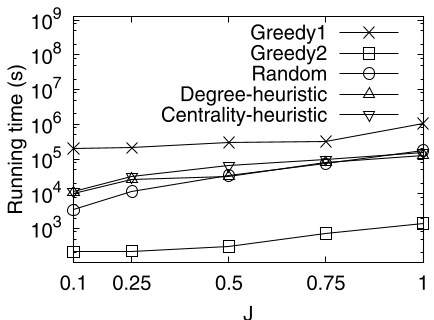 Table 1: Performance comparison showing Greedy methods requiring significantly fewer seeds than traditional heuristics.
Critical Analysis & Conclusion
Takeaway
The J-MIN-Seed problem is a critical addition to the viral marketing toolkit. By proving its NP-hardness and providing a greedy solution with solid error bounds, the authors have given marketers a mathematically sound way to minimize "Cost-per-Acquisition" (CPA).
Limitations
- Computational Intensity: Despite the efficiency of Greedy2, calculating "Expected Influence" over thousands of Monte Carlo simulations remains the bottleneck for real-time applications.
- Model Dependency: The SCC-based "Full-Coverage" algorithm is highly optimized for the IC model but requires further refinement for the more complex Linear Threshold (LT) model.
Future Outlook
Future research should look into Adaptive J-MIN-Seed, where the seed set is not chosen all at once, but updated dynamically as the marketing campaign progresses and real-world influence data flows back into the model.