
Madmica: Solving the Privacy-Relevance Paradox in Decentralized Social Networks
Minimizing Social Data Overload through Interest-Based Stream Filtering in a P2P Social Network
This paper introduces Madmica, a decentralized Online Social Network (OSN) built on the Friendica P2P protocol. It implements an interest-based stream filtering mechanism that leverages user interaction models to reduce information overload while preserving user privacy through decentralization.
TL;DR
Madmica is a decentralized social network that tackles two fundamental problems at once: Privacy and Information Overload. By building on the Friendica P2P protocol and implementing a localized, interest-based filtering mechanism, it allows users to own their data while ensuring their newsfeeds remain relevant through a reinforcement learning-based "interest overlay" on social relationships.
Background: The Centralization Trap
Modern social media users are trapped in a trade-off. Centralized platforms like Facebook offer sophisticated filtering (EdgeRank) to keep content "interesting," but at the cost of total surveillance and data ownership loss. Decentralized alternatives like Diaspora or Mastodon offer privacy but often leave users drowning in a raw, unfiltered "firehose" of data.
The authors argue that the problem with existing filters is twofold:
- They are Centralized, posing a privacy risk.
- They are One-Dimensional, treating a "friendship" as a single value rather than a complex bond that varies across topics (e.g., I may care about a friend's "Tech" posts but not their "Sports" updates).
Methodology: Localized Interest Modeling
Madmica's core innovation is the Interest-Based Relationship Model. Instead of a central server deciding what you see, your own local node performs the filtering.
1. Interest-Based Overlays
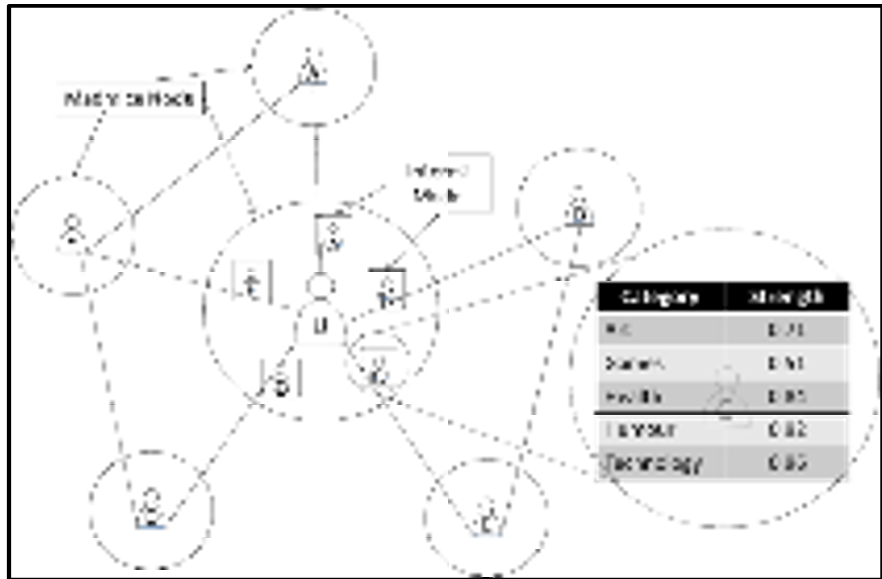
Every piece of content in Madmica is categorized (e.g., "Technology," "Education"). Your node maintains a unique "relationship strength" score for every friend per category.
2. The Feedback Loop
The system uses a formula derived from Simulated Annealing for reinforcement learning. When you interact with a post (like, comment, or share), your node sends an AJAX request to update the relationship strength for that specific category.
- High Interaction: Signals high interest, increasing the weight of future posts from that friend in that category.
- Low Interaction: The weight decays, eventually filtering those posts out of your primary view.
Pilot Study: Does it actually work?
A 3-week study involving graduate students yielded several key insights:
- Dynamic Relevance: 91% of respondents noticed that their feed became more interesting as the system learned their preferences.
- Effective Throttling: Users reported that the volume of social data was "about normal," suggesting the filter successfully prevented the "data deluge" common in early-stage social networks.
- The Trust Gap: Interestingly, users were hesitant to trust the filter unless they understood how it worked or had direct manual control over the settings. Trust in a P2P setting is as much about transparency as it is about privacy.

Critical Analysis & Conclusion
Madmica proves that relevance does not require centralization. By shifting the computational burden of filtering to the user's own node, we can achieve a personalized experience without a "Big Brother" architecture.
Limitations & Future Work
- The Filter Bubble: By hyper-optimizing for interest, there is a risk of isolating users from diverse perspectives—a classic problem that the authors acknowledge needs a "serendipity" mechanism.
- UX Complexity: While computer scientists in the study appreciated hosting their own nodes, the "general" user might find decentralized maintenance daunting.
- Explainability: Future iterations must provide "intuitive controls" so users don't feel the algorithm is a black box, even if it lives on their own hardware.
Madmica serves as a vital blueprint for the next generation of "Social Web 3.0" applications that prioritize user agency without sacrificing the curated experience we have come to expect.