
Beyond Connectivity: Minimizing Social Contagion via Topic-Aware Node Blocking
Minimizing the Social Influence from a Topic Modeling Perspective
The paper introduces a topic-aware approach to minimize negative social influence (e.g., rumors or infections) by blocking a limited set of nodes. It utilizes Hierarchical Dirichlet Process LDA (HDP-LDA) and KL divergence to quantify topic relevance, integrated into a Topic-aware Independent Cascade (TIC) model.
TL;DR
Fighting rumors or digital "infections" in social networks usually involves blocking influential users. However, most strategies are "topic-blind." This paper introduces a method that uses HDP-LDA to understand what is spreading and combines this with structural centrality. The result? A drastic reduction in contagion spread (reduction from 320 to 180 infected nodes in real-world tests) by targeting nodes that are not just highly connected, but specifically susceptible to the topic at hand.
The "Topic-Blind" Fallacy
In the study of social influence, most prior work treated every "item" (a rumor, a virus, a meme) the same way. But real humans have interests. A user who is highly influential in "Tech Gadgets" might have zero influence in "Political Rumors."
Existing methods, which focus on Out-degree (how many followers someone has) or Betweenness (how often they act as a bridge), ignore the Relevance between the node and the content. The authors argue that if we don't know the topic, we are effectively fighting a wildfire without knowing which trees are the most flammable.
Methodology: The TIC Model and HDP-LDA
To solve this, the authors adopt the Topic-aware Independent Cascade (TIC) model. In this framework, the probability of user influencing user is not a fixed number; it is a weighted average based on the topic distribution of the item being spread.
1. Extracting the "DNA" of Influence
The researchers use HDP-LDA (Hierarchical Dirichlet Process - Latent Dirichlet Allocation). Unlike standard LDA, HDP-LDA is non-parametric—it discovers the number of topics automatically.
- It analyzes messages across links to determine the "topic signature" of each user.
- It uses KL Divergence to calculate the distance between a potential node and the negative information .
- Intuition: The smaller the KL divergence, the more likely the node is to "accept" and "spread" that specific rumor.
2. Topic-Aware Heuristics
The paper redefines classic centrality measures by injecting topical relevance:
- Topic-aware Betweenness ():
- Topic-aware Out-degree ():
By dividing structural importance by topical distance, they prioritize nodes that sit at critical junctions (high or ) AND are topically aligned with the rumor (low ).
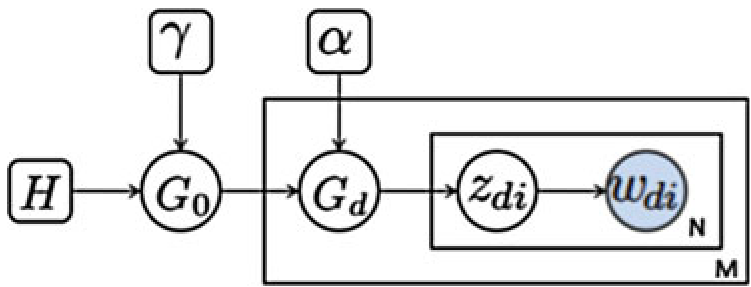 Figure 1: The process of predicting topic distributions for new messages using HDP-LDA.
Experimental Battleground: Sina Microblog & Facebook
The authors tested their heuristics against standard "Out-degree" and "Betweenness" on two real datasets.
- Sina Microblog: 2,000 nodes, real propagation logs.
- Facebook: 4,039 nodes, topic probabilities simulated via HDP-LDA.
Key Findings
The "Topic-aware" versions of the algorithms outperformed the structural-only versions across the board.
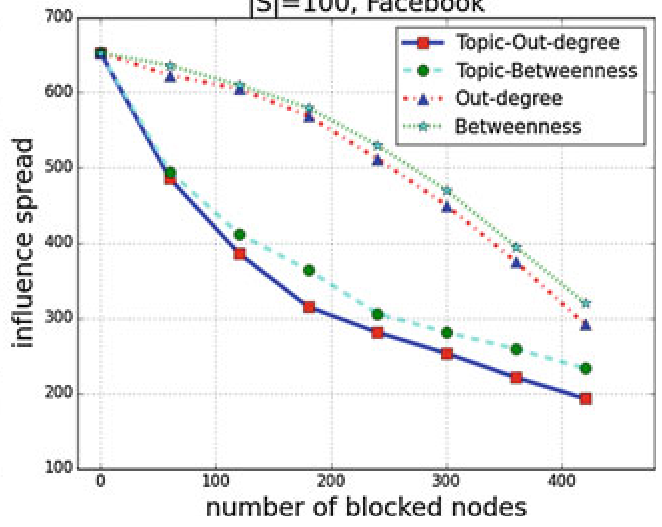 Figure 2: Performance comparison showing Influence Spread (vertical axis) vs. Number of Blocked Nodes (horizontal axis).
As shown in the charts, the green and blue lines (Topic-aware methods) drop the total infection size much faster than the black and red lines (Standard Centrality). In many cases, blocking just a few "topically relevant" nodes is as effective as blocking twice as many "highly connected" nodes.
Critical Insight & Conclusion
While the performance gain is massive, the authors ensure the computational cost remains manageable. The Gibbs sampling for HDP-LDA and the heuristic scoring both scale linearly with the neighborhood size, making this applicable to large-scale networks.
The Takeaway: If you want to stop a rumor, don't just look for the person with the most followers. Look for the "bridge" who actually talks about that specific topic. Social networks are not just graphs of nodes; they are graphs of interests.
Limitations: The study assumes we can observe enough historical data to map topics for every link. In highly private or sparse networks, the "topic signature" might be too noisy to calculate accurately.