
Minimum Budget for Misinformation Blocking: A Scalable Threshold-Based Approach
Minimum budget for misinformation blocking in online social networks
This paper introduces the Targeted Misinformation Blocking (TMB) problem, which aims to find the minimum set of nodes to remove from a social network to reduce misinformation influence by a specific threshold γ. The authors provide complexity proofs and propose two scalable, near-linear time algorithms, STMB-LT and STMB-IC, tailored for Linear Threshold and Independent Cascade diffusion models.
TL;DR
Most research asks: "Given nodes, how much misinformation can we block?" This paper flips the script to ask: "To block a specific amount of misinformation, what is the smallest number of nodes we must intervene on?" The authors prove this problem (TMB) is extremely hard (#P-hard/NP-hard) but provide highly scalable algorithms—STMB-LT and STMB-IC—that outperform current state-of-the-art methods like DAVA in both speed and solution quality.
Problem & Motivation: The Shift from "Max-Influence" to "Min-Cost"
In the fight against "Fake News," resources (budget, man-power, or "vaccination" units) are often limited. Existing literature mostly treats the budget as a fixed constraint. However, a social media platform might have a different goal: "We need to ensure that no more than 5% of our users see this rumor. What is the minimum intervention required?"
The authors identify this as the Targeted Misinformation Blocking (TMB) problem. This shift is mathematically significant. While Maximizing Influence Reduction is typically submodular (allowing for 1-1/e approximation), the Budget Minimization version with a fixed threshold is much stickier.
Methodology: From Probabilities to Trees
The core challenge is that social influence is probabilistic. To solve this, the authors utilize the Live-Edge Model. By "sampling" the network according to edge weights (LT model) or activation probabilities (IC model), they turn a probabilistic graph into a set of deterministic "Sample Graphs" (or trees).
1. The LT Model (Submodular Logic)
Under the Linear Threshold model, the authors prove that the influence reduction function is monotone and submodular. This allows them to use a "Lazy Forward" greedy approach, which drastically reduces the number of influence evaluations required by focusing only on the most promising nodes.
2. The IC Model (Breaking Submodularity)
Interestingly, the authors prove that is neither submodular nor supermodular under the Independent Cascade model. To combat this, they propose STMB-IC, which builds a tree rooted at the misinformation source for each sample. This structural simplification allows for near-linear time processing even when the underlying math doesn't guarantee a clean approximation ratio.
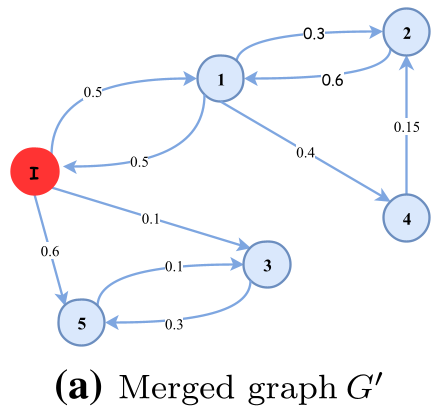 Fig 1: Illustrating the process of generating a tree root at I from a graph G under IC model rules.
Experimental Performance
The researchers tested their approach against several baselines, including DAVA (a state-of-the-art vaccination strategy), and standard centrality measures (Degree, PageRank).
Quantitative Edge:
- Efficiency: On the Stanford dataset (over 2 million edges), STMB-LT finished in ~18,000 seconds, whereas traditional Greedy methods couldn't even finish within 500,000 seconds.
- Quality: In IC model tests, STMB-IC500 was 67.3% better than DAVA in finding a smaller blocking set for the same reduction target.
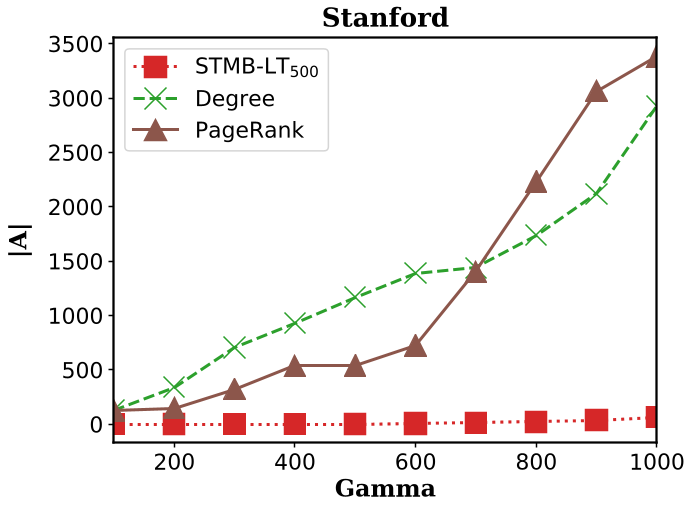 Fig 2: Comparison of solution quality in the LT model. Lower values indicate a smaller node set selected to meet the threshold—our STMB-LT achieves the lowest cost.
Critical Insight: Why Centrality Fails
A key takeaway from the experiments is why Degree and PageRank perform so poorly. These methods focus on the network structure in isolation. However, misinformation blocking is source-dependent. A highly connected node is useless to block if it never sits on a path from the misinformation source. The STMB family thrives because it specifically targets the "Influence Flow" from the source node .
Conclusion & Perspective
The TMB problem is a more practical formulation for organizations that have specific safety targets. By leveraging tree-based sampling, this paper provides a roadmap for real-time misinformation mitigation on massive graphs.
Limitations: The model assumes the misinformation source is known. In the real world, identifying the "Patient Zero" of a rumor remains a primary hurdle before these blocking strategies can be deployed.
Future Work: Integrating these strategies with Reinforcement Learning or applying them to "Multiplex" networks (where a rumor spreads across Twitter and Facebook simultaneously) offers an exciting next step.