
MCC-D2D: Optimizing Crowdsourcing in the Non-Deterministic World of Mobile D2D
Minimum-Cost Crowdsourcing with Coverage Guarantee in Mobile Opportunistic D2D Networks
This paper addresses the Minimum-Cost Crowdsourcing (MCC) problem in mobile opportunistic Device-to-Device (D2D) networks. It proposes a joint optimization framework covering task allocation, data processing, and computation offloading, specifically designed to handle the non-deterministic connectivity of D2D environments while guaranteeing field-of-interest coverage.
TL;DR
This research tackles the challenge of running crowdsourcing tasks—like searching for a lost pet or collecting environmental data—in areas with no cell service. By treating mobile users as opportunistic relays and processors, the authors propose a system that minimizes costs while guaranteeing that a specific area is covered with high probability, even when network connections are constantly breaking and reforming.
Background: The Infrastructure Gap
While we take 5G for granted, vast rural areas and disaster zones lack reliable infrastructure. Even where it exists, uploading gigabytes of crowdsourced video can be prohibitively expensive. D2D (Device-to-Device) communication offers a solution, but it is notoriously difficult to manage because it is non-deterministic: you never know exactly when two people will walk past each other to swap data.
The Multi-Dimensional Challenge
Unlike previous works that assume participants are just "on" or "off," this paper argues that the design space is much deeper:
- Sensing Quality (Q): Higher resolution means better detection probability but more data.
- Data Processing (P): Should a node shrink the data before sending it? Processing saves bandwidth but adds delay.
- Computation Offloading (O): Can a node's neighbors help process the data (Mobile Cloudlets)?
The authors synthesize these into the Minimum-Cost Crowdsourcing (MCC) problem.
Methodology: Submodularity and Distributed Heuristics
The core innovation lies in proving that the coverage function is submodular. This mathematical property allows the authors to use a greedy-style approximation algorithm while guaranteeing that the result isn't far from the absolute theoretical optimal.
1. The Centralized Approximation
The algorithm iteratively picks the "best" node-strategy pair that provides the highest marginal gain in coverage per unit of cost.
2. The Online Distributed Heuristic
Since a central controller doesn't exist in a disconnected D2D network, the authors designed a two-phase protocol:
- Task Advertising: The task "filters" through the network. Highly connected nodes aggregate potential coverage info.
- Task Splitting: When a node receives a "responsibility" (a target coverage probability), it decides whether to handle it or split it among its neighbors based on its own local "Cloudlet."
 Table: Key notations and strategy dimensions for the MCC problem.
Experiments and Real-World Evidence
The authors didn't just stay in the realm of theory. They deployed a prototype on 21 Android tablets carried by students for 15 days.
Key Findings:
- Coverage Guarantee: The system successfully adapted to different coverage requirements (). As the requirement increased, the system smartly recruited more "aggregated" nodes.
- Popularity Matters: Task "Originators" who were more social (higher node popularity) achieved the target coverage with much lower costs and delays because they could recruit directly rather than relying on multi-hop paths.
- The Weekend Slump: Data showed that success rates dropped on Fridays and Saturdays because student mobility (the "carrier" of the data) changed, highlighting the sensitivity of D2D to human behavior.
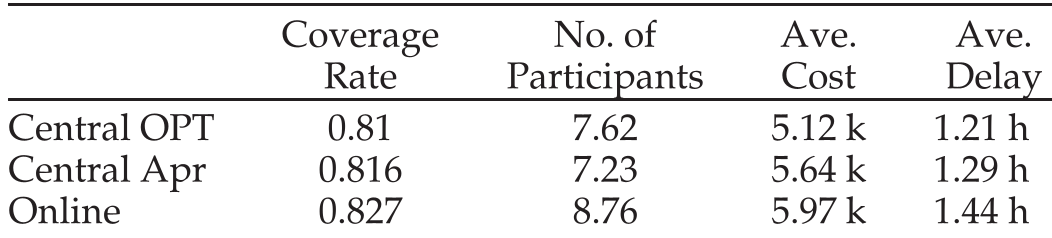 Table: Comparison between the Optimal (OPT), Approximation (Apr), and Online Heuristic. The Online method performs remarkably close to the OPT despite having only local information.
Critical Insight & Future Outlook
The most striking takeaway is the efficiency of the Online Heuristic. Even without a global view of the network, the distribution of "coverage responsibility" allows for a self-organizing crowdsourcing network. However, the paper assumes nodes are cooperative. In the real world, incentive mechanisms (paying users for their battery/data) would be the next critical layer to add to this architecture.
As we move toward 6G and ubiquitous AI, the ability to offload computation to "passing strangers" (Mobile Cloudlets) as demonstrated here will likely become a cornerstone of edge computing.