
The Coalition Problem: How Many "Spies" Are Needed to Know Everything in a Social Network?
Minimum number of information gatherers to ensure full observability of a dynamic social network: A structural systems approach
The paper introduces the "Coalition Problem" in dynamic social networks, aimed at identifying the minimum number of agents (information gatherers) required to ensure full structural observability. Utilizing structural systems theory and LTI modeling, the authors demonstrate that this optimization task is fundamentally NP-hard but can be effectively approximated through a reduction to the Minimum Set Covering problem.
TL;DR
When agents in a social network interact dynamically, their internal states (opinions, wealth, etc.) evolve. This paper tackles a critical question: What is the minimum number of agents who must share their private observations to reconstruct the state of every single person in the network? The study proves this is an NP-hard problem but reveals a clever path to a solution using graph theory and set-covering approximations.
Background & Positioning
In a world of distributed systems—from gossip protocols to industrial sensor webs—we often assume we have "enough" data. But in a competitive or private environment, information is siloed. The authors position this work at the intersection of Control Theory and Social Network Analysis, moving beyond "what is observable" to "who is the most efficient coalition of observers."
The Core Challenge: Why is this Hard?
Modern networks are massive. If you have agents, checking every possible combination of agents to see if they can "observe" the network leads to an exponential explosion of possibilities.
The authors identify a fundamental bottleneck: the minCOS (Minimum Constrained Output Selection) problem. They prove that the Coalition Problem is at least as hard as minCOS, classifying it as NP-hard. You can't just pick the agents with the most "friends"; the structure of how information flows over time determines if a coalition is successful.
Methodology: From Matrices to Graphs
The magic of this paper lies in Structural Systems Theory. Instead of worrying about whether an interaction strength is 0.5 or 0.7, the authors look at the topology (the "zeros" and "non-zeros").
1. The Power of SCCs
The network is decomposed into Strongly Connected Components (SCCs). Specifically, they focus on non-bottom linked SCCs—clusters of agents that don't pass information to other clusters. If you can't see what's happening in one of these "root" clusters, the rest of the network's state remains a mystery.
2. The Reduction Trick
The authors prove that if the system has a "perfect matching" (which is common in networks where agents remember their own previous state), the observability problem simplifies significantly:
- The Universe (): All the non-bottom linked SCCs in the network.
- The Sets (): The specific SCCs that Agent can "see" through their local measurements.
This transforms a complex Control Theory problem into a classic Minimum Set Covering Problem.
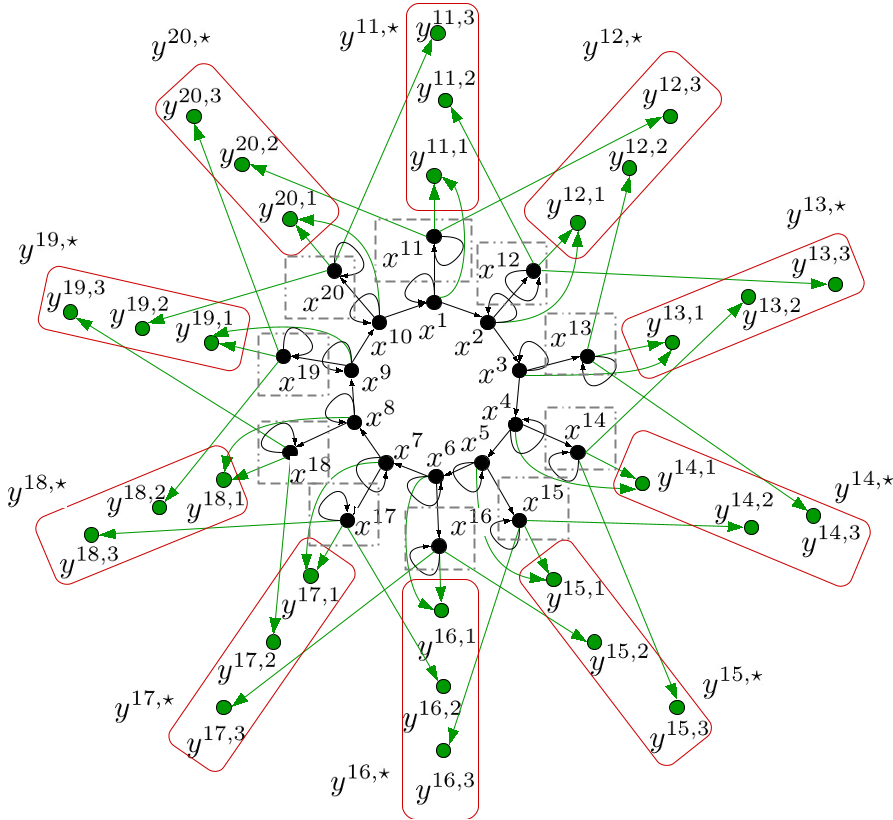 Figure 1: The system digraph illustrating how agents (black nodes) and their outputs (green nodes) interact. The gray dashed boxes represent the critical SCCs that must be covered.
Experimental Insight: The 20-Agent Example
The authors present a 20-agent network (see Figure above). While 20 agents might seem small, the possible subsets of agents are .
By using their reduction:
- They identified 10 critical non-bottom linked SCCs.
- They mapped which agents (11 through 20) had measurements covering which SCCs.
- They found that a coalition of just 4 agents ({11, 14, 17, 19}) was sufficient to achieve full observability.
Critical Analysis & Conclusion
Takeaway
The structural approach is powerful because it is robust. Since it depends on the topology rather than exact numerical parameters, the "coalition" identified will remain effective even if the exact interaction strengths between agents change slightly.
Limitations
The current model assumes Linear Time-Invariant (LTI) dynamics. In real social networks, interactions are often non-linear and time-varying (e.g., people change who they talk to). Furthermore, the assumption of a "perfect matching" (Assumption 1), while often true for systems with self-loops, might not hold in all sparse communication protocols.
Future Outlook
This work provides a rigorous foundation for Privacy vs. Surveillance studies. By knowing the "minimum number of gatherers," we can also work backward to design networks that are harder to observe, protecting the privacy of the agents within.