
MST-Community: Balancing Precision and Scalability in Social Network Analysis
A novel approach based on the minimum spanning tree to discover communities in social networks
This paper introduces a novel community detection method for social networks by combining a hybrid similarity measure with the Minimum Spanning Tree (MST) algorithm. By integrating Jaccard similarity with a custom "rate of connections between neighbors," the approach achieves State-of-the-Art (SOTA) accuracy on benchmark datasets with a highly efficient time complexity.
TL;DR
Community detection is a cornerstone of social network analysis, but researchers have long fought a zero-sum game between computational speed and partition accuracy. This paper breaks the deadlock by introducing a new similarity metric—combining Jaccard coefficients with local neighborhood density—and applying it within a Minimum Spanning Tree (MST) framework. The result? A method that achieves superior modularity and accuracy at a lean complexity.
Background & Positioning
In the graph theory landscape, detecting communities means finding clusters where internal connections are denser than external ones.
- Classic Approaches: Girvan-Newman (GN) is accurate but too slow for large graphs ().
- Speed Kings: Modularity optimization (CNM) is fast but suffers from the "resolution limit," often missing small, fine-grained communities.
This paper positions itself as a middle ground: it leverages the efficiency of MST algorithms (like Prim’s) while using a sophisticated local weighting scheme to ensure the resulting clusters are sociologically meaningful.
The Core Insight: Beyond Common Neighbors
The authors argue that simply counting common neighbors (Jaccard similarity) isn't enough. Two nodes might share a friend, but that doesn't mean they belong in the same "inner circle."
The New Metric
The authors introduce , the rate of connections between neighbors. It measures how many actual links exist between the neighbors of node and node compared to the total possible links. The final weight is defined as: Note: Lower weights signify higher similarity, which is why we use a Minimum Spanning Tree.
Methodology: The MST Approach
The algorithm follows three crisp phases:
- Weighting: Every edge is assigned a weight based on the hybrid similarity.
- MST Construction & Pruning:
- Build an MST of the graph.
- Calculate the mean weight () of all edges in the tree.
- Delete any edge with weight (i.e., low similarity edges).
- Constraint: Edge deletion is stopped if it results in a cluster smaller than 4 nodes to maintain community integrity.
- Post-processing: Reattach outliers/isolated nodes to the community where they have the most neighbors.
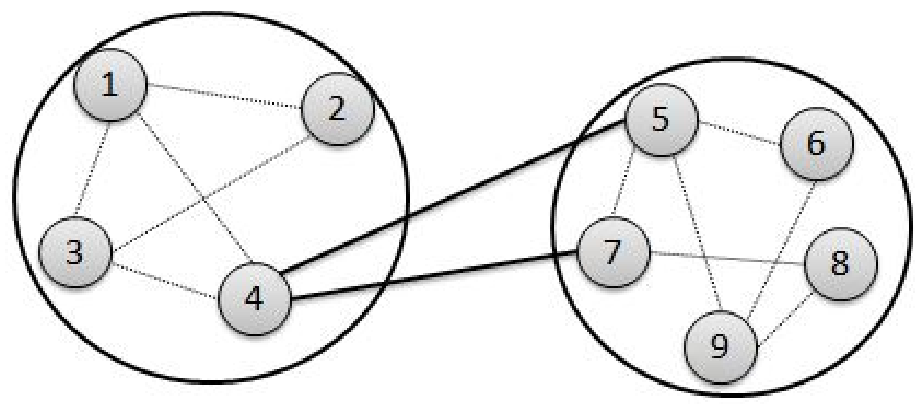 Fig 1: A conceptual graph showing how specific nodes (like and ) are clustered based on neighborhood connection rates.
Experiments & Results
The authors tested their method against heavyweights: CNM, WalkTrap, and Leading Eigenvector (LE) on five benchmarks (Karate Club, Dolphins, Les Miserables, etc.).
Performance Benchmarks
| Dataset | Our Method | CNM | WalkTrap | LE |
|---|---|---|---|---|
| Dolphin Network | 0.50 | 0.49 | 0.49 | 0.49 |
| Les Miserables | 0.55 | 0.50 | 0.52 | 0.53 |
While the Spectral method (LE) wins on very small graphs (Karate Club), the proposed MST method scales better, consistently improving modularity as the network size increases.
Accuracy: Precision & Recall
Using the gold-standard Girvan-Newman results as a baseline, the authors' method demonstrated higher precision and recall than competitors. This suggests that the similarity metric effectively identifies "true" community boundaries that modularity maximization alone might overlook.
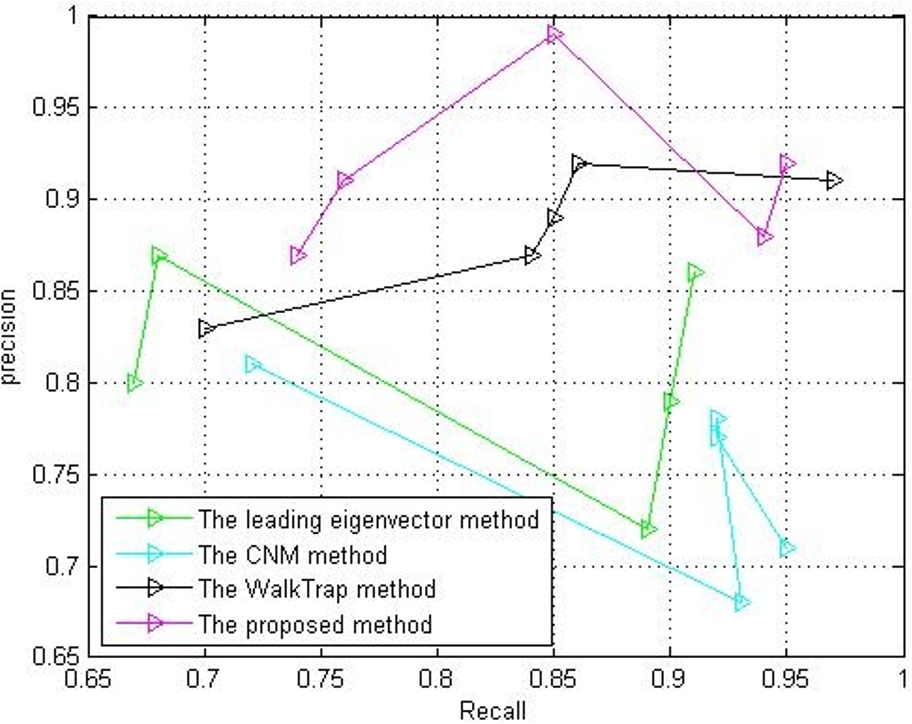 Fig 2: Reliability tests showing the proposed method leading in the trade-off between precision and recall.
Critical Insight & Conclusion
The genius of this approach lies in its simplicity. By moving away from global modularity optimization—which can be computationally heavy and prone to errors—and focusing on local structural similarity preserved via an MST, the authors achieve a "best of both worlds" scenario.
Limitations: The assumption that every community must have at least 4 nodes is a heuristic that might not hold true for all types of social networks (e.g., highly fragmented ones). However, for the standard benchmark sets, it serves as an effective regularizer.
Future Outlook: With a complexity of , this method is a prime candidate for analyzing massive modern datasets, such as Twitter follower graphs or large-scale co-authorship networks, where traditional spectral methods would fail to compute.