
Decoding the Anonymous: Merging Psycholinguistics and Social Topology
Mining Information of Anonymous User on a Social Network Service
This paper proposes a novel framework for de-anonymizing user profiles on Social Network Services (SNS) by combining Opinion Mining with psychological analysis via LIWC and a custom social relationship scoring formula. The method focuses on extracting biographical traits (age, gender) and mental states from text to enhance semantic understanding.
TL;DR
Is an anonymous user truly anonymous? This paper argues that our writing habits and interaction frequencies act as a "psychological watermark." By combining LIWC (Linguistic Inquiry and Word Count) for psychological profiling with a specialized Relation Number formula, the authors demonstrate a method to identify gender, age, mental state, and genuine preferences of anonymous SNS users.
Contextual Positioning
While most sentiment analysis focuses on what is being said, this work focuses on who is saying it and to whom. It sits at the intersection of Opinion Mining and Computational Psycholinguistics, moving beyond simple keyword matching to create a multi-dimensional persona of anonymous actors.
Problem: The Reliability Gap in Social Mining
Standard data mining treats all texts equally. However, the authors identify a critical nuance: Reliability. For instance, a post written in a state of depression or by someone intentionally lying (characterized by specific linguistic markers like fewer third-person pronouns) should not carry the same weight in a marketing or forensic analysis as a "healthy" text. Existing works often ignore the social context—the difference between a comment to a stranger (weak tie) versus a close friend (strong tie).
Methodology: The Two-Pronged Approach
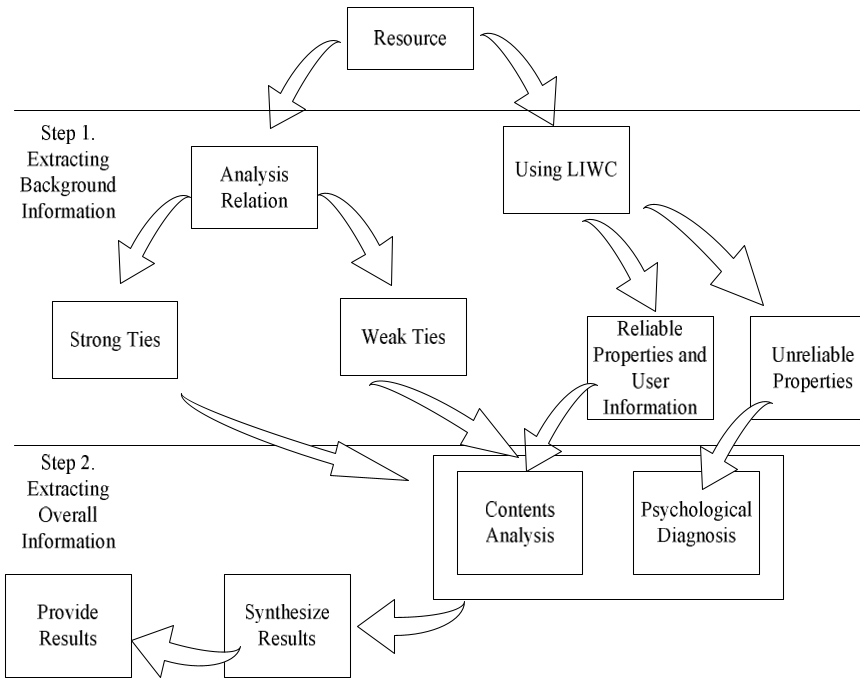
The authors propose a system architecture that filters raw social media data through two primary lenses:
1. The Relation Number (Quantitative Social Depth)
To distinguish between superficial interactions and genuine relationships, the authors use a specific formula to calculate the Relation Number ():
Where interaction degrees and comment volumes are normalized. A value indicates "Strong Ties," where users are more likely to reveal their true selves.
2. LIWC Integration (Qualitative Psychology)
By analyzing the frequency of word categories (e.g., self-references, cognitive words, negative emotions), the system extracts:
- Demographics: Gender and age (e.g., females tend to use more first-person singular pronouns).
- Stability: Markers for depression or deception.
- Reliability: Filtering out "noise" from unreliable mental states.
Case Study & Evidence
The authors validated their framework on an anonymous target, correlating the extracted profile with a real-world interview.
- Relationship Accuracy: The formula matched 67% of online relations to real-world counterparts.
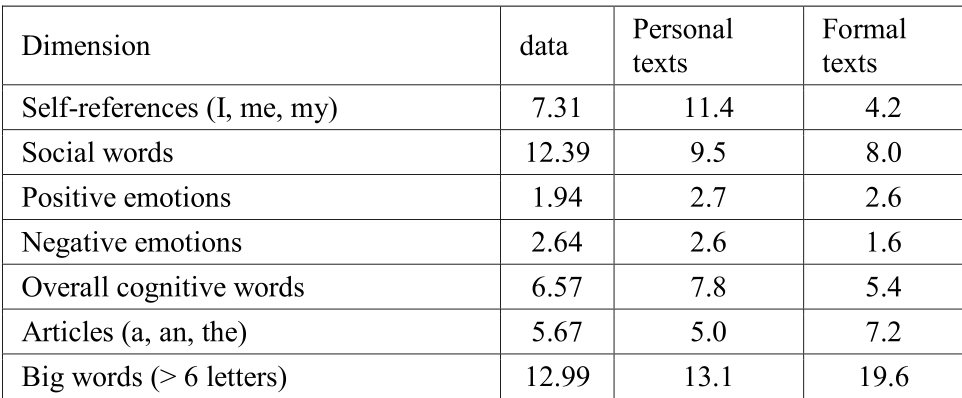
- Linguistic Profiling: The target showed a high frequency of self-references (7.31) and cognitive words, correctly identifying her as a "young female" with specific emotional markers.
- Refined Sentiment: The system mapped specific likes (e.g., Easter, Trip plans) and dislikes (Traveling lovers) exclusively from strong-tie interactions, ensuring high-confidence data.
Critical Insight & Conclusion
The true value of this work lies in its data-cleaning philosophy. By using psychology to assign a "trust score" to social media text, it mitigates the impact of "opinion spam" and emotional noise.
Limitations: The 67% accuracy in relationship matching suggests that "online personas" still differ significantly from real-life personalities. Furthermore, as the authors acknowledge, the disparity between virtual and physical social networks remains a challenge for future computer science and psychology cross-over research.
Future Outlook: This methodology has profound implications for Digital Forensics (tracking criminal behavior through linguistic style) and Hyper-Personalized Marketing, provided that ethical safeguards are implemented to prevent the misuse of de-anonymized data.