
Mining Business Opportunities: How AI Decides Where Your Next Shop Should Open
Mining Business Opportunities from Location-based Social Networks
This paper introduces a specialized recommendation framework to mine business opportunities from Location-based Social Networks (LBSNs). It proposes a two-step pipeline consisting of a greedy district partitioning algorithm and the EmbeddingWARP model to recommend new business categories for specific urban areas, achieving state-of-the-art performance on Yelp datasets.
TL;DR
Deciding where to open a new business has traditionally been a mix of gut feeling and expensive manual surveys. This paper presents a data-driven alternative using Location-based Social Networks (LBSNs). By partitioning cities into functional districts and applying a specialized ranking model called EmbeddingWARP, the authors can predict which business categories (e.g., a gym vs. a cafe) are missing from a specific neighborhood with high precision.
Background: Beyond the Government Grid
Urban development is moving faster than city planners can track. While traditional methods rely on "official zones," this paper argues that the actual function of a neighborhood is defined by human behavior—where people check-in, eat, and shop. The goal is to move from coarse geographic circles to "Functional Business Districts" that mirror real-world commercial synergy.
The Problem: The Hidden Logic of Categories
Why does a boutique coffee shop thrive next to a yoga studio but fail next to a car repair shop? This is the "functional correlation" problem. Existing recommendation systems often treat business categories as independent labels. Furthermore, most systems focus on suggesting where a user should go (POI recommendation), whereas this work flips the script to help investors decide what to build.
Methodology: The Two-Step Success Blueprint
1. Greedy District Discovery
Instead of using arbitrary grid squares, the authors identify Landmark Venues—the "gravity centers" of a city where check-ins are densest. Using a geographical venue graph and a Breadth-First Search (BFS) approach, they cluster adjacent venues into cohesive "Business Districts." This ensures the recommendations are rooted in areas with established foot traffic.
2. The EmbeddingWARP Model
The core innovation lies in how the model understands business types.
- Category Embedding: Using techniques inspired by Word2Vec, the model learns latent representations of business categories. If "Sushi Bars" and "Ramen Shops" frequently appear near the same landmark, their vectors move closer in the latent space.
- WARP Loss Ranking: Most models use simple similarity. EmbeddingWARP uses a Weighted Approximate-Rank Pairwise (WARP) loss. It doesn't just ask "is this category good?"—it iteratively samples "negative" categories until it finds one that the model incorrectly ranks higher than a "positive" one, then optimizes to fix that specific mistake.

Experimental Battleground: Yelp 2015 Dataset
The researchers tested their model against four major US cities. The results were clear: the EmbeddingWARP model consistently beat standard Collaborative Filtering methods like BPRMF and WRMF.
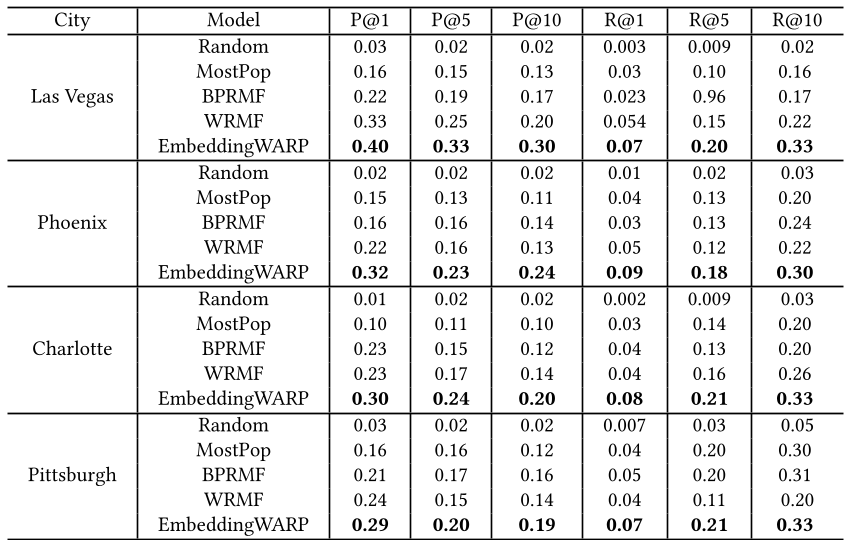
In Las Vegas, the model achieved a Precision@1 of 0.40, meaning it could pinpoint the single most needed business category with 40% accuracy—nearly double the performance of popular-based recommendation methods.
Critical Insight: The Future of Urban AI
The takeaway for the industry is profound: The city is a graph, not a map. By treating business types as nodes in a functional network, we can identify "commercial vacuums"—places where the crowd's needs (revealed by check-ins) aren't yet met by the existing supply.
Limitations & Future Work
The current model relies on "Internal" data—what is already in the city. The authors suggest that the next frontier is Transfer Learning: using insights from a mature city like New York to predict business needs in a rapidly developing city in another part of the world.
Conclusion
This work transforms LBSN check-ins from social vanity metrics into a powerful engine for urban economics. For investors, it reduces the risk of the "wrong shop in the right place." For citizens, it means more convenient services that actually match their lifestyle.