
Beyond Order: Mining the Temporal Pulse of Clinical Data for Liver Transplantation
Mining Clinical Data with a Temporal Dimension: A Case Study
This paper presents a clinical case study applying the Time-Annotated Sequences (TAS) mining paradigm to analyze the efficacy of Extracorporeal Photopheresis (ECP) therapy in liver transplant patients. By utilizing the TAS algorithm, the researchers successfully extracted sequential patterns of biochemical variables (like interleukins) annotated with frequent transition time intervals, outperforming traditional sequential pattern mining.
TL;DR
Researchers have moved beyond simple "event A follows event B" analysis by implementing Time-Annotated Sequences (TAS) to monitor liver transplant patients. By capturing the exact time between biochemical changes, the system identified patterns that physicians recognized as early warning signs for organ rejection—something traditional data mining often misses.
Background Positioning
In the hierarchy of data science, sequence mining (like PrefixSpan) has long been a staple. However, this paper represents a critical transition from Ordinal Logic (knowing the order) to Temporal Logic (knowing the duration). It positions itself as a bridge between theoretical pattern mining and high-stakes clinical application, specifically focusing on Extracorporeal Photopheresis (ECP) therapy.
Problem & Motivation: The "Time Gap" in Medical Data
Why aren't standard algorithms enough for doctors? In medicine, when a reaction occurs is often as important as what occurred.
Current sequential pattern mining (FSP) treats time as a mere index. If a patient shows a drop in Interleukin-12 on Day 2 and another on Day 10, FSP simply sees a sequence of two drops. The TAS paradigm argues that the 8-day gap is a vital data point that should be part of the extracted knowledge, not just a constraint used for pruning.
Methodology: The TAS Paradigm
The core of this work is the n-TAS definition: a sequence of itemsets where each transition is annotated with a temporal value .
The τ-Containment Intuition
The algorithm doesn't look for exact time matches (which are rare in biological systems) but uses -containment. A pattern is "contained" within a patient's history if the items match and the time gaps are within a professional threshold of tolerance ().

The researchers evolved their approach through three iterations:
- Trend-based: Focused on relative changes (increase/decrease).
- Milestone-based: Focused on deviations from "normal" at fixed dates (e.g., Day 7, Day 14).
- Surprise-driven: The most successful approach, which removed "normal" data points to let the anomalies—the true signals of rejection—shine through.
Experiments: Validating with Physicians
The study analyzed a unique dataset of 50 liver transplant patients. The most striking result came from the third analysis phase.
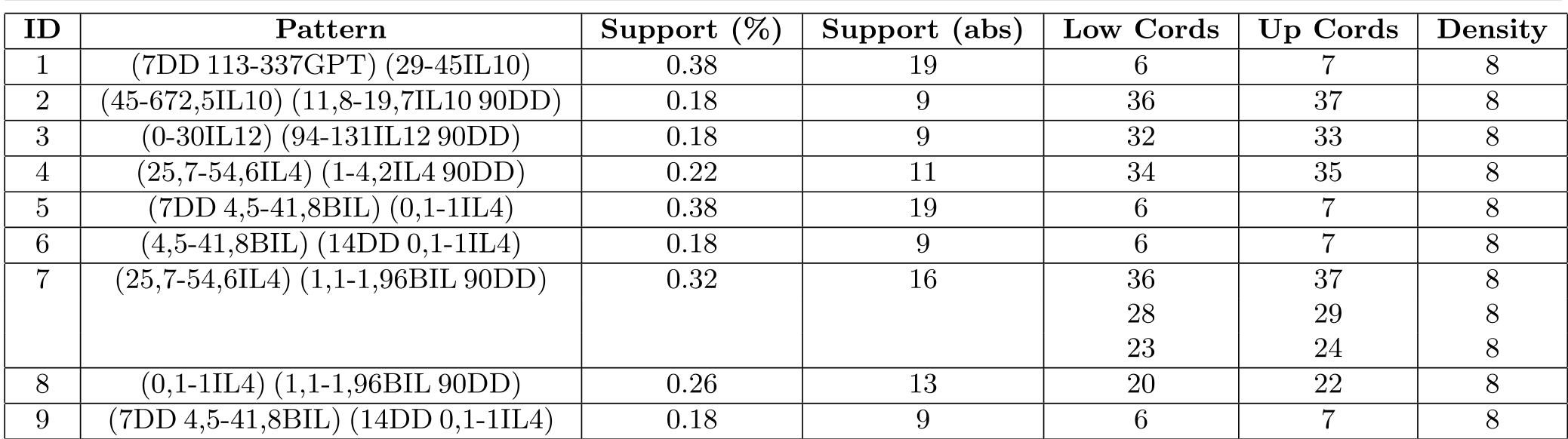
- Clinical Insight: TAS IDs 2 and 3 in the final analysis showed highly irregular interleukin levels at specific time intervals (around 90 days).
- Physician Feedback: When presented with these automated patterns, doctors hypothesized they were early markers of rejection. Upon checking the records, the patients supporting these patterns were indeed those who experienced rejection episodes.
Critical Analysis & Conclusion
Summary (Takeaway)
The real value of this work isn't just a new list of patterns; it's the methodological framework for handling clinical time-series data. By treating time as an interval rather than a point, TAS reveals the "rhythm" of a patient's recovery or decline.
Limitations
- Missing Data: The dataset was pruned from 127 patients to 50 due to incomplete records, highlighting a common "real-world" bottleneck.
- Discretization Sensitivity: The results highly depend on how continuous variables like IL-10 levels are converted into categorical "bins."
Future Work
The authors suggest moving toward a predictive warning system by integrating genetic polymorphisms and chimerism data into the temporal sequences. This would transform TAS from a diagnostic tool into a proactive shield for transplant recipients.
Editor's Note: This research stands as a seminal example of how algorithmic "density" (looking for clusters in time) can decode complex biological responses that are otherwise invisible to standard sequential analytics.