
Wikipedia as a Cultural Mirror: Mining the World’s Culinary Relations
Mining cross-cultural relations from Wikipedia - A study of 31 European food cultures
The paper presents a computational framework for Mining Cross-Cultural Relations by analyzing 27 language editions of Wikipedia focusing on 31 European food cultures. It introduces metrics for Cultural Similarity, Understanding, and Affinity, demonstrating that Wikipedia can serve as a non-reactive proxy for sociological research.
TL;DR
Researchers have developed a method to extract cultural relationships—Similarity, Understanding, and Affinity—by analyzing how different language communities on Wikipedia describe and consume information about food. By studying 31 European food cultures across 27 languages, the study finds that our digital footprints on Wikipedia are deeply influenced by geography, migration, and a strong "self-focus" bias.
Background: The Digital Lens of Culture
When a Romanian editor writes about "French Cuisine," do they see the same thing a French person sees? Usually, the answer is no. According to Pierre Bourdieu, "taste" is a primary marker of social and cultural identity. This paper moves beyond traditional surveys to use Wikipedia—the world’s most diverse encyclopedia—as a laboratory for Computational Social Science.
The Problem: The "Tower of Babel" and Knowledge Bias
Most people assume Wikipedia is a neutral repository. However, previous research shows that only a tiny fraction of concepts are truly "universal" across languages. The core problem this paper addresses is: How can we quantify the hidden cultural biases in how we perceive others versus how we perceive ourselves?
Methodology: The CCRM Framework
The authors propose a Cross-Cultural Relation Mining (CCRM) framework focusing on three pillars:
- Cultural Similarity: If the Swedish and Finnish cuisine articles both link to "Herring" and "Potatoes," they are considered culturally similar.
- Cultural Understanding: An asymmetric measure. Does the English Wikipedia’s description of "Italian Cuisine" match the Italian Wikipedia’s own description?
- Cultural Affinity & Bias: Does a community pay more attention to a specific foreign culture than its global popularity would justify?
Architecture of Interests
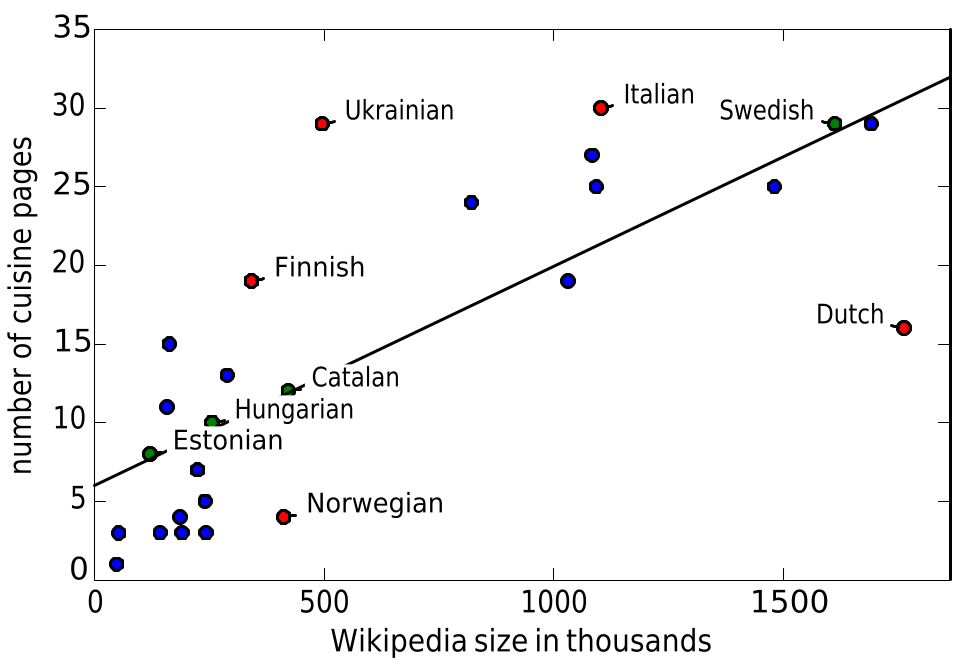 Figure: The correlation between Wikipedia edition size and interest in foreign food cultures. While size matters, some cultures (like Italy) show an outsized interest in culinary diversity.
Key Insights and Results
1. The Power of Proximity
Geography remains the strongest predictor of culture. The study finds that neighboring countries are, on average, 1.5 times more similar in their culinary descriptions than non-neighbors. For instance, the closest culinary pairs found were Russia-Ukraine and Finland-Sweden.
2. Migration as a Bridge to Understanding
Why is Turkish cuisine one of the best-understood food cultures in Europe (ranking 3rd, just behind French and Italian)? The authors found a significant correlation () between migration statistics and cultural understanding. The physical movement of people translates directly into the digital accuracy of cultural representation.
3. The "Self-Focus" Bias
Data proves we are digitally narcissistic. Every single language community analyzed showed a Self-Focus Bias. Interestingly, this bias is much higher in view counts than in outlinks, suggesting that while editors try to be diverse, the general public primarily consumes content about their own culture.
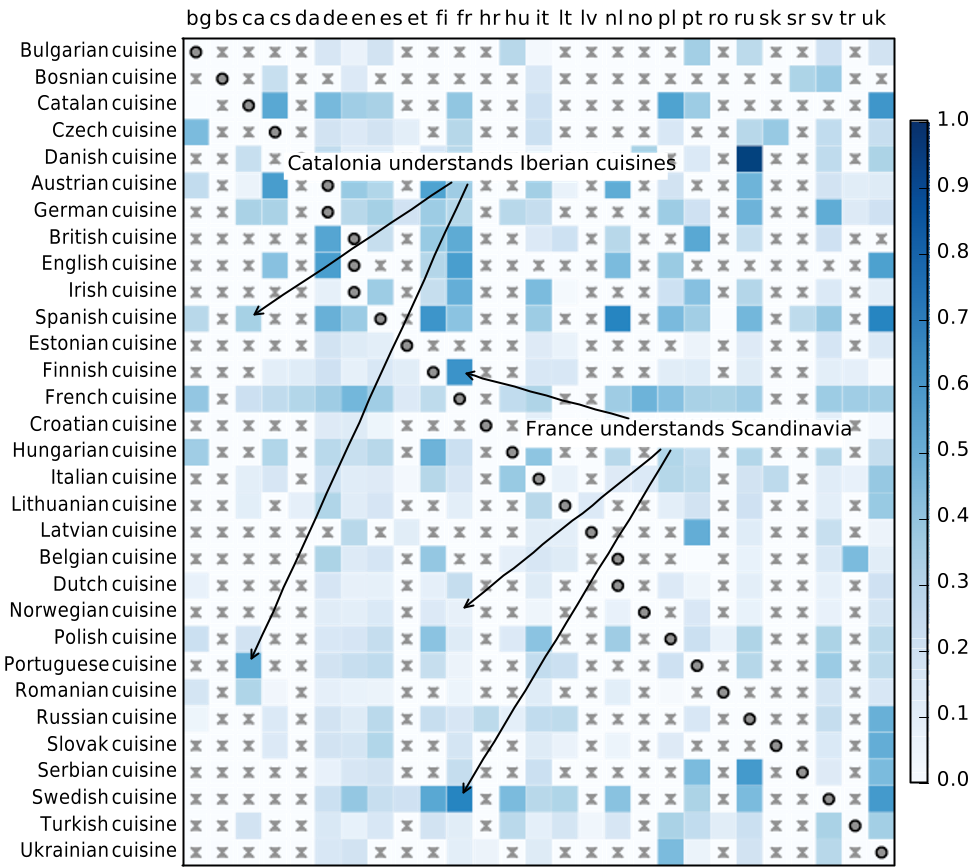 Figure: A heatmap showing the "Understanding" matrix. Sparse areas indicate a lack of cross-cultural knowledge or interest.
Critical Analysis: Beyond the Plate
While this study focuses on food, the implications are vast. The methodology can be extended to music, literature, and art.
Limitations:
- Language Country: Associating the English Wikipedia solely with the UK or US is a simplification.
- Selection Bias: Wikipedia users represent a specific demographic that may not reflect an entire nation's views.
Conclusion: A Tool for Global Harmony?
By unveiling these biases, the Wikipedia community can identify "knowledge gaps"—areas where descriptions are stereotypical or incomplete. More importantly, it proves that similar cultural groups not only understand each other better but also show higher mutual interest. In a world of increasing conflict, understanding these digital affinities might be the first step toward better cross-cultural empathy.
Takeaway: Our digital diet is as localized as our physical one. If you want to understand a culture, don't just look at what they eat—look at what they write and read about what they eat.