
Mining the "First Impression": How Topic Models Decode Vlogger Personalities
Mining Crowdsourced First Impressions in Online Social Video
This paper explores crowdsourcing "thin-slice" first impressions—encompassing personality, attractiveness, and mood—of YouTube vloggers. Using 442 vlogs and over 2,210 Amazon Mechanical Turk annotations, the authors propose a Topic Modeling (LDA) framework to discover multidimensional "prototype" impressions (e.g., "Easygoing," "Grouchy") and predict them via multimodal behavioral analysis.
TL;DR
First impressions are formed in seconds. Researchers Joan-Isaac Biel and Daniel Gatica-Perez have developed a probabilistic framework that uses Topic Modeling to categorize YouTube vloggers into multifaceted profiles like "Easygoing," "Charming," or "Grouchy." By analyzing audio, video, and even YouTube comments, they’ve shown that we can automatically predict how an audience perceives a creator with surprising accuracy.
Background: Beyond Simple Labels
In the world of social computing, we are good at identifying what is in a video (a cat, a car, a tutorial). We are less skilled at identifying who the person is in the eyes of the viewer. Traditionally, researchers looked at personality or mood in isolation. But human perception is messy—we often conflate "attractiveness" with "friendliness" (the Halo Effect). This study moves the goalposts by treating impressions as a multidimensional "bag-of-words."
The Methodology: Topic Models for Humans
The researchers treated vlogger impressions like a text document. Instead of words like "apple" or "bank," the "vocabulary" consisted of traits like high-extraversion, low-agreeableness, or excited mood.
1. Crowdsourcing "Thin Slices"
Using Amazon Mechanical Turk, the team gathered impressions based on 1-minute "thin-slices" of vlogs. They found that strangers are remarkably consistent in judging traits, especially Extraversion and Happiness.
2. Discovering Prototype Impressions
By applying Latent Dirichlet Allocation (LDA), they identified 6 core "Topic Impressions":
- Easygoing: High extraversion, openness, and friendliness.
- Grouchy: Low agreeableness, disappointment, and low conscientiousness.
- Geek: High conscientiousness, smart, and relaxed.
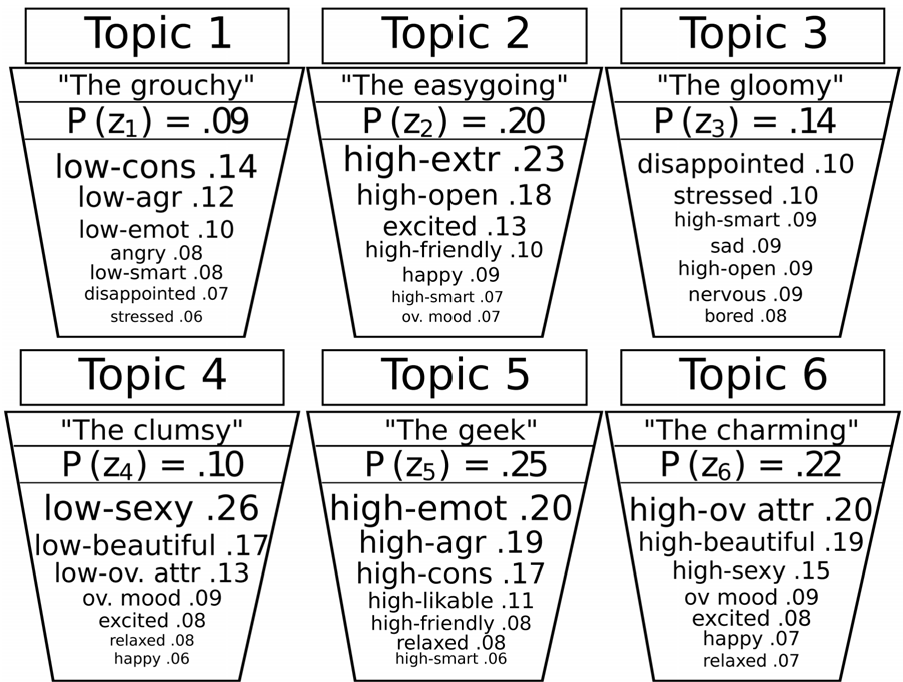 Fig 1: The most probable words and traits defining the 6 discovered vlogger archetypes.
Automatic Prediction: Can AI "Feel" the Vibe?
The study explored three primary data sources to predict these topics:
- Nonverbal Cues (AV): Speaking rates, pitch, and body motion energy. This was the powerhouse for predicting the "Easygoing" archetype (R² = 0.41).
- Verbal Content (TRA): Using LIWC to categorize words in transcripts. This excelled at identifying "Geeks" and "Grouchy" personalities.
- The Audience (COMMENTS): A novel addition. The researchers found that what viewers say in the comments section acts as a reflecting mirror of the vlogger's traits.
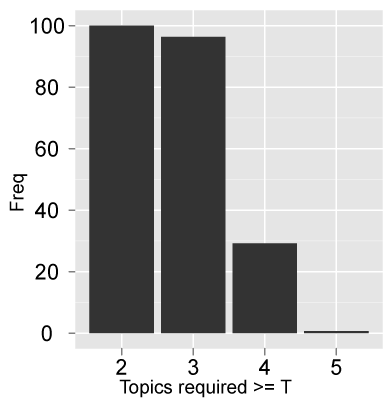 Fig 2: Prediction performance across different modalities. Note how "Easygoing" thrives on audiovisual cues, while "Geek" relies on verbal content.
Why YouTube Comments Matter
One of the paper's most intriguing findings is the value of audience metadata. While comments are often noisy and toxic, they contain high-level semantic info that mimics vlogger transcripts. The authors found that as comment threads grow longer (e.g., >50 comments), the predictive power for traits like "Agreeableness" increases significantly. This suggests that the crowd acts as a distributed sensor for creator personality.
Critical Insight & Future Outlook
This work validates that the digital "first impression" is as structured as face-to-face interaction. However, the study relies on 1-minute clips. Future research should address:
- Longevity: Do these impressions hold over a creator's entire career?
- Diversity: How do cultural differences in the audience affect these "prototype" topics?
Takeaway: For developers of search and recommendation engines, this research provides a blueprint for "personality-based" retrieval—imagine a YouTube filter for "Easygoing" or "Helpful" creators rather than just "Most Viewed."
Conclusion
By fusing Topic Models with multimodal behavioral analysis, Biel and Gatica-Perez have turned subjective "vibes" into quantifiable data. Whether it's the pitch of your voice or the words in your comments section, your online persona is more legible than you might think.