
Beyond Personality: Decoding the Probabilistic Landscape of Vlogger First Impressions
Mining Crowdsourced First Impressions in Online Social Video
This paper presents a framework for crowdsourcing and modeling multifaceted first impressions of YouTube vloggers, covering personality (Big-Five), attractiveness, and mood. It introduces a probabilistic topic modeling approach (LDA) to discover prototypical "impression topics" and evaluates automatic prediction using nonverbal, verbal, and community-comment features.
TL;DR
This research moves beyond simple personality labels to map the complex "bag of impressions" viewers form when watching YouTube vlogs. By combining crowdsourced data with Latent Dirichlet Allocation (LDA), the authors discovered distinct vlogger prototypes—like the "Easygoing" or "Geek"—and proved that these impressions can be predicted using nothing more than nonverbal cues and the audience's own comments.
The Problem: The One-Dimensional Sieve
In human psychology, we rarely judge a person solely on their "Level of Extraversion." We see a blend: a person might seem happy and attractive, or perhaps stressed but intelligent. Most prior work in social computing has treated these traits as isolated silos. Furthermore, the sheer volume of YouTube content makes traditional, expert-led behavioral analysis impossible to scale.
The authors' insight was to treat impressions like a language. Just as a document is a mixture of topics, a vlogger’s social persona is a mixture of co-occurring impressions.
Methodology: Mapping the "Bag-of-Impressions"
The study utilized a dataset of 442 YouTube vlogs, collecting 2,210 annotations via Amazon Mechanical Turk.
1. Multi-Facet Crowdsourcing
Annotators evaluated three primary dimensions:
- Personality: Using the Ten-Item Personality Inventory (TIPI) for Big-Five traits.
- Attractiveness: Both physical (Beautiful, Sexy) and non-physical (Likable, Smart).
- Mood: 10 distinct states ranging from High Arousal (Excited) to Low (Bored).
2. Discovering Prototypes with LDA
To move from raw scores to "social prototypes," the authors treated each vlogger as a "document" and their scores as "words." Using LDA, they extracted 6 stable topics that represent real-world social archetypes.
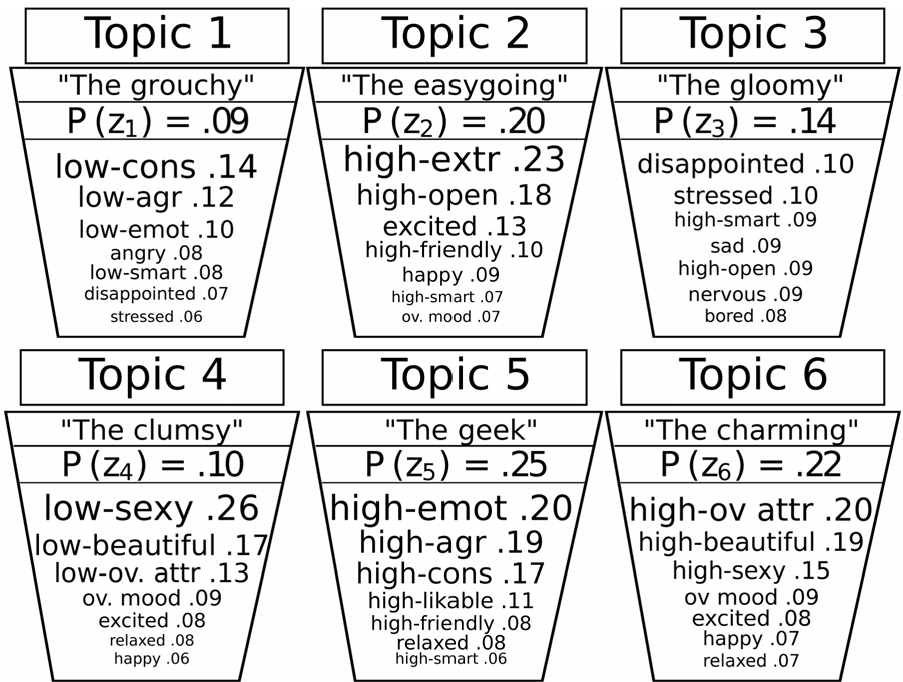 Figure: The 6 discovered topics. Font size indicates the probability of an impression word within that topic.
For instance:
- Topic 2 (Easygoing): Dominated by High Extraversion, Friendliness, and Happiness.
- Topic 1 (Grouchy): A mix of Low Agreeableness, Low Emotional Stability, and Anger.
Experimental Results: Can Machines "Read" the Vibe?
The researchers tested three feature sets for automatic prediction:
- AV (Audiovisual): Pitch, energy, speech activity, and motion energy.
- TRA (Transcripts): Lexical categories (LIWC) from manual transcriptions.
- Comments: Information mined from the YouTube audience's reactions.
Key Performance Insights
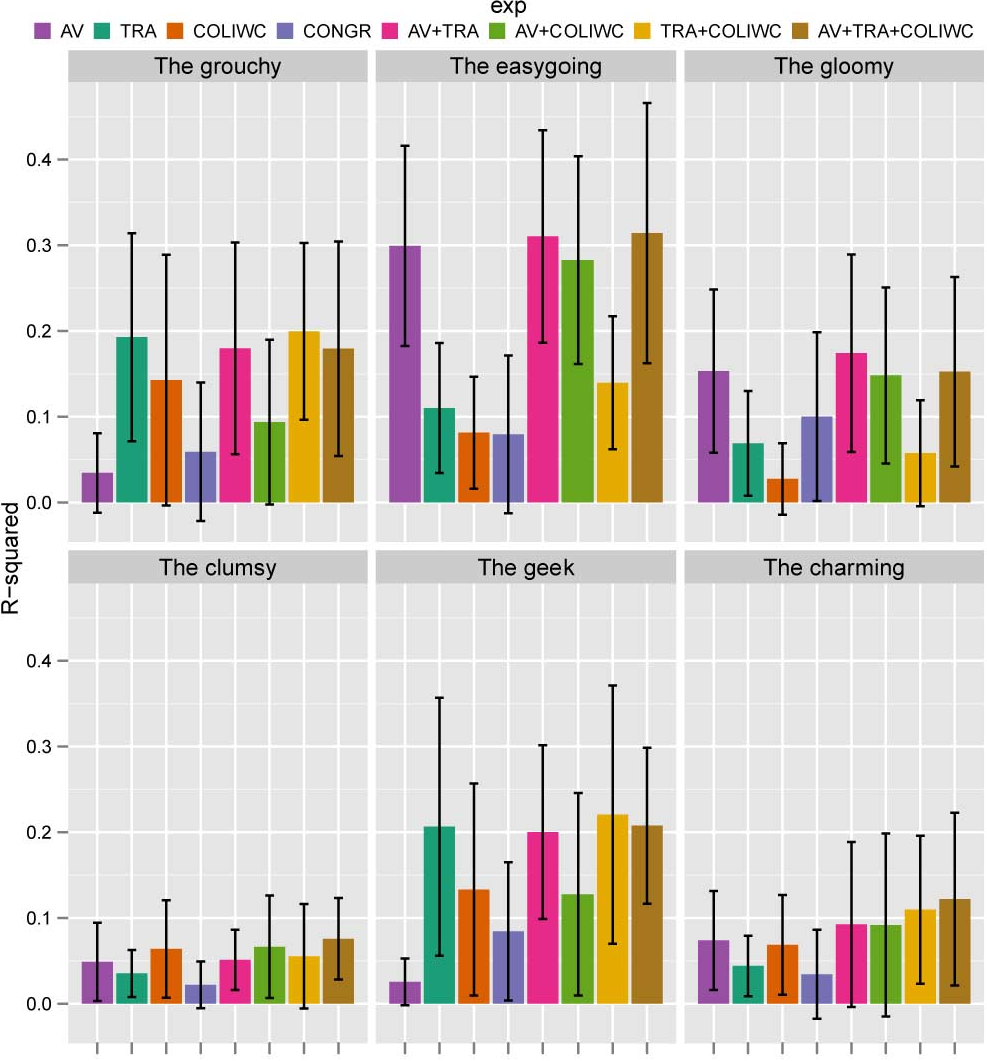 Figure: R-squared values for topic prediction across different modalities.
- Audiovisual cues were strongest for predicting the "Easygoing" topic (), largely driven by weighted motion energy and vocal pitch.
- Transcripts excelled at identifying "Geek" and "Grouchy" profiles, where the specific choice of words relates to Conscientiousness and Agreeableness.
- Audience Comments were a surprising success. The study found a strong correlation between what a vlogger says and how the audience responds. As comment threads get longer (over 50 comments), the for predicting traits like "Grouchy" increases significantly, suggesting comments can serve as a proxy for expensive manual transcriptions.
Deep Insight: The Halo Effect Digitized
The study quantitatively confirmed the "Halo Effect" in social video: attractiveness judgments were significantly correlated with Extraversion ( to ) and positive moods. Interestingly, Agreeableness showed even stronger links to perceived attractiveness in the vlogging context than Extraversion—a nuance often missed in non-video social media studies.
Taking it Forward
While the study confirms that first impressions are relatively consistent across a "crowd" of viewers, it leaves the door open for future work:
- Stability: Do these impressions hold over a vlogger's entire channel history?
- Authenticity: How do these perceived impressions compare to the vlogger’s actual self-reported personality?
- Scalability: Can we use these "topic signatures" to build better recommendation engines that match users with creators of a specific "vibe"?
Ultimately, this work proves that the "thin-slices" of behavior we see in 60-second clips are rich enough for both humans and machines to build a complex, multidimensional map of social identity.