
SVM and Latent Class Models: Tackling the Core Bottlenecks of Personalized Marketing
Mining customer product ratings for personalized marketing
This paper explores personalized marketing through recommender systems, proposing the use of Support Vector Machines (SVM) for content-based filtering and the Latent Class Model (LCM) for collaborative filtering. The study demonstrates SMV's resilience to high-dimensional feature spaces and extends LCM to handle recommendations for new customers outside the training set, achieving SOTA performance in movie recommendation tasks.
TL;DR
This paper addresses the fundamental challenges of content-based and collaborative recommender systems—feature explosion and data sparsity. By leveraging Support Vector Machines (SVM) for content analysis and Latent Class Models (LCM) for user collaboration, the authors provide a robust framework that outperforms traditional Naive Bayes and correlation-based methods, particularly in data-sparse scenarios like movie recommendations.
Problem & Motivation: The "Information Overload" Paradox
In the early era of e-business, companies faced a dual challenge: customers were overwhelmed by choices (Information Overload), while systems struggled to understand them due to "noisy" or "empty" data.
- Feature Selection Problem: In content-based systems, describing a product (like a movie) involves thousands of binary features (e.g., "Cast includes Bruce Willis"). Traditional models fail under this high dimensionality unless features are manually selected.
- Sparsity & First-Rater Problem: Collaborative filtering relies on "word-of-mouth." If a user has only rated two movies, find a "link-minded" peer is nearly impossible. Similarly, new products with zero ratings (First-Raters) are invisible to these systems.
Methodology: The Core Mechanics
1. SVM for High-Dimensional Content Matching
The authors propose SVMs because their performance is linked to the margin of separation rather than the number of features. This allows the system to ingest thousands of attributes from the IMDb—such as directors, writers, and cast—without the need for ad hoc feature pruning.
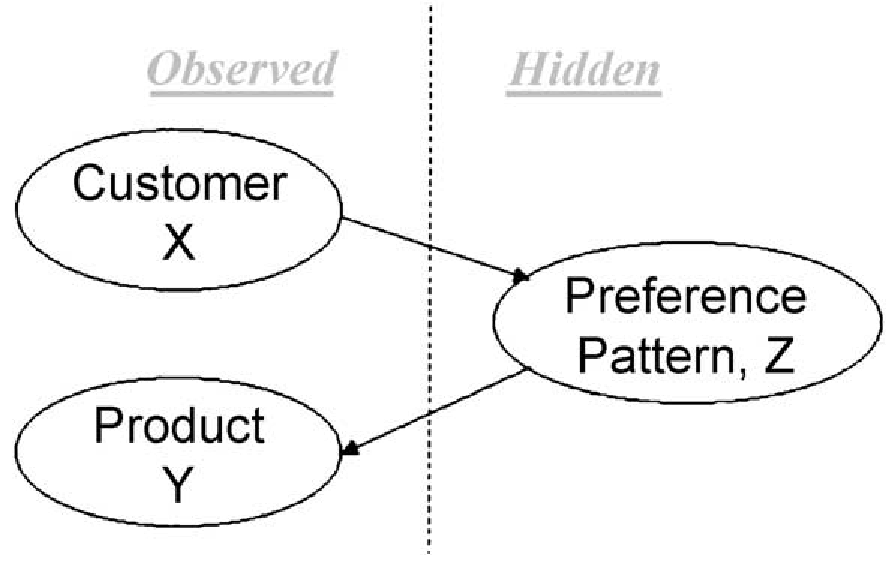
2. Latent Class Model (LCM) for Collaborative Smoothing
To solve sparsity, the paper uses LCM to assume that users belong to hidden "latent classes" (preference patterns).
- The Extension: Critically, the authors provide a mathematical way to handle users outside the training set. By using a small sample of a new user's ratings, they calculate the probability of that user belonging to a latent cluster, allowing for "averaged" recommendations from similar peers even with minimal data.
Experiments & Results: Proving the Edge
The researchers used 2.8 million ratings from the EachMovie database and 6,620 features from IMDb.
Content-Based Performance
The SVM achieved a Break-even point of 80.3%, significantly higher than Naive Bayes (78.8%) and 1-Nearest-Neighbor (76.2%). The results prove that SVM’s automatic regularization is superior to manual feature selection in C4.5 rules.
Collaborative Filtering Accuracy
The LCM showed its greatest strength at "low recall" levels. In real-world apps, users only look at the top 5-10 recommendations. LCM achieved significantly higher precision in this "top-tier" range compared to the standard Pearson Correlation (P-Corr).
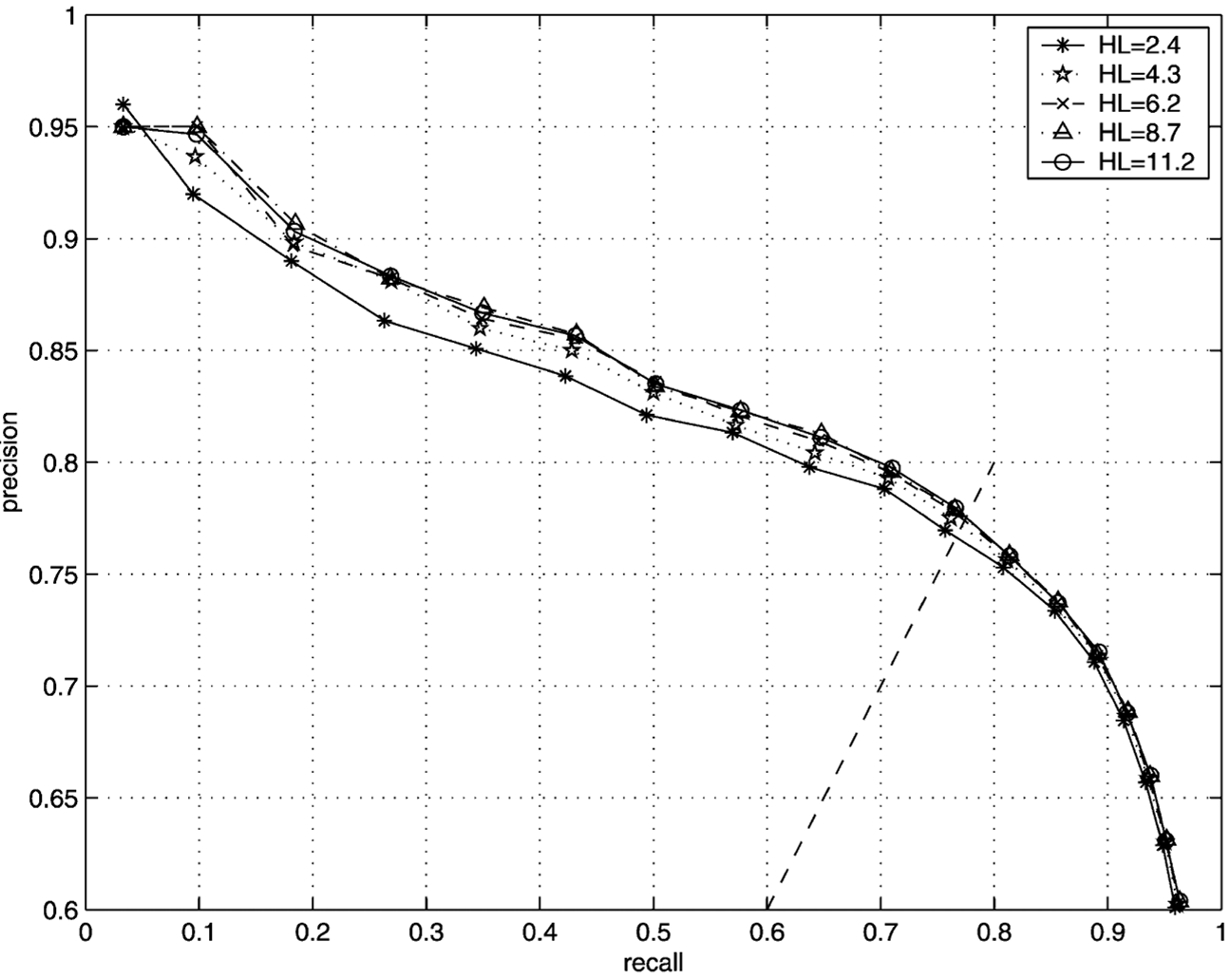 Fig: The recall–precision curves show that LCM (right) maintains higher precision at lower recall rates than P-Corr (left).
Critical Analysis & Conclusion
Summary: This work marks a shift from simple heuristic algorithms to more rigorous statistical learning in recommender systems. By treating recommendation as a classification task (SVM) and a hidden variable problem (LCM), it provides a more stable foundation for personalized marketing.
Limitations:
- Dynamic Scaling: While training happens offline, the models need re-training as more preference ratings arrive.
- Model Saturation: As the user history grows very long, the performance of LCM tends to saturate, whereas simpler correlation methods eventually catch up.
Future Outlook: The integration of these two approaches—combining SVM's content understanding with LCM's social clusters—remains the "Holy Grail" of hyper-personalized marketing, a path the authors suggest is the next frontier.