
Mining Directed Social Networks: Quantifying Influence Through Word Propagation
Mining directed social network from message board
The paper introduces a method for mining directed social networks from Internet message boards, where nodes represent individuals and directed edges represent the flow of influence. It utilizes the Influence Diffusion Model (IDM) to quantify influence based on the propagation of specific terms across message reply chains.
TL;DR
This seminal 2005 work shifts social network analysis from "who knows whom" to "who influences whom." By tracking how specific terms travel through reply chains on message boards, the authors quantify "psychological distance" and map the flow of influence as a directed graph, revealing the hidden structures of online discourse.
Background: From Connectivity to Influence
In the early days of social media (Friendster, Orkut), social networks were often viewed as undirected graphs of friendships. However, the authors argue that in virtual spaces, geographical distance is irrelevant. What matters is Influence—the ability of one person's ideas to be adopted and passed on by others.
The core insight is that influence isn't just a direct link; it’s a measurement of how much a respondent (User B) acts as a catalyst for the original poster's (User A) ideas to reach a wider audience.
Methodology: The Influence Diffusion Model (IDM)
1. The Atomic Unit: Message Influence
The influence of a preceding message on a subsequent message in the same chain is defined by the persistence of terms: This counts the number of terms originating in that survive through the chain until . If the chain is broken, the influence drops to zero.
2. Aggregating to Individuals
The total influence of person on person () is calculated by summing the influence of 's messages through 's replies and the subsequent propagation of those terms.
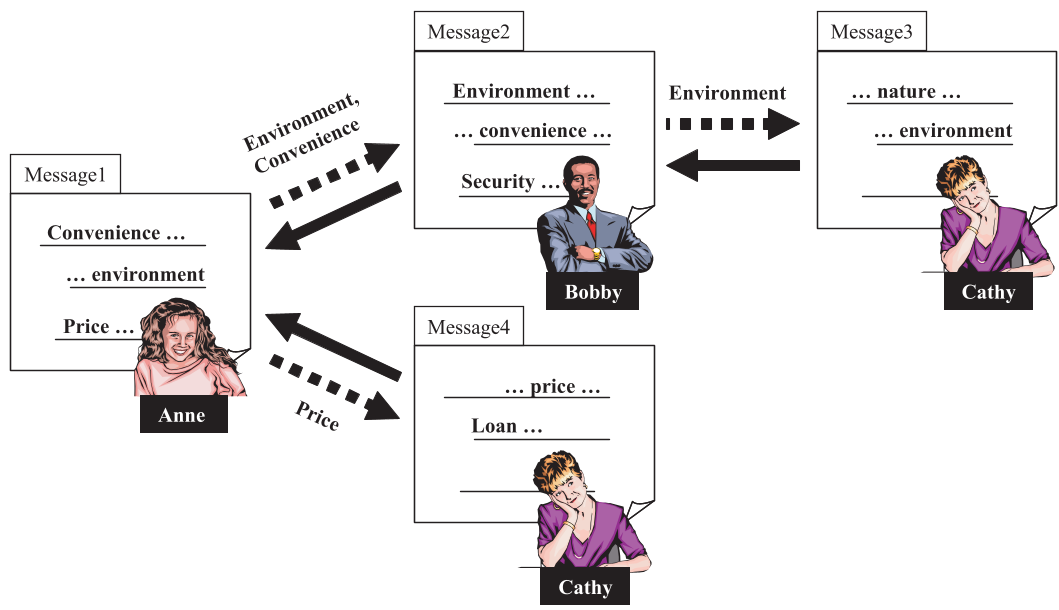 Figure 1: Visualizing how terms flow from Anne to Bobby to Cathy. Bobby's influence is measured by how effectively he carries Anne's "Environment" term forward.
3. Mapping the Network
By calculating these weights, we get a Directed Social Network. The "distance" between users is the inverse of influence (). If there is no influence, the distance is set to the maximum possible diameter of the network.
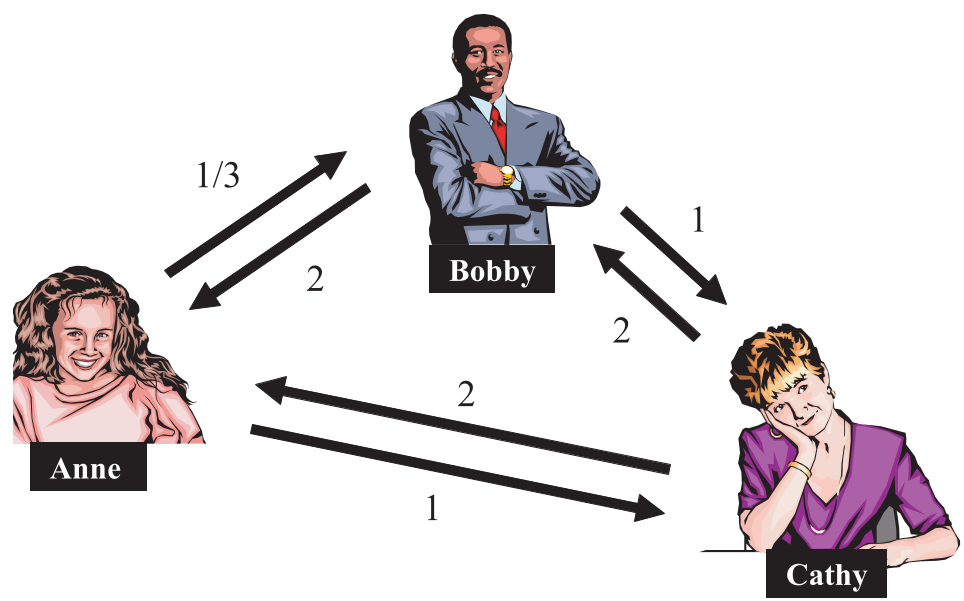 Figure 2: The resulting graph where edge thickness and directionality represent the strength of contextual similarity and influential flow.
Experiments & Archetypes
The researchers analyzed 3,000 different social networks extracted from message boards. This large-scale analysis allowed them to categorize digital communication into three states via "communication gaps":
- Interactive: High mutual influence.
- Distributed: Clustered influence within subgroups.
- Soapbox: One-way influence where one user broadcasts terms but rarely adopts others'.
Critical Analysis & Professional Perspective
While this 2005 paper relies on exact string matching for "terms" (a limitation given the complexity of natural language), its structural intuition is brilliant. It predates modern "Viral Marketing" and "Opinion Leader" algorithms by focusing on the mediator's role in diffusion.
Limitations:
- Exact Term Matching: Does not account for synonyms or paraphrasing.
- Temporal Decay: Assumes influence propagates equally regardless of the time delay between posts.
Future Outlook
Directly following this work, the field evolved into Sentiment Analysis and Latent Dirichlet Allocation (LDA) to better capture "Contextual Similarity." Today, this logic underpins how recommendation algorithms identify "vibe-setters" or "influencers" on platforms like TikTok or X (Twitter).
Takeaway: To understand a network, don't just look at the lines—look at the words traveling across them.