
medicX: Mining Critical Drug-Drug Interactions through Deep Learning and SVMs
Mining drug-drug interactions for healthcare professionals
The paper introduces medicX, an end-to-end system designed to detect Drug-Drug Interactions (DDIs) from biomedical literature. It utilizes an LSTM-CRF architecture for Named Entity Recognition (DNER) and a two-stage rich feature-based SVM for interaction identification, achieving an F1-score of 88.22% in DNER and demonstrating superior performance on MedLine abstracts compared to previous SOTA SVM models.
TL;DR
Drug-Drug Interactions (DDIs) are a leading cause of adverse reactions and deaths globally. medicX is a new diagnostic framework that automates the discovery of these interactions from vast biomedical databases like PubMed. By pairing an LSTM-CRF for drug name recognition with a two-stage SVM for interaction logic, it achieves state-of-the-art performance in identifying clinical warnings hidden within complex medical abstracts.
The "Information Silo" Problem in Healthcare
While databases like DrugBank exist, they are often incomplete or updated at different intervals. For a healthcare professional, the real "truth" often lies buried in thousands of new research papers published on MedLine. Manually reading these is impossible. The challenge for AI is twofold:
- Recognition (DNER): Identifying "Asprin" vs "Acetylsalicylic acid" across different naming conventions.
- Identification (DDI): Determining if the sentence describes a harmful effect, a pharmacokinetic mechanism, or simply mentions two drugs in passing (Negative interaction).
Methodology: The Two-Pillar Architecture
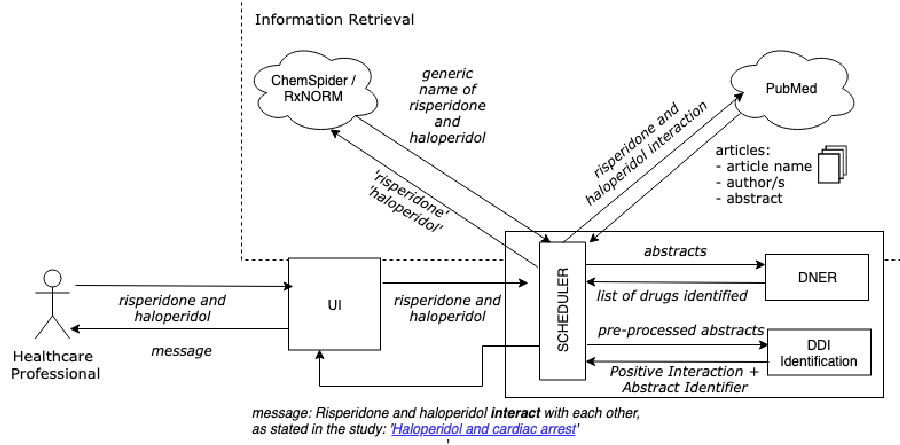
The authors designed medicX with a modular pipeline to handle the transition from raw text to structured medical insight.
1. Drug Named Entity Recognition (DNER)
The system uses a Bi-directional LSTM stacked with a CRF (Conditional Random Field) layer.
- Why it works: The Bi-LSTM captures the context of words from both directions (left and right), which is crucial for identifying multi-word drug names. The CRF layer ensures that the sequence of tags (Begin, Inside, Outside) makes logical sense.
- The Result: It outperformed the 2013 DDI competition winner by nearly 1.6%, showing that deep learning can capture chemical linguistic patterns without needing massive manual dictionaries.
2. DDI Identification Component
For the interaction part, the authors opted for a two-stage Linear SVM.
- Stage 1: A binary "filter" to determine if any interaction exists.
- Stage 2: A multi-class classifier to label the type (Advice, Effect, Mechanism, etc.).
- The Secret Sauce: They integrated BioSentVec (pre-trained biomedical word embeddings) and sentence-level dependency paths. By calculating the "shortest path" between two drugs in a sentence's grammatical structure, the model ignores "noise" and focuses on the verbs connecting the entities.
Experimental Battleground: MedLine vs. DrugBank
The model was put to the test against the DDIExtraction 2013 gold standard.
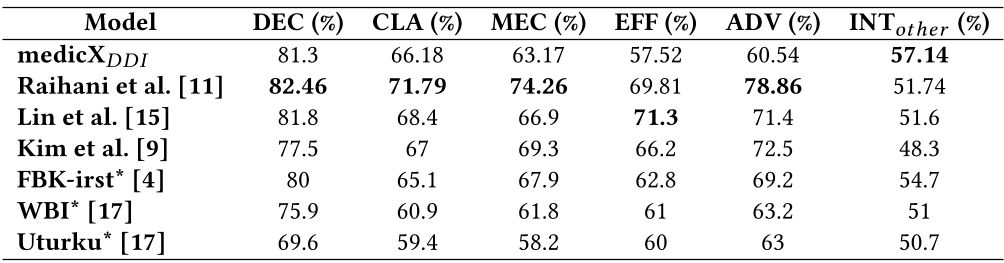
The results reveal a fascinating insight: While many models struggle with the sparse and complex language of MedLine abstracts, medicX outperformed the state-of-the-art by 10.72% in that specific category. This makes it particularly valuable for "New Knowledge Discovery" where information hasn't yet been codified into structured databases.
Critical Insight & Future Outlook
The success of medicX highlights that while Deep Learning (LSTM) is superior for "finding things" (DNER), traditional SVMs—when boosted with rich features and post-processing—remain incredibly robust for "classifying relationships" in low-data regimes.
Limitations: The system still struggles with "Interaction_other" cases simply because there isn't enough training data (only 6% of the corpus).
Future Work: The transition to Transformer-based architectures (like BERT) and the expansion of the "Trigger Word" dictionary could further push these boundaries. medicX stands as a vital bridge between raw academic research and the tools clinicians need at the bedside.
Takeaway
By focusing on the Shortest Dependency Path and Entity Blinding, medicX learns the logic of how drugs interact rather than just memorizing drug names, making it a powerful tool for the future of pharmacovigilance.