
Scaling Pharmacovigilance: Mining Drug Side Effects at Scale with Apache Spark
Mining Frequency of Drug Side Effects over a Large Twitter Dataset Using Apache Spark
This paper presents a robust big data pipeline for mining adverse drug effects (ADE) from Twitter using Apache Spark. By combining sentiment analysis, multi-layered n-gram features, and an ensemble classifier, the system achieves state-of-the-art accuracy in identifying self-reported side effects and accelerates processing speed by 2.5x.
TL;DR
Pharmaceutical clinical trials often lack the sample size to catch every adverse drug event (ADE). This paper introduces a high-performance pipeline using Apache Spark and Ensemble Learning to mine Twitter data, achieving a 2.5x speedup in processing and superior accuracy in detecting side effects compared to previous state-of-the-art models.
The Problem: The Voluntary Reporting Gap
The FDA’s Adverse Event Reporting System (FAERS) is the gold standard for drug safety, but it has a "blind spot." It depends on voluntary reports from healthcare providers, which primarily capture severe reactions. Millions of patients, however, discuss mild to moderate side effects on Twitter. The challenge? Twitter is noisy, full of slang, and the data volume is overwhelming for standard analytical tools.
Methodology: High-Throughput Sentiment Mining
The authors designed a five-stage pipeline to transform raw, noisy tweets into structured medical insights.
1. The Power of Ensemble Learning
The core of the identification process is a "Hard Vote" Ensemble Classifier. Instead of relying on a single model, the authors combined:
- Support Vector Machines (SVM)
- Logistic Regression (LGR)
- Naïve Bayes, kNN, and Decision Trees
By leveraging both lexicon-based features (sentiment scores from SentiWordNet, AFINN) and structural features (character and word n-grams), the model reached an f1-score of 0.7760.
2. Distributed Architecture with Spark
To handle the scale of nearly 500k tweets, the research transitioned from a sequential Scikit-Learn environment to Apache Spark. By partitioning the dataset into RDDs (Resilient Distributed Datasets) across 12 cores, they achieved significant parallelism.
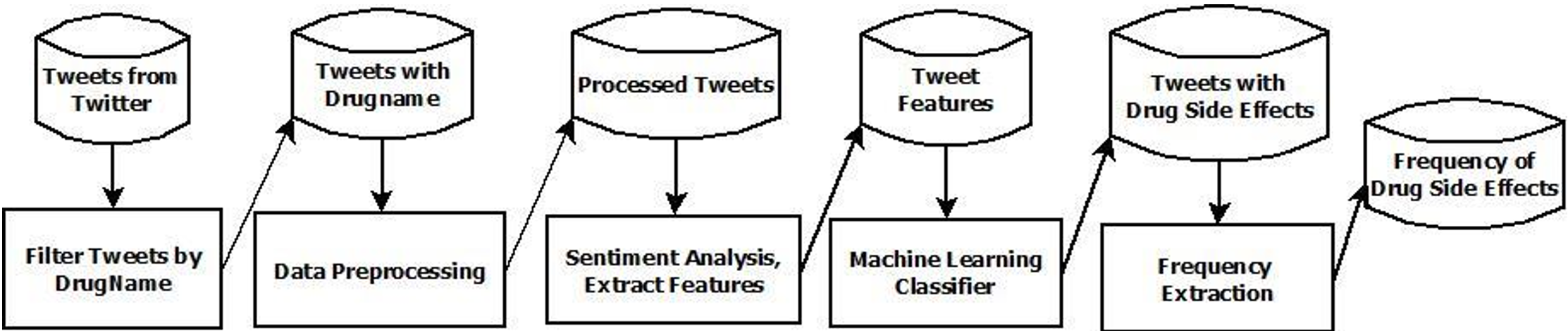 Figure 1: The proposed pipeline architecture, from streaming to MetaMap frequency extraction.
Key Findings & Results
Performance Gains
The shift to Spark wasn't just a marginal improvement; it was a game-changer for large-scale analysis.
| Pipeline | Total Time (200k Tweets) |
|---|---|
| Scikit-Learn | 257.88 minutes |
| Apache Spark | 105.63 minutes |
Real-World Side Effect Analysis
The system identified that for anxiety medication like Xanax, "Drowsiness" and "Abnormally High" were the most reported effects. Interestingly, the pipeline also detected Drug-Drug Interactions (DDI)—for instance, the combination of Benadryl and Melatonin significantly increased reports of extreme drowsiness.
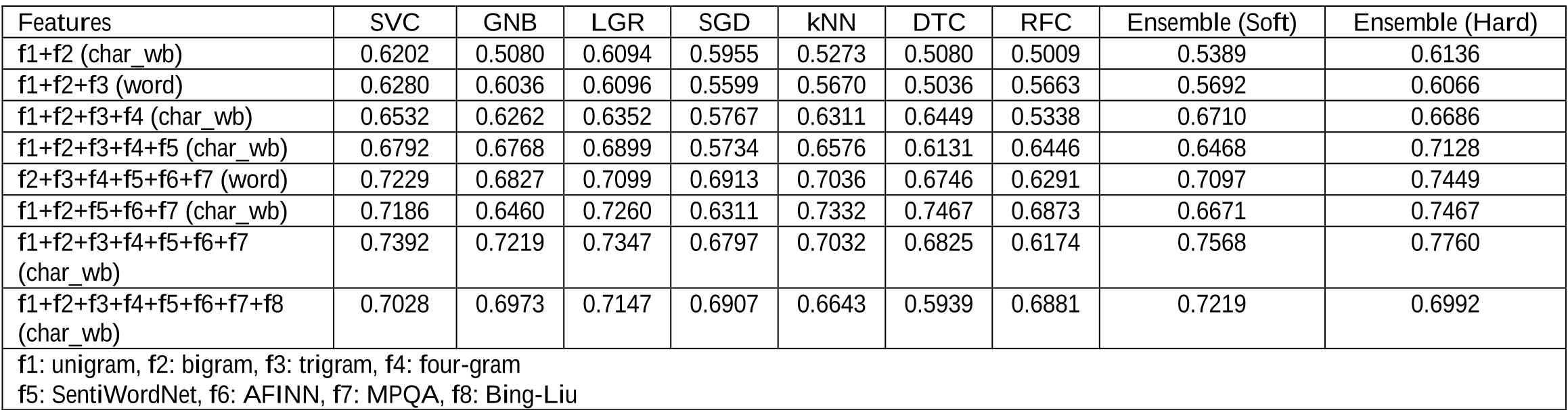 Figure 2: Comparison of different feature sets and classifier performance.
Critical Insight: The "Context" Challenge
One of the paper's most honest contributions is discussing the limitations of MetaMap. For example, when a user says they are "chilling" on Xanax, MetaMap (a medical tool) might categorize "chills" as a physical shivering symptom. This highlights an ongoing need in the field: the infusion of linguistic context into medical entity recognition.
Conclusion
This work proves that social media is a viable "digital laboratory" for drug safety. By combining the distributed power of Apache Spark with sophisticated Ensemble Classifiers, researchers can now monitor public health trends in near real-time, potentially identifying dangerous drug interactions long before they appear in clinical reports.
Future Outlook
The next step for this technology lies in Live-streaming Analytics. Imagine a dashboard for the FDA that updates side-effect frequencies globally every hour, allowing for immediate intervention when a new dangerous drug combination starts trending.