
Mining Emotions on Plutchik’s Wheel: Bridging Psychology and Machine Learning
Mining Emotions on Plutchik's Wheel
This paper introduces a supervised machine learning framework for emotion detection in tweets by mapping 13 initial emotion labels to the Plutchik’s Wheel of Emotions. It reformulates the task from difficult multi-label classification into four distinct binary classification problems (Love vs. Hate, Joy vs. Sadness, Trust vs. Disgust, and Anticipation vs. Surprise), achieving up to 87% accuracy using Random Forest and SVM.
TL;DR
Researchers from the University of Connecticut have developed a robust framework for detecting emotions in tweets by leveraging Plutchik’s Wheel of Emotions. By transforming a complex 13-label dataset into four binary "polar opposite" classification problems, the study achieved an impressive 87% accuracy. The work highlights that while some emotions are linguistically distinct (Love vs. Hate), others (Anticipation vs. Surprise) remain challenging to separate even with modern ML models.
Problem & Motivation: Beyond "Positive vs. Negative"
Most social media analysis is stuck in the realm of Sentiment Analysis—simply determining if a user is happy or sad. However, human affect is far more granular. Detecting specific emotions like "Trust" or "Disgust" can unlock deeper insights for mental health monitoring, political polling, and targeted advertising.
The authors identified two major roadblocks in prior research:
- Multi-label Complexity: Trying to predict 6 or 8 emotions simultaneously often results in poor performance.
- Contextual Noise: Tweets are brief and informal, requiring more than just word-counts to understand the underlying feeling.
The Insight: By using a psychological anchor—Plutchik's Wheel—we can treat emotions as binary opposites, effectively "zooming in" on the nuances that distinguish one feeling from its direct psychological counter-part.
Methodology: The Architecture of Affect
The authors processed a dataset of 40,000 tweets, mapping them to 8 primary emotions. They evaluated five models: Random Forest (RF), SVM, Naive Bayes (NB), Gradient Boosting (GB), and Multi-Layer Perceptron (MLP).
Feature Engineering
The secret sauce of this study is the balanced feature set:
- Linguistic Features: 6,148 unigrams and TF-IDF scores to capture vocabulary.
- Metadata Features: Sentiment scores (Vader/TextBlob), emoticon frequency, use of ellipses, and punctuation intensity (e.g., "!" counts).
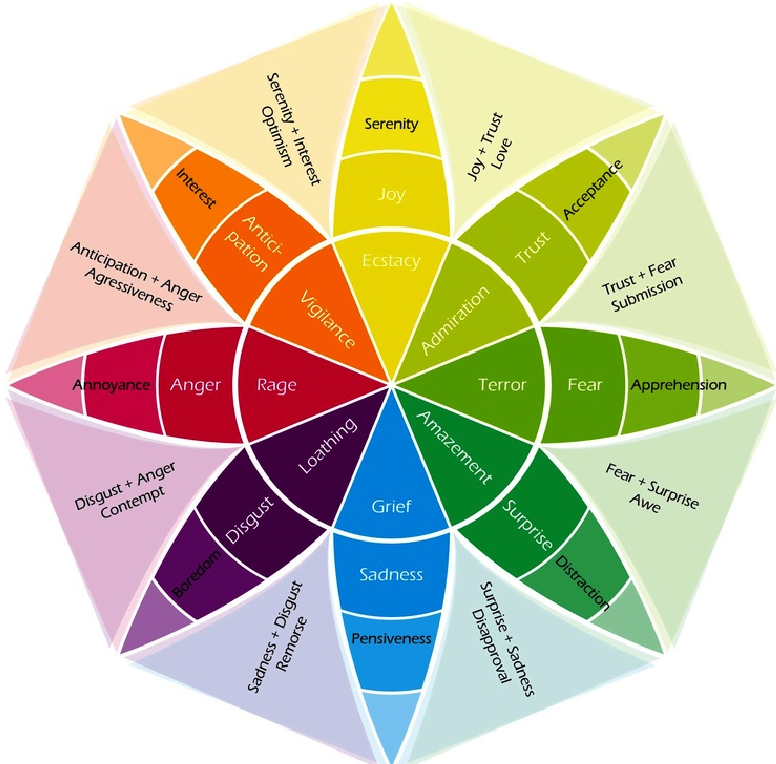 Figure 1: Plutchik's Wheel provides the theoretical framework for organizing emotions into binary classification pairs.
Experiments & Results: Which Emotions Are Easiest to Detect?
The results revealed a fascinating hierarchy of "detectability."
| Emotion Pair | Top Accuracy | Observation |
|---|---|---|
| Love vs. Hate | 87% | Highly polarized; very distinct linguistic signatures. |
| Joy vs. Sadness | 78% | Strong separation, often driven by sentiment scores. |
| Trust vs. Disgust | 77% | Harder to distinguish; often relies on subtle word choices. |
| Anticipation vs. Surprise | 73% | Most difficult; these emotions often overlap in social media usage. |
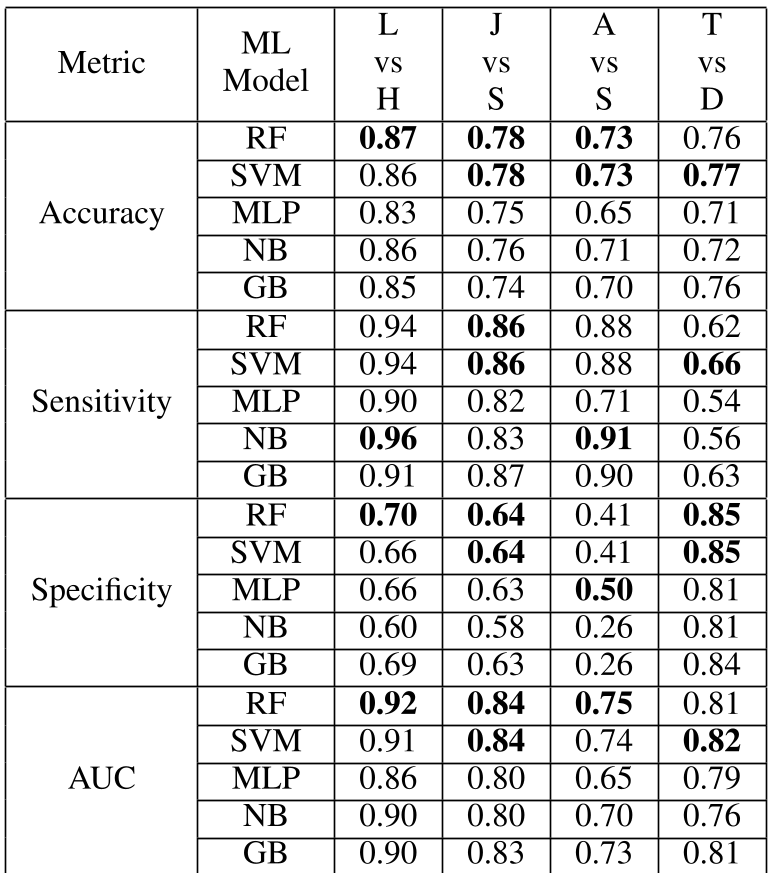 Table 1: Performance metrics across different ML models and emotion pairs.
The Power of Metadata
The study proved that text alone isn't enough. Analysis using Random Forest importance showed that metadata (like exclamation marks and sentiment intensity scores) provides roughly 40% of the discriminating power. For example, "Worry" (mapped to Disgust) was uniquely identified by the sarcastic use of smiley faces, a nuance that standard text-only models might miss.
Critical Analysis & Conclusion
This work successfully demonstrates that psychological grounding can simplify machine learning tasks. By reducing the problem space to polar opposites, the models can learn specific boundaries more effectively than a "one-vs-all" approach.
Limitations
- Anticipation vs. Surprise: The model still struggles here, likely because "surprise" can be either positive or negative, muddling the binary boundary.
- Sarcasm: While metadata helps, sarcasm remains the "final boss" of emotion mining, especially in the "Worry" category.
Future Outlook
The authors aim to expand this to Reddit and Instagram, where the mix of long-form text and visual metadata may provide an even richer environment for testing Plutchik-based models. This research paves the way for more empathetic AI that understands not just what we say, but the complex emotional wheel spinning behind our words.