
Enriched Social Graphs: Cracking the Code of Cross-Thread Forum Interactions
Mining an enriched social graph to model cross-thread community interactions and interests
This paper introduces a novel text mining framework to construct an enriched social graph for Web forums. The method uniquely combines "reply-to" relationship identification with "message-similarity" clustering to model cross-thread interactions and identify community interests, even when discussions deviate from their original topics.
TL;DR
Web forums are notorious for "thread drift"—where conversations evolve far beyond their original titles. This paper presents a methodology to bridge these fragmented conversations by creating an Enriched Social Graph. By combining structural "reply-to" links with multi-dimensional message similarity, the authors successfully map how users interact across different threads based on overlapping interests rather than just thread IDs.
Problem & Motivation: The "Deviated Discussion" Trap
Most forum analysis tools treat threads as silos. However, if a user in a "Politics" thread starts discussing "Economic Policy," their comments might be highly relevant to another ongoing thread in the "Finance" section.
Current state-of-the-art (SOTA) models—like the Hybrid Interactional Coherence (HIC) algorithm—focus primarily on Structural Links (who replied to whom). This approach fails in two ways:
- Context Blindness: It ignores the content similarity between a reply and posts in other threads.
- Structural Fragmentation: It cannot connect two users who are talking about the exact same niche topic in two different places unless they explicitly reply to one another.
The authors' insight is that temporal proximity and semantic similarity can serve as "virtual links" that unify these scattered interactions.
Methodology: The Two-Pillar Approach
The paper proposes a pipeline that transforms raw forum crawls into a condensed network of clusters.
1. Robust Reply-to Identification
To identify who is talking to whom, the system uses:
- Sliding Window Technique: Breaks quotes into substrings to find matches even if the original text was edited.
- Jaro-Winkler Metric: Uses approximate string matching to find "obscured" mentions—where a user types another's name (often misspelled) instead of using a formal quote.
2. Agglomerative Similarity Clustering
This is the core innovation. Every post is compared against every other post using a weighted formula: (where C=Content, T=Title, A=Author, L=Timestamp)

The algorithm starts with each post in its own cluster and iteratively merges them based on this similarity until a threshold is reached. This effectively "collapses" the forum into a set of Interest Clusters.
Experiments & Results
The researchers tested their approach on the "Stormfront" forum dataset.
Structural Accuracy
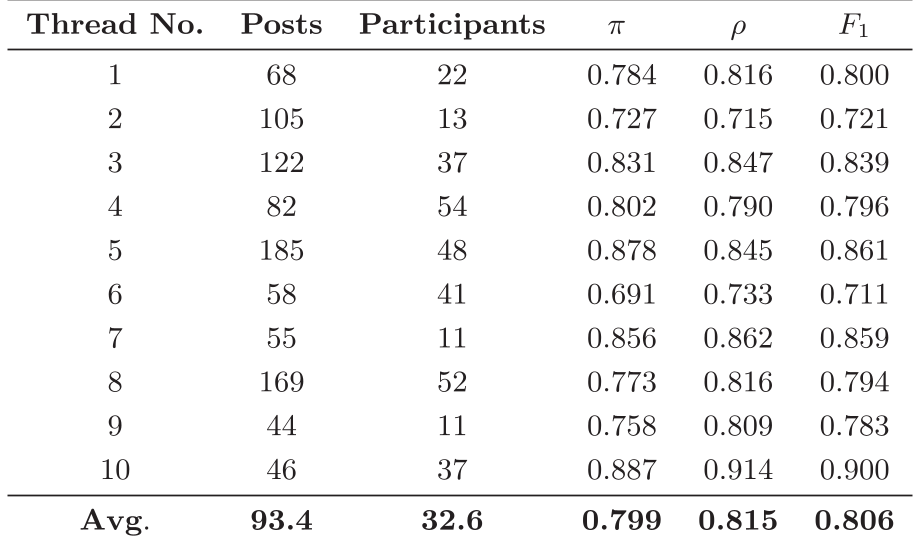
The "reply-to" identification achieved an average F1-score of 0.806, proving highly reliable at reconstructing the basic conversation tree.
The Enriched Graph
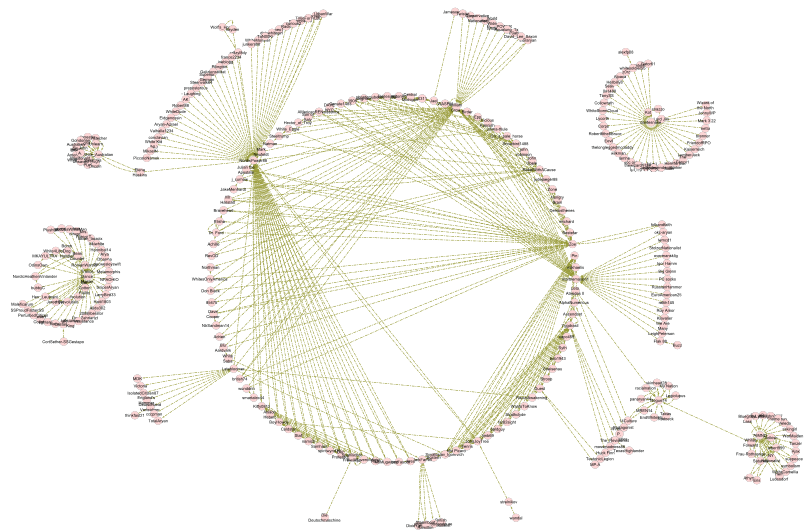
The final output is a graph where Nodes = Clusters of Similar Posts and Edges = Reply-to Interactions. By shifting the view from individual posts to clusters, the researchers reduced 934 individual posts into 173 meaningful interaction nodes, making the underlying community structure much easier to visualize.
Critical Analysis & Conclusion
Takeaway
This work provides a blueprint for "Interest-Based Social Modeling." It acknowledges that in digital folksonomies, the Topic is the gravity that pulls users together, and that topic often ignores the artificial boundaries of "Thread Titles."
Limitations
- Manual Parameter Tuning: The weights () were set experimentally (e.g., weighing content at 0.7). In a production environment, these would need to be dynamically learned via supervised learning.
- Scale: The dataset used (934 posts) is relatively small. The O(n²) nature of pair-wise clustering might face performance bottlenecks on massive forums like Reddit or StackOverflow.
Future Outlook
By integrating modern NLP (like BERT or GPT embeddings) for the CSim (Content Similarity) component, this methodology could significantly improve its precision in identifying nuanced cross-thread overlaps, potentially becoming a powerful tool for community moderation and trend discovery.