
EHLM: Restoring Social Network Integrity through Nash Equilibrium
Mining hidden links in social networks to achieve equilibrium
This paper introduces the Equilibrium based Hidden Link Mining (EHLM) problem, which aims to identify missing connections within social network communities by treating community formation as a game. It proposes a two-stage algorithm that leverages the concept of Nash equilibrium and a novel "k-hop Community Loyalty" (k-HCL) metric to detect and predict hidden relations.
In the vast architecture of social networks, what we see is often just the tip of the iceberg. Privacy settings, data collection errors, and complex human interactions mean that many social ties—hidden links—go unrecorded. While traditional link prediction looks at the "geometry" of the graph, a pioneering paper by Huan Ma et al. suggests we should look at its "sociology."
By treating communities as the result of a Game-Theoretic process, the researchers have developed a method to find missing links by identifying where the network has become "unstable."
TL;DR
The paper proposes the Equilibrium based Hidden Link Mining (EHLM) algorithm. It identifies "active" individuals (those who are unhappy in their current community due to missing local ties) and predicts links specifically to bring the network back into a Nash equilibrium. Evaluation on datasets like NetHEPT and Enron proves this stability-centric approach significantly outperforms standard topological algorithms.
Why Traditional Link Prediction Fails
Traditional methods like Common Neighbors or Jaccard's Coefficient are "passive." They calculate similarity scores for every possible pair in the network. However, they ignore a fundamental truth: social networks have communities.
People join communities because they derive value from them. If a person appears to have more "loyalty" to an outside group than their own, it’s often not because they belong there, but because the data representing their current community is incomplete.
The Core Concept: k-Hop Community Loyalty (k-HCL)
The authors introduce a sophisticated metric to measure how "loyal" an individual is to their group. Unlike simple degree counts, k-HCL considers neighbors up to hops away, with further neighbors carrying exponentially less weight.

A node is in Nash Equilibrium if it has no incentive to move to another community. If its loyalty to its current community is lower than its potential loyalty elsewhere, the node is flagged as Active.
The Hardness Principle
The paper provides a rigorous mathematical proof showing that even in the simplest case (1-hop neighbors), partitioning a graph to satisfy a Strong Nash Equilibrium is NP-hard. This justifies the use of heuristic approximation algorithms like EHLM.
The EHLM Algorithm: A Two-Stage Process
The methodology follows a logical pipeline:
- Locate Active Individuals (SAIS): Calculate the -HCL for every node across all communities. If a node is "restless" (higher loyalty elsewhere), it is added to the Active Individual Set (AIS).
- Search Hidden Links: Proactively add links between active nodes (or their neighbors) within the same community to increase their loyalty and restore equilibrium.
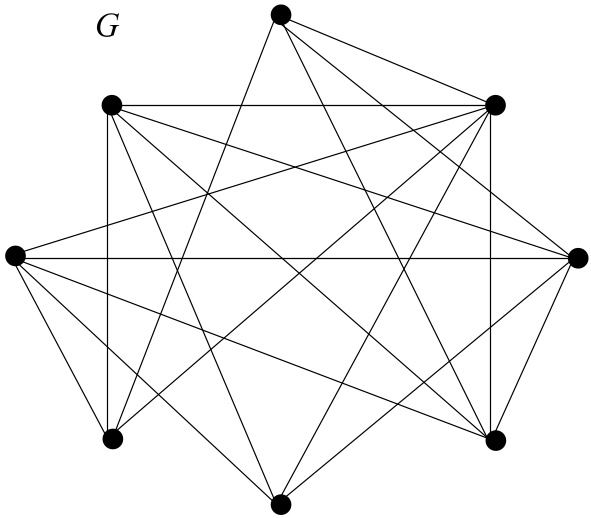 Fig: Theoretical construction used to prove the NP-hardness of the Nash equilibrium partition problem.
Experimental Results: Stability Equals Accuracy
The researchers tested EHLM against three classic baselines:
- Random Method
- Common Neighbors
- Jaccard's Coefficient
Across datasets like NetHEPT (academic citations) and American College Football, EHLM consistently ranked higher in precision.
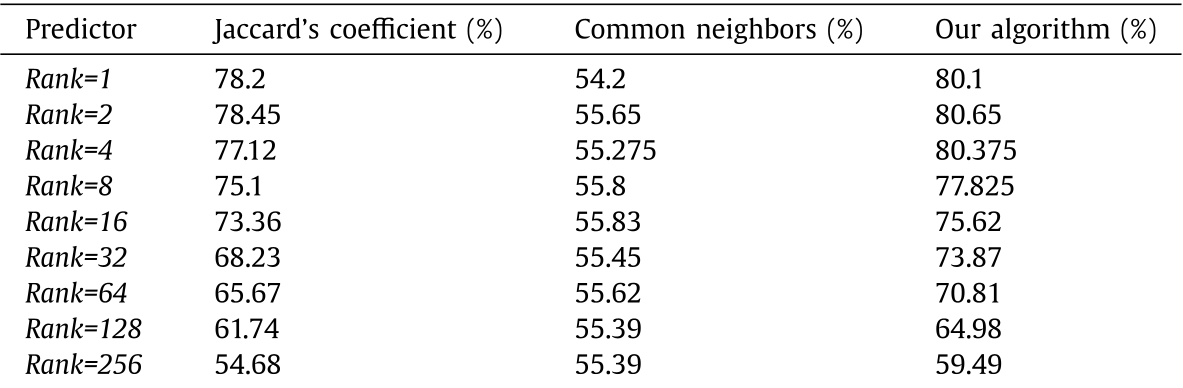 Table: In the ACF dataset, EHLM achieved over 80% precision in its top-tier predictions, significantly leading Jaccard's and Common Neighbors.
Key Insight: The performance gap is most noticeable in the "Rank=1" to "Rank=16" categories—meaning EHLM is exceptionally good at finding the most certain missing links first.
Critical Analysis & Future Outlook
Takeaways
- Strategic Targeting: By focusing on "unstable" nodes, we reduce the search space for hidden links and improve accuracy.
- Mathematical Grounding: The NP-hardness proof sets a solid theoretical foundation for why this problem requires specialized algorithmic approaches.
Limitations
The current model treats networks as undirected and unweighted. In the real world, "loyalty" might be driven by the strength of a connection (weight) or the direction of influence.
Future Work
The authors plan to extend this to weighted social networks and temporal networks, where community loyalty changes over time. This could revolutionize how we track evolving criminal organizations or shifting consumer demographics in marketing.
Summary: By viewing a social network as a living game where every player seeks equilibrium, Ma et al. have turned a search problem into a stability problem, providing a more "human" way to predict the links that should be there.