
FP-Twitter: Mastering Real-Time Hot Topic Detection via Stream Mining
Mining Hot Topics from Twitter Streams
The paper introduces an enhanced FP-Stream algorithm designed for hot topic detection in Twitter streams. It treats Twitter posts as transactions and words as items, transforming the challenge into a time-sensitive frequent pattern mining problem.
TL;DR
This research tackles the "Twitter speed" problem in public opinion analysis. While traditional clustering algorithms struggle with the brevity and rapid spread of tweets, the authors repurpose the FP-Stream algorithm to detect frequent word-sets in real-time. By introducing a flexible time-window and a damping factor, they successfully identify emerging sub-topics (e.g., from generic "flu" to specific "symptoms" and "pigs") with high temporal sensitivity and low latency.
Context: Why Clustering Fails Twitter
Mining hot topics from the web used to be a problem of grouping similar documents together. However, Twitter changed the game:
- Extreme Sparsity: A 140-character tweet provides very few co-occurring words for a clusterer to grab onto.
- Velocity: Topics explode and fade in hours, rendering static batch processing obsolete.
- Scale: The sheer volume of incoming "transactions" requires an algorithm that can forget the irrelevant old and prioritize the urgent new.
The authors identify that for social media, "Hot" equals "Frequent." Instead of asking "Which cluster does this belong to?", they ask "Which set of words is currently appearing together more than usual?"
Methodology: Evolution of the FP-Stream
The core innovation lies in adapting the Frequent Pattern Stream (FP-Stream) algorithm to the chaotic nature of social media.
1. The Flexible Tilted-Time Window
Original FP-Stream models are often "chunk-based," meaning they need a fixed number of tweets (e.g., every 1000 tweets) to update. The authors argue this is counter-intuitive for humans. We want to know the hot topics of the "last hour," not the "last 1000 posts." They extended the tilted-time window to support variable batch sizes, allowing updates based on wall-clock time.
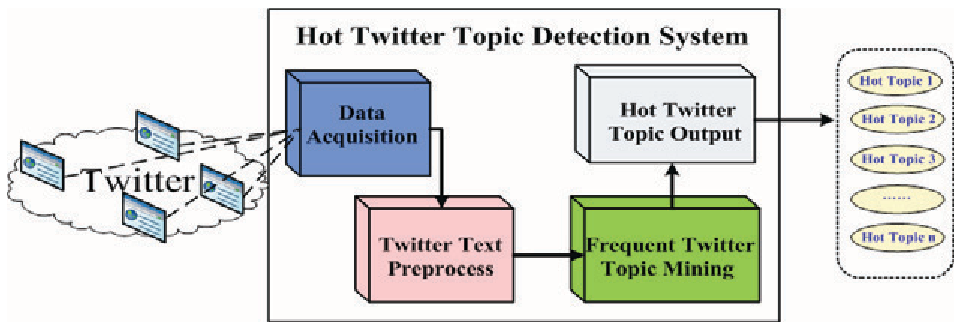 Figure 1: The proposed Hot Twitter Topic Detection System showing the pipeline from acquisition to frequent pattern mining.
2. Damping Factors & Thresholds
To ensure the system remains time-sensitive, a damping factor is applied to the support numbers (sup_num). This mathematically ensures that a word-set popular five minutes ago carries more weight than one from five hours ago. They also redefine the "sub-frequent" boundary () to capture emerging trends before they hit the major "Hot" threshold ().
Experimental Analysis
The researchers tested their approach on the 2009 H1N1 (Swine Flu) outbreak dataset.
Topic Evolution
The results showed a clear progression of public interest. Early in the window (April 26), the frequent patterns were generic ("Flu", "Swine"). As the stream progressed to May 3, the patterns became more specific ("Swine Flu Symptoms", "Confirmed Cases", "Hysteria"), proving the method's ability to track the finer details of a developing crisis.
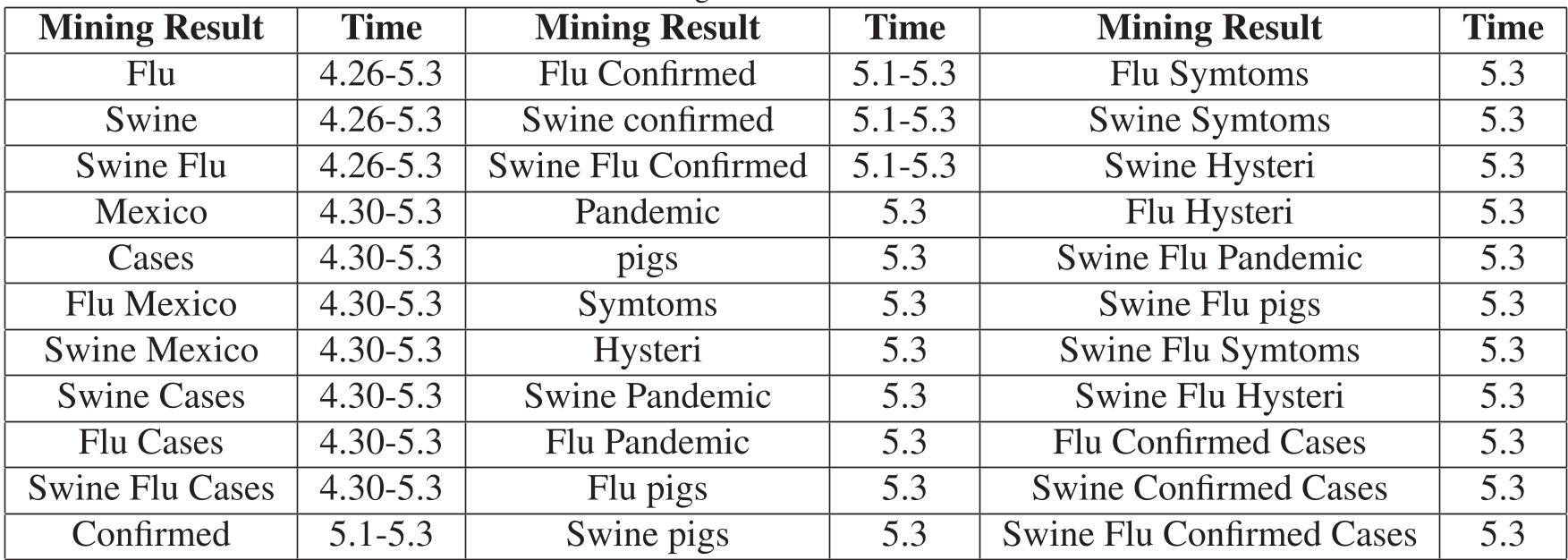 Table 1: Evolution of hot topics detected over a one-week period during the H1N1 crisis.
Performance & Scalability
A key highlight is the efficiency. The time consumption for mining these patterns is measured in seconds. As the support threshold decreases (meaning the system looks for more granular, less frequent patterns), the time consumption remains manageable, showing efficient scaling.
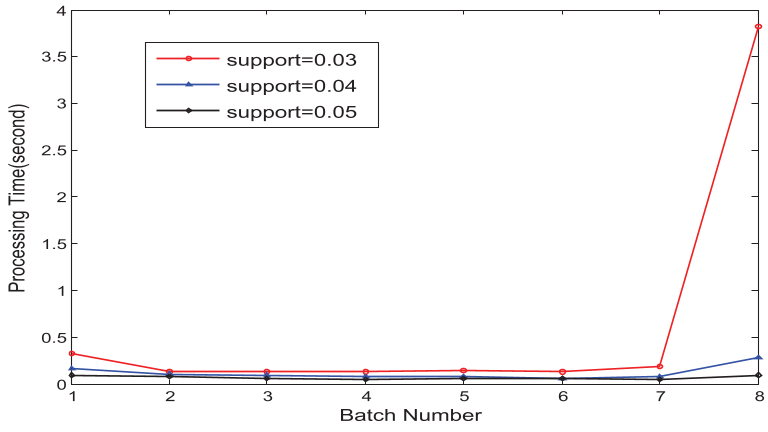 Figure 2: Time consumption vs. Support Threshold, showing real-time processing capabilities.
Critical Insight & Future Outlook
The beauty of this work is its Inductive Bias: it assumes that in a high-speed stream, the frequency of itemsets is a better proxy for "importance" than complex semantic distance.
Limitations:
- Semantics: Because it relies on exact word matches, it might miss topics where people use different synonyms for the same event (e.g., "H1N1" vs "Swine Flu").
- Noise: Twitter is notoriously noisy; without heavy preprocessing, "Frequent Patterns" can often just be common slang or stop-words.
Future Work: Integrating this temporal mining logic with Conceptual Graphs or Large Language Models (LLMs) could bridge the gap between "Frequent Pattern Mining" and "Deep Semantic Understanding."