
Mining Intelligence Without Grammar: A Pattern-Driven Approach to Information Extraction
10967_Mining Information Extraction Rules from Datasheets Without Linguistic Parsing.
The paper introduces a hybrid information extraction (IE) framework designed for technical datasheets, combining Association Rule Mining (Apriori) with Decision Tree learning (C4.5). It specifically targets "part-number" extraction from unstructured ASCII text converted from PDFs, achieving high precision and recall without any linguistic pre-processing (parsing, POS tagging, or lexicons).
TL;DR
Researchers from IBM Almaden and the Université de Saint-Etienne have developed a method to extract critical technical data (like product part-numbers) from unstructured datasheets without using a single line of linguistic parsing. By combining Association Rule Mining with C4.5 Decision Trees, they've bypassed the need for Part-of-Speech tagging and complex lexicons, proving that statistical context is often a more robust signal than grammar in technical domains.
Background: The PDF-to-ASCII Nightmare
In industrial B2B marketplaces (like IBM's Pangea project), the primary source of truth is the electronic component datasheet. These are usually PDFs—highly visual and semi-structured. However, to process thousands of them automatically, they are often converted to ASCII. In this "meat grinder" conversion, all visual hierarchy, font cues, and table structures are lost.
Existing SOTA systems of the time (such as RAPIER or SRV) hit a wall here because they require a linguistic structure that simply doesn't exist in a raw ASCII dump of a technical spec. The authors' insight: Frequent context is a proxy for semantic meaning.
Methodology: The Hybrid Pipeline
The paper proposes a three-stage pipeline that treats Information Extraction as a data mining problem rather than a natural language problem.
1. Context Extraction and Apriori Mining
The system uses a sliding window (size ) to capture the words surrounding a known part-number (e.g., "The [part-number] is a..."). By applying the Apriori algorithm, the system identifies "Frequent Contexts"—sequences of words that appear repeatedly around target entities.
2. Generating the Training Set
This is the clever part:
- Positive Examples: Contexts that are instances of the frequent models mined in step 1.
- Negative Examples: Contexts of tokens that match the frequent models but do not actually contain a part-number.
3. Decision Tree Learning
Instead of manually writing rules, the system feeds these examples into a C4.5 decision tree. The tree learns to distinguish between a "Part-Number Context" and a "Noise Context."
 Figure 1: The Pangea System integrates web crawling, classification, and this IE module to keep electronic databases up-to-date.
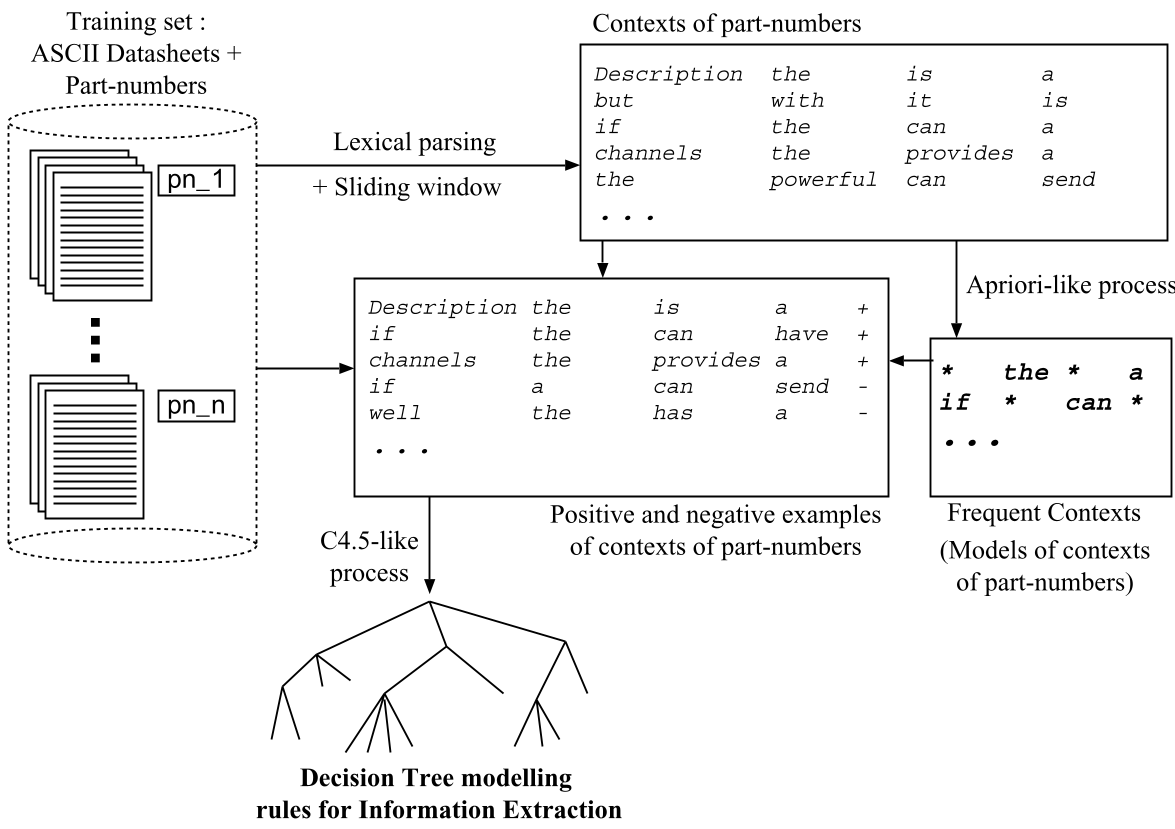 Figure 2: The core workflow combining sliding windows, Apriori mining, and Decision Tree induction.
Experiments: Precision vs. Noise
The researchers found a fascinating correlation between the Support Threshold (the frequency required to consider a pattern "frequent") and the final performance.
- The Balancing Act: If the support is too high, you get too few rules (Low Recall). If the support is too low, you get too much noise (Low Precision).
- The Ratio Effect: Performance is heavily dictated by the ratio. As the number of negative examples () approaches the number of positive examples (), the decision tree becomes significantly more efficient.
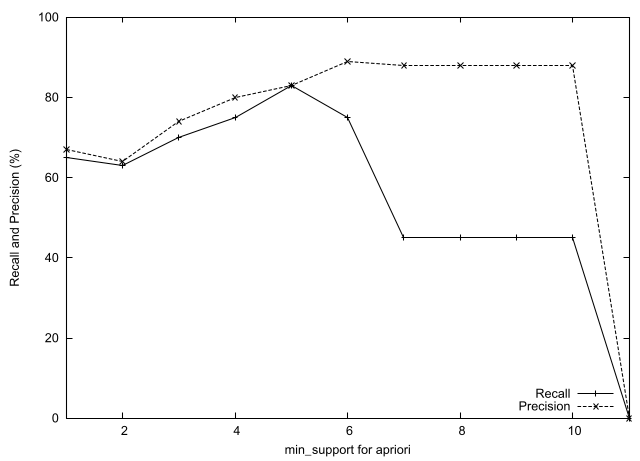 Figure 3: (a) Negative/Positive ratio vs Support; (b) Recall/Precision vs Support.
Critical Insight & Perspectives
What makes this approach valuable even today is its Inductive Bias. It assumes that in technical documentation, "location is logic." You don't need to know that "Voltage" is a noun to know that the number following it in 90% of documents is a specification.
Limitations
- Heuristic Final Step: After the tree identifies candidates, the system simply picks the most frequent token. In complex documents with multiple different components, this "majority vote" would fail.
- Window Sensitivity: The choice of context size is arbitrary and could benefit from attention-based mechanisms found in modern LLMs.
Conclusion
This paper serves as a classic example of "Simple beats Complex" when the data is noisy. By ignoring the linguistic "rules" of English and focusing on the statistical "rules" of the datasheet format, the authors created a system that is faster to train and easier to deploy than its grammar-reliant predecessors.
Takeaway: When dealing with domain-specific text (bioinformatics, log files, technical specs), linguistic parsing is often a distraction. Mine the patterns, build the tree, and let the data find its own structure.