
Decoding the Programmable Web: Why Social Tags are the DNA of API Mashups
Mining Integration Patterns of Programmable Ecosystem with Social Tags
This paper introduces a comprehensive network analysis framework to mine integration patterns in the programmable ecosystem (APIs and Mashups) by incorporating social tags. Leveraging data from ProgrammableWeb, the authors propose hybrid network models (Mashup-API-Tag) that capture both technical composition and functional semantics, revealing that modern Mashups integrate APIs with real-life applications.
TL;DR
While many view the API economy as a simple Lego-set of technical components, this paper argues that the "Programmable Ecosystem" is actually a complex social-technical network. By analyzing over 6,000 APIs and Mashups, the authors prove that social tags are not just noise—they are essential pointers that link code to real-life applications. They introduce a Hybrid Mashup-API-Tag (HMAT) network that reveals integration patterns hidden from traditional analysis.
Background: The "Single API" Paradox
In traditional service-oriented architecture (SOA) research, a "Mashup" is defined by how it combines multiple APIs. However, the authors observed a glaring contradiction in the data: most Mashups (over 50%) use only one API.
If we only look at API-to-API connections, the ecosystem looks fragmented and "lonely." The missing link? Real-life features. A Mashup like "2010 Formula One Map" isn't just a technical call to Google Maps; it's a bridge between a mapping service and the "Sports/F1" domain. This paper shifts the focus from how APIs connect to what they are accomplishing.
Methodology: High-Dimensional Network Modeling
The authors move beyond the bipartite "Mashup-API" graph. They introduce several key network transformations:
- Tag-Oriented API-Tag Network (TAT): Captures the functional semantics of APIs.
- Hybrid Mashup-API-Tag (HMAT): A three-mode network where Mashups are connected to both the APIs they invoke and the tags that describe their purpose.
- Clique-Based Topic Mining: By finding "Cliques" (fully connected subgraphs) in the Tag-Tag network, the authors can group messy social tags into "Cohesive" topics (e.g., grouping "mobile", "telephony", and "sms" into a singular functional domain).
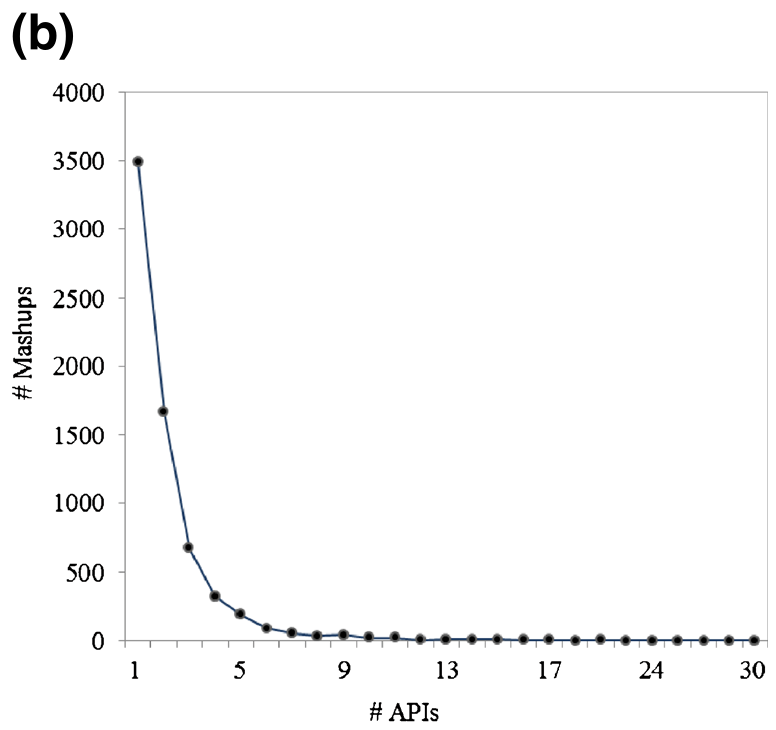 Figure: The transition from simple API composition to a semantic network including Social Tags.
Key Insights from Experimental Discovery
The research yields fascinating architectural insights into the "Small World" of the Web:
- Power-Law Dynamics: Much like the Web itself, a few "Hub" APIs (Google Maps, Twitter) and "Hub" tags (map, social, search) dominate the landscape, following a Power-law distribution.
- Semantic Cohesion: The clique analysis identifies groups of tags that naturally "stick" together. For instance, the "Mobile-Telephony-SMS-Message" clique represents a robust functional pillar of the ecosystem.
- Hybrid Visibility: The HMAT model reveals that even single-API Mashups are highly "collaborative" when you consider their integration with real-world data represented by tags.
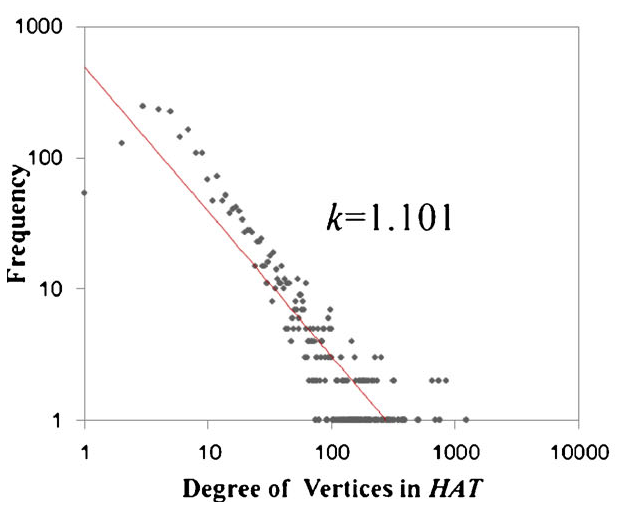 Figure: Degree distribution showing that tags and APIs hold nearly equal importance in the hybrid ecosystem structure.
Practical Use: Interactive Service Discovery
One of the most compelling parts of the paper is the Network-Aware Search. Instead of a flat keyword search, the authors propose a step-by-step navigation through the tag network.
- User starts with "Mobile" -> The system suggests the most related tags (Telephony, SMS) based on edge weights.
- User selects "Telephony" -> The search space narrows from 402 APIs to 128 instantly, guided by actual usage patterns in existing Mashups.
Critical Analysis & Future Outlook
Takeaway: This paper is a seminal effort in treating the Web API ecosystem as a Social Machine. It successfully argues that the "intent" behind a Mashup (the Tag) is just as important as the "tool" (the API).
Limitations:
- Tag Noise: Social tags are notoriously messy. While the authors use stemming and filtering, they admit that text descriptions (captured via LDA) would offer deeper semantic richness.
- Temporal Dynamics: The study is a snapshot; the API world evolves rapidly (e.g., the transition from SOAP to REST, and now to LLM-based agents).
Future Work: The authors envision a "Service Network" that behaves like a social graph for software components. In the age of AI, this paves the way for "Autonomous Agents" that can navigate these semantic networks to compose complex services on the fly without human intervention.
Conclusion
By mining the "Integration Patterns" through social tags, Han et al. provide a map for the previously unnavigable sea of Web APIs. It's a reminder that even in the world of programmable interfaces, the human element—expressed through social tagging—remains the best descriptor of utility and value.