
ST-SIM: Deciphering the Hidden Pulse of Social Influence in Physical Mobility
Mining of Location-Based Social Networks for Spatio-Temporal Social Influence
This paper introduces ST-SIM (Spatio-Temporal Social Influence Mining), a framework designed to identify influential users in Location-Based Social Networks (LBSNs). By modeling "followship" events—where a user visits a location previously checked into by a friend—the method employs a heat diffusion-based propagation mechanism to quantify social influence across space and time, achieving superior accuracy in predicting user check-in behavior compared to state-of-the-art baselines like EBM.
TL;DR
Why do you visit a specific coffee shop? Is it purely personal taste, or is it because a "travel expert" in your social circle checked in there last week? ST-SIM (Spatio-Temporal Social Influence Mining) is a sophisticated framework that proves your mobility is largely a product of social information diffusion. By treating social influence like heat spreading through a network, it predicts your future check-ins with unprecedented accuracy by analyzing the spatial, temporal, and categorical context of your friends' behaviors.
Problem & Motivation: Beyond Static Friendships
In the world of Location-Based Social Networks (LBSNs), classic recommendation systems often treat "social factors" as just another feature. They assume that if you are friends with someone, you share similar tastes in POIs (Points of Interest). However, the authors of ST-SIM argue this view is too simplistic.
The reality of influence is:
- Directed: You might follow a food blogger friend, but they likely don't follow you.
- Decaying: A recommendation or check-in from six months ago has far less impact than one from yesterday.
- Context-Dependent: Following a friend to a niche hidden bar suggests strong influence; "following" them to a major airport is likely just a coincidence.
The challenge lies in quantifying this "Social Strength" across millions of users and locations while accounting for the fact that influence can propagate through "friends of friends."
Methodology: The Heat of Influence
The core of ST-SIM is the Spatio-Temporal Social Follow Relationship. The authors move away from undirected friendship graphs to directed "Followship" graphs. If User A visits a place within a valid time window after User B, a followship link is established.
1. Background Featurization
To avoid the noise of coincidental check-ins, ST-SIM weights every followship event using three filters:
- Temporal (): Higher weight is given to more recent followships using an exponential decay function.
- Spatial (): Uses a distance distribution probability from the user's hometown.
- POI Entropy (): Uses Shannon entropy to identify "hot spots." High entropy (lots of different people visiting) decreases the influence weight of a followship at that location.
2. The Diffusion Model
Borrowing from physics, the framework treats the query user as a "heat source." Social influence is the "heat" that diffuses through the network over time. This allows the model to capture multi-hop influence.
 The Unified Social Strength Formula combines the Inter-user interaction (sinter) and Intra-user interest (sintra) to rank influential candidates.
Experimental Insights
The researchers tested ST-SIM against several baselines, including public frequency (popular spots) and the state-of-the-art EBM (Entropy-Based Model).
Key Findings:
- Social vs. Self: The experiments revealed that the
Inter(Social Influence) factor was significantly more accurate in predicting future behavior than theIntra(Self-Interest) factor. This confirms the dominant role of social "lead" in our urban movement. - Propagation Coefficient (): The model is sensitive to how fast influence spreads. If the "heat" spreads too far (), performance drops because multi-degree "strangers" start receiving similar scores to close friends, introducing noise.
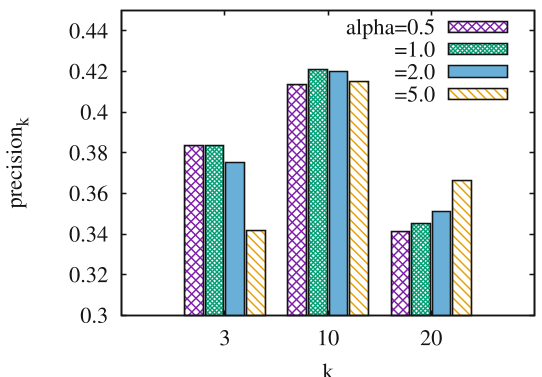 The ranking results demonstrate ST-SIM's superior Precision and MAP relative to frequency-based and social-only baselines.
Critical Analysis & Conclusion
ST-SIM successfully bridges the gap between digital social networks and physical geography. Its greatest strength is the dynamic weight tuning, which acknowledges that not all check-ins are created equal.
Limitations:
- The model heavily relies on "hometown" estimation, which can be inaccurate for highly mobile populations or digital nomads.
- It assumes a positive correlation in followship; it does not model "anti-influence" (avoiding places friends have been).
Future Outlook: This framework has massive potential for Hyper-local Marketing. Businesses can identify the "Travel Experts" who actually drive foot traffic to new locations, allowing for more surgical influencer marketing campaigns than simply targeting users with high follower counts.