
Locating Success: Mining Influence Scope for Smarter Outdoor Marketing in LBSNs
Mining Location Influence for Location Promotion in Location-Based Social Networks
The paper introduces LoP (Location Promotion), a novel framework for maximizing marketing influence in Location-Based Social Networks (LBSNs). It models the problem as a "location influence scope maximization" task, utilizing a dynamic Location-Location Graph (LLG) and Betweenness Centrality to identify the optimal K locations for promotional activities.
TL;DR
Outdoor marketing—like handing out flyers or setting up billboards—has entered the digital age. This paper presents LoP (Location Promotion), a strategy that mines user check-in data to find the "sweet spot" for promotions. By moving beyond simple popularity and focusing on Influence Scope Overlap, the authors provide an algorithm that maximizes how far a business's message travels through urban space.
The Problem: Why Popularity Isn't Everything
In traditional viral marketing, we look for "influencers"—people with many followers. In outdoor marketing, businesses often make the mistake of just picking the most crowded locations (high foot traffic). However, this paper identifies a critical flaw: Influence Overlap.
If you own a restaurant and hand out flyers at a nearby mall, but most people at that mall already know about your restaurant because they walk past it every day, your marketing budget is wasted. The goal isn't just to find crowded places; it's to find places that reach new audiences who are likely to visit your specific target location ().
Methodology: The Science of Urban Flow
The authors propose a multi-step framework to map out urban influence:
1. The Location-Location Graph (LLG)
Instead of just looking at where people are, the authors look at where they are going. By analyzing check-in sequences (e.g., User A visited , then within an hour), they construct an LLG. This graph captures the "sequential mobility" of a city—the hidden pathways of urban life.
2. Betweenness Centrality (BC) as Influence
The paper leverages Betweenness Centrality, a concept from graph theory. A location with high BC acts as a "bridge" in the shortest paths between many other locations.
- Insight: If a location is a bridge, information (like a promotional gift) distributed there is more likely to propagate across the city as users move to their next destinations.
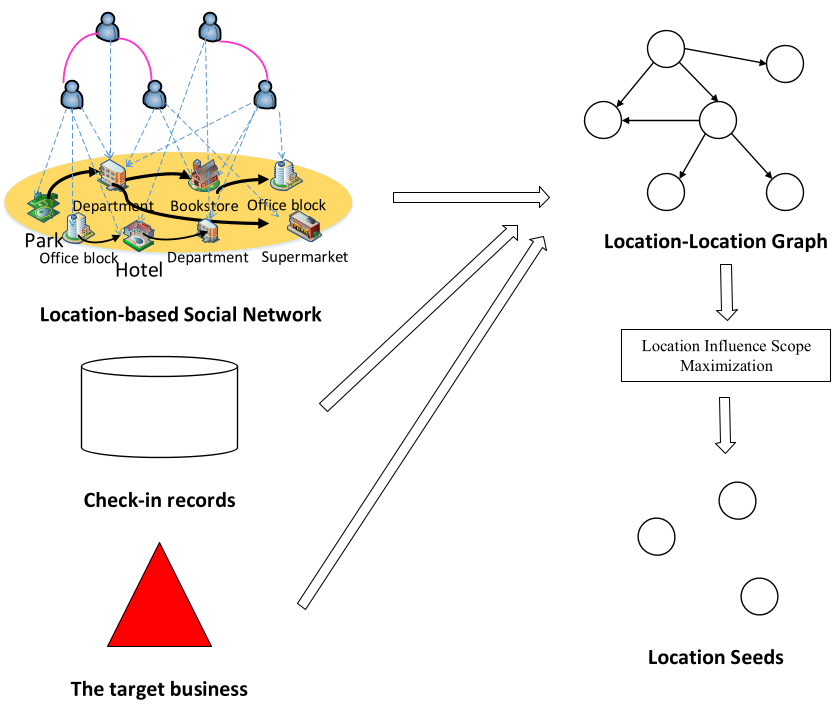 Figure: The framework of location promotion, from data collection to seat selection.
3. Eliminating Overlap
The core contribution is the objective function for Influence Scope Gain. It doesn't just calculate how influential a location is; it calculates how much extra influence adds to the target business that doesn't already have.
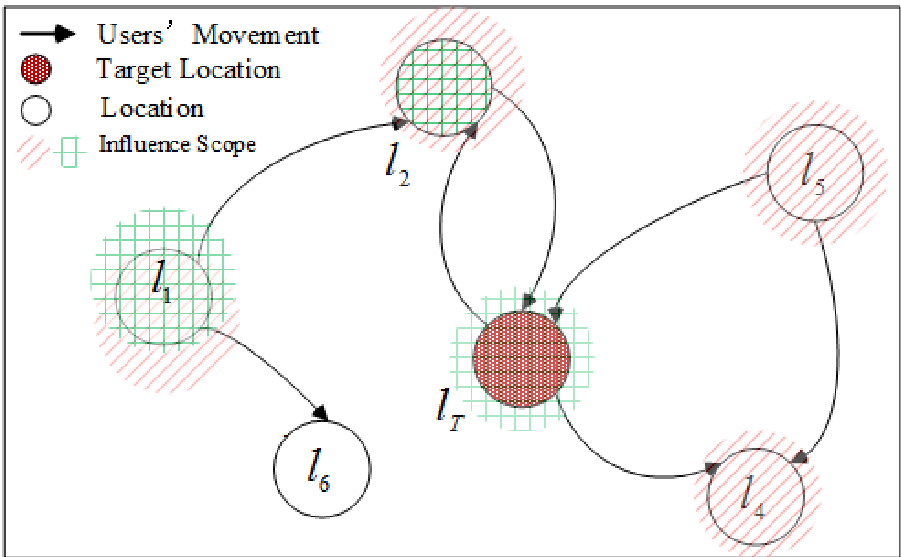 Figure: Visualizing how influence scopes overlap. The LoP algorithm specifically targets the unique green gain, avoiding the redundant blue areas.
Experiments: Proving the Gain
Using massive datasets from Foursquare and Gowalla (millions of check-ins), the authors tested their "Lazy-Forward" greedy algorithm against standard baselines.
- Key Finding: Selecting locations based on pure Out-Degree (most outgoing connections) or Naive-Select (most unique visitors) often fails because these popular spots overlap too much with the business's existing reach.
- Performance: The proposed LoP method consistently provided a higher "Influence Scope Gain," especially as the number of promotional sites () increased.
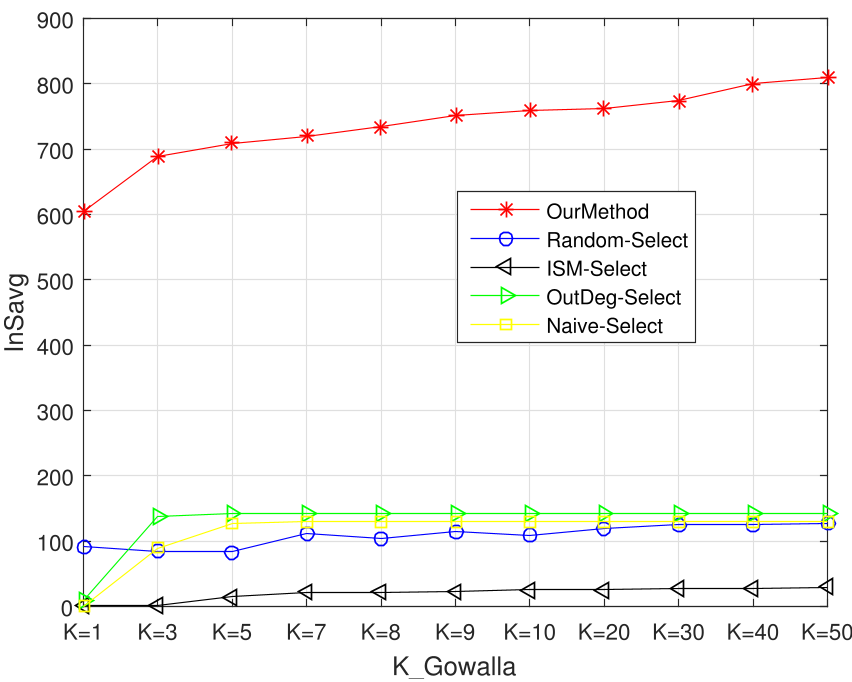 Figure: Comparison of average influence scope across different methods. "Our_method" (LoP) shows clear dominance.
Critical Insight & Future Outlook
This work shifts the paradigm of LBSN research from "recommender systems" (finding places for users) to "promotion systems" (finding users/places for businesses).
Takeaway for Data Scientists: The use of submodular optimization here is brilliant because it mathematically accounts for the "diminishing returns" of adding more promotional locations—a reality every marketing manager understands intuitively but often struggles to quantify.
Limitations: The model currently treats all check-ins equally. Future iterations would benefit from including semantic tags (e.g., distinguishing between a "gym" check-in and a "bar" check-in) to ensure the promotional context matches the user's intent.
Conclusion
The LoP algorithm is a powerful tool for urban "outdoor marketing." By understanding the flow of a city and respecting the boundaries of existing influence, businesses can stop shouting into the wind and start placing their messages where they truly matter.