
Mining Privacy Settings: Balancing the Scale Between Safety and Social Utility
Mining Privacy Settings to Find Optimal Privacy-Utility Tradeoffs for Social Network Services
The paper proposes a data-mining framework using Latent Trait Theory (LTT) to optimize privacy-utility tradeoffs in Social Network Services (SNS). By analyzing real-world Facebook settings from over 10,000 accounts, it introduces algorithms to recommend personalized privacy configurations based on a user's specific privacy concerns and functional utility goals.
TL;DR
Social Network Services (SNS) like Facebook present users with dozens of privacy toggles, but few have the patience to tune them. This paper introduces a framework that uses Latent Trait Theory to mine thousands of existing privacy settings, creating a "recommendation engine" for privacy. It doesn't just treat privacy as a wall; it treats it as a tradeoff, allowing users to say, "I want to be private, but I need recruiters to find me," and then calculating the optimal settings to achieve both.
Context: The Burden of Choice
In the modern digital landscape, SNS providers maximize their platform value by setting "high visibility" as the default. While fine-grained controls exist, they are often a maze. The author identifies two critical bottlenecks:
- Knowledge Gap: Users don't know the relative risk of disclosing a "Home Town" vs. "Religious Views."
- Utility Loss: Privacy isn't free. Hiding your email protects you from spam but also blocks potential business opportunities.
Methodology: Privacy as a Latent Trait
The researchers turn to Item Response Theory (IRT)—a mathematical framework typically used in psychometrics to measure hidden traits like intelligence. Here, the "latent trait" is a user's Privacy Concern ().
The Model
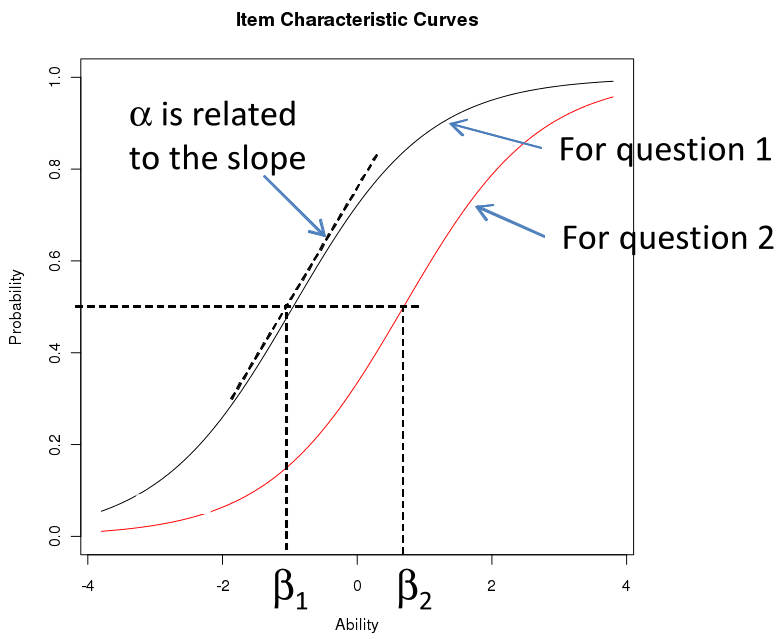
Each profile item (e.g., gender, phone number) is modeled using a logistic function:
- (Difficulty/Sensitivity): Measures how "private" an item is. If is low, only people with very low privacy concerns disclose it.
- (Discrimination): Measures how much this specific item helps distinguish between a private person and a public one.
Personalizing the Tradeoff
The core innovation is the Personalized Utility Model. By introducing weights () into the Maximum Likelihood Estimation (MLE) process, the system can bias recommendations. For instance, if a user is job-hunting, the algorithm overweights items like "Employer" or "Education," ensuring these remain visible even as the overall privacy level is tightened.
Experimental Insights from Facebook
The authors crawled thousands of Facebook accounts using a clever "Friends-of-Friends" (FoF) visibility check to deduce privacy settings.
Key Findings:
- The Perception Gap: "Friend Lists" are disclosed by almost everyone, suggesting a lack of risk awareness. Conversely, "Address" and "Phone Number" are hidden by nearly all, indicating high perceived sensitivity.
- The Red Curve: By plotting "Privacy Rating" against individual users, the researchers identified a stable curve of "Optimal Configurations."
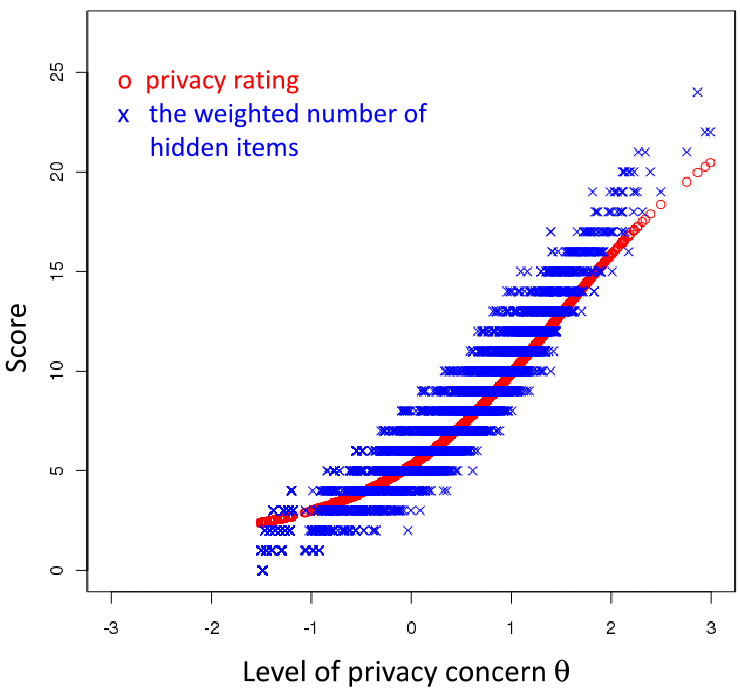
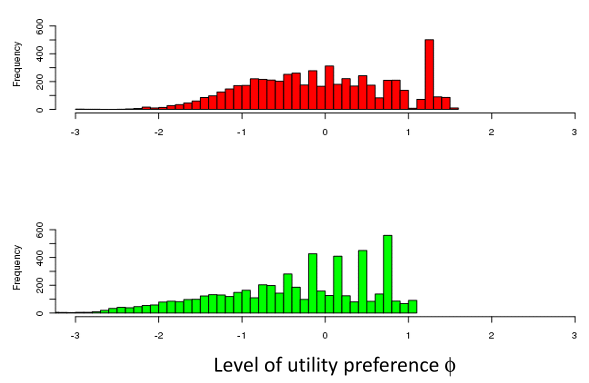
- Utility Tradeoff: There is a clear linear relationship between privacy and utility in standard settings (Fig 11 in the paper), but using the Weighted Utility Model creates a non-linear frontier that gives users more control (Fig 12).
Deep Insight: Beyond Binary Privacy
This research moves the field from "binary privacy" (0 or 1) to a probabilistic manifold. By observing how others behave, the system infers the "social norm" of privacy. The true value lies in its ability to support specific life goals—like professional networking—without requiring the user to become a cybersecurity expert.
Conclusion & Limitations
The study successfully proves that IRT can effectively model digital privacy. However, the authors note that identifying the "perfect" weights for utility is still an intricate task. Furthermore, social network sub-structures (e.g., age-specific communities) likely have different privacy models, which remains a promising area for future work.
Takeaway for Tech Leads: When designing user-facing privacy systems, don't just provide a list of checkboxes. Provide weighted personas (e.g., "The Job Seeker", "The Social Butterfly") that use peer behavior to calculate the safest, most useful configuration automatically.