
ELDA: Leveraging Public Emotion to Build Better Corporate Credit Ratings
Mining Emotions of the Public from Social Media for Enhancing Corporate Credit Rating
This paper introduces a novel framework for enhancing corporate credit rating prediction by mining public emotions from social media, specifically Twitter. It proposes the Emotion Latent Dirichlet Allocation (ELDA) model to extract the distribution of eight basic emotions based on Plutchik’s Wheel of Emotions, combining these with traditional financial indicators in a Random Forest ensemble model.
TL;DR
Researchers from the City University of Hong Kong and Tsinghua University have bridged a critical gap in Fintech by using social media "mood" to predict corporate creditworthiness. By developing a specialized Emotion Latent Dirichlet Allocation (ELDA) model, they successfully integrated Twitter-based public emotions with traditional financial ratios, achieving a significant boost in credit rating accuracy and timeliness.
Background: The Latency of Traditional Ratings
Credit ratings (AAA, AA, B, etc.) are the bedrock of global finance, yet they suffer from a "frequency mismatch." Financial indicators like Return-on-Assets (ROA) or Debt-to-Assets (DTA) are typically reported quarterly, while the underlying reality of a company's risk can change in days.
While many researchers have used social media sentiment to flip stocks for quick gains, the authors of this paper argue that public emotion—the collective "fear," "trust," or "anger" directed at a company—is an untapped goldmine for predicting the long-term stability and credit risk of a firm.
The Core Innovation: Emotion Latent Dirichlet Allocation (ELDA)
The architectural breakthrough of this study is the ELDA model. Standard LDA (Latent Dirichlet Allocation) is unsupervised; it finds "topics" but doesn't know what they mean. ELDA transforms this into a semi-supervised process focused entirely on human affect.
1. The Mathematical Intuition
Grounded in Plutchik’s Wheel of Emotions, ELDA tracks eight basic emotions: Anger, Anticipation, Disgust, Fear, Joy, Sadness, Surprise, and Trust.
The model uses the NRC Emotion Lexicon as a prior knowledge base. If a word like "collapse" is known to be associated with "Fear" in the lexicon, ELDA ensures its probability is concentrated in that emotion category. Words not in the lexicon are then "pulled" into these emotion clusters based on how often they appear next to labeled words.
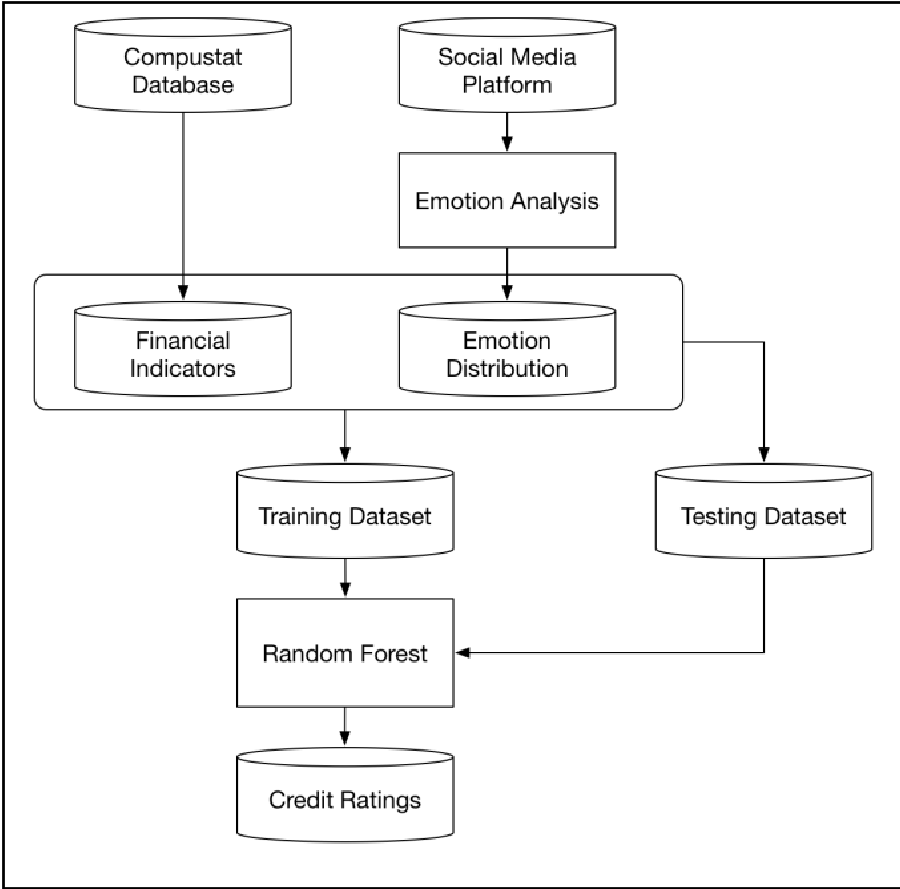
2. Integration with Financial Data
The framework doesn't throw away traditional accounting. Instead, it combines the following:
- Financial Indicators: DTA, ROA, IC, Loss, Size, and Capital Intensity.
- Emotion Vectors: Normalized distributions of public sentiment extracted via ELDA.
Experimental Results: Why Emotion Matters
The researchers tested their method on a dataset of 118 North American companies over a six-year period.
Performance Boost
The inclusion of social media emotion features pushed the classification accuracy of the Random Forest (RF) model from 74.6% (financial-only) to 77.6% (hybrid).

As shown in the table above, Random Forest significantly outperformed traditional models like Logistic Regression and SVM. This suggests that the relationship between public emotion, financial health, and credit risk is highly non-linear, making ensemble tree-based models the superior choice.
Confusion Matrix Insight
The model showed exceptional performance in identifying AAA and B ratings, while the most common errors occurred between adjacent classes (e.g., A vs. BBB), which is expected given the nuanced nature of mid-tier credit risk.
Critical Analysis & Conclusion
Why it Works
Social media acts as an early warning system. For instance, a surge in "Anger" or a drop in "Trust" on Twitter regarding a company's product quality or leadership can precede a financial downturn that won't show up on a balance sheet for months. By the time the "Interest Coverage" ratio drops, the rating might already be "stale."
Limitations
- Platform Bias: The study is currently limited to Twitter (X). The demographic and professional bias of different platforms (e.g., LinkedIn vs. Reddit) might yield different results.
- Sarcasm: While ELDA is robust, topic models often struggle with high-level linguistic nuances like sarcasm or financial slang that can flip the meaning of a sentence.
Future Outlook
The democratization of data means that "soft" indicators like public emotion are no longer "side-shows"—they are essential components of modern risk management. As we move toward 2026 and beyond, expect to see credit agencies like S&P and Moody's integrating these real-time "emotion streams" directly into their algorithmic rating pipelines.
Takeaway: If the public stops trusting a company on social media, the credit market will likely follow suit.