
Mapping the Academic Genome: Mining Research Directions from Student Grades
Mining Relations between Courses and Research Directions from Educational Data
The paper introduces HSminer and QSminer, two novel Educational Data Mining (EDM) methods designed to identify major academic research directions and their relationships with specific courses. By applying Latent Dirichlet Allocation (LDA) to student grade data, the authors cluster elective courses into thematic research areas and then map compulsory courses to these areas using recursive LDA or Pearson correlation coefficients.
TL;DR
Researchers from Beihang University have developed two algorithms, HSminer and QSminer, that use Latent Dirichlet Allocation (LDA) and Pearson correlation to automatically identify major research directions (like AI or Software Engineering) from student elective choices. By analyzing grade patterns, these tools can reveal which foundational compulsory courses are most critical for specialized research success.
Problem & Motivation: The Hidden Structure of Education
In the traditional university setting, the link between a 100-level "Advanced Mathematics" course and a highly specialized research area like "Pattern Recognition" is often assumed but rarely quantified. Existing Educational Data Mining (EDM) techniques have largely focused on predicting whether a student will fail or pass.
The authors identify a significant gap: Curriculum Analysis. They argue that elective courses represent a student's internal research interest, while compulsory courses provide the necessary substrate. The motivation was to create a data-driven map that shows how these two categories interact, essentially uncovering the "latent themes" of an academic department based solely on student performance records.
Methodology: From Topic Models to Course Clusters
The core innovation lies in treating a student's transcript as a "document" where the courses are "words."
1. Data Preprocessing
Since LDA requires "frequency" rather than raw grades, the authors converted numerical scores into frequency counts:
- High grades (≥85): Frequency = 5
- Passing grades (60-85): Frequency = 1
- Failures: Frequency = 0
2. Mining Research Directions (The "How")
Using the elective courses as the primary signal, the authors applied Latent Dirichlet Allocation (LDA) to discover number of themes. Each theme represents a research direction.
3. Integrating Compulsory Courses
The researchers proposed two distinct paths for integrating the foundational "compulsory" courses:
- HSminer (Qualitative): Uses a recursive LDA approach. If an elective course belongs to Research Direction , and a compulsory course frequently clusters with , then is added to .
- QSminer (Quantitative): Uses the Pearson Correlation Coefficient to calculate the linear dependence between student performance in foundational courses and elective courses.
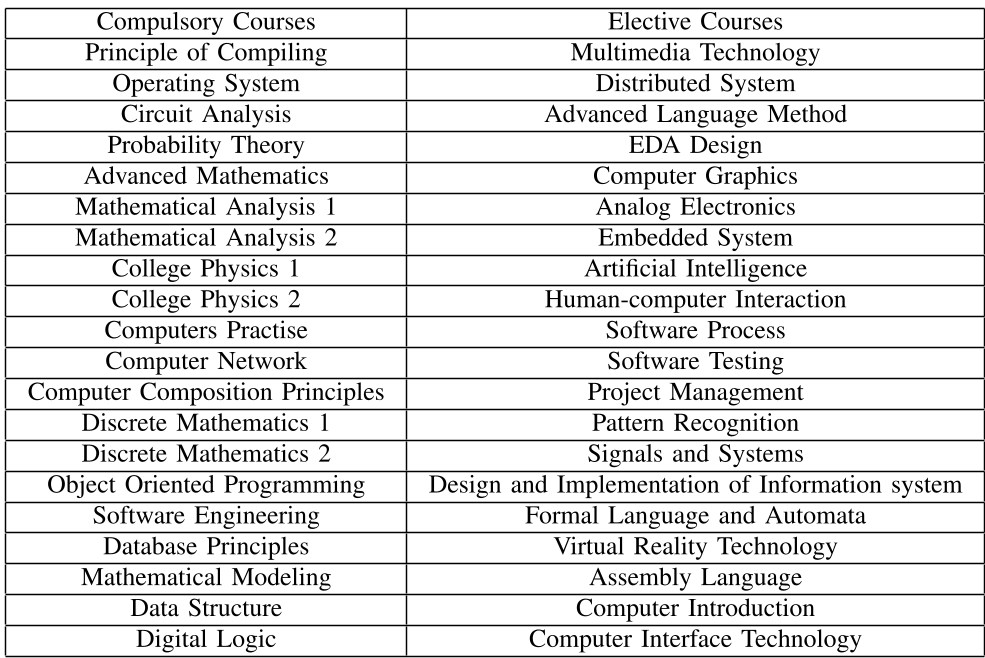 Table 1: The input dataset categorization of Compulsory and Elective courses.
Experiments & Results: Validating the Map
The study utilized real-world data from the School of Computer Science at Beihang University (590 students, 40 courses).
Key Findings:
- Direction Identification: The algorithms correctly identified five pillars: Pattern Recognition, Software Engineering, HCI, Graphics, and Computer Architecture.
- Deep Correlations: The results (shown in Table III below) show that courses like "Principle of Compiling" and "Operating Systems" consistently appeared as high-weight supporters across almost all research directions, confirming their status as fundamental "core" knowledge.
- Recursive Insights: As the mining rounds increased (Round 1 to Round 3), the algorithms moved from directly related technical courses to more foundational mathematical ones (e.g., "Discrete Mathematics" and "Mathematical Analysis").
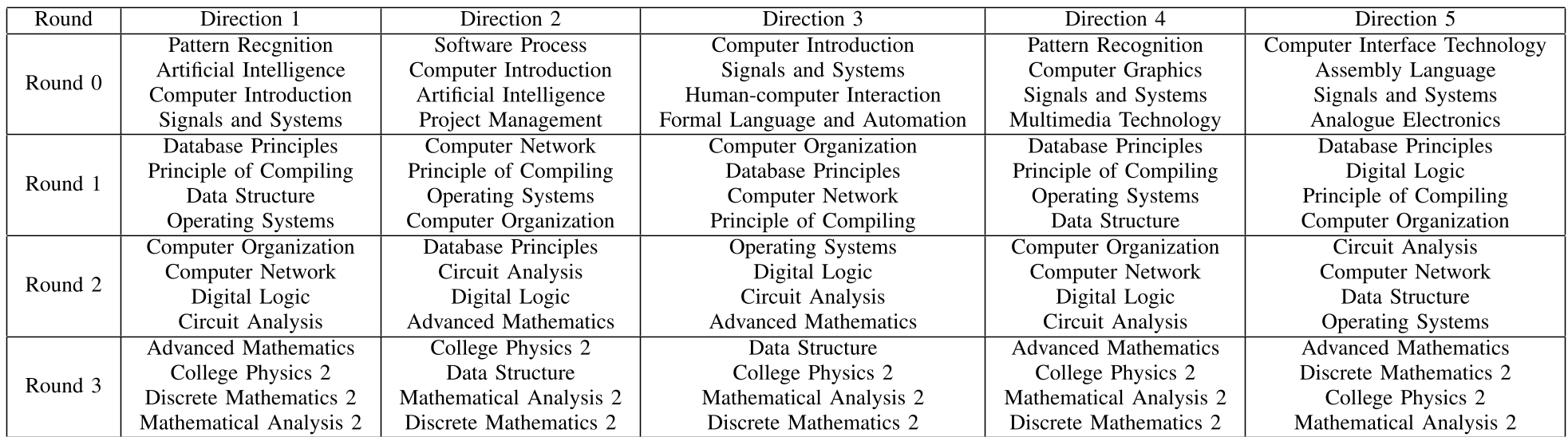 Table 3: The recursive results of QSminer showing how different tiers of courses support specific directions.
Critical Analysis & Conclusion
Takeaway
The paper successfully demonstrates that LDA is not just for text. By treating student grades as a proxy for academic "topics," the authors provide a quantifiable way to audit university curricula. This can help administrators ensure that elective offerings are well-supported by the foundational compulsory courses.
Limitations
A primary limitation is the Data Sparsity. Students who fail or do not take specific electives create "zeros" in the matrix, which can bias LDA. Furthermore, the correlation-based approach (QSminer) assumes a linear relationship between grades, which may not capture the non-linear "threshold" effects where a student only needs a "good enough" understanding of math to excel in AI.
Future Outlook
Future work could extend this by incorporating Temporal Mining—analyzing how these relationships evolve over 10-20 years as research fields shift, or applying this to MOOC platforms to provide automated "Research Track" recommendations for online learners.