
Mining Semantic Threads: Bridging the Gap in Localized POI Recommendations
Mining Semantic Location History for Collaborative POI Recommendation in Online Social Networks
The paper introduces a novel collaborative Point-of-Interest (POI) recommendation method that mines semantic location history from Location-Based Social Networks (LBSNs). By mapping physical check-ins to a three-level hierarchical category structure, the method achieves superior performance (F-score up to 0.551) over traditional Collaborative Filtering (CF) and SVD-based approaches.
TL;DR
This research tackles the "sparsity" and "locality" trap in POI recommendations by shifting the focus from where you check in to what kind of places you like. By projecting raw GPS coordinates into a semantic category hierarchy (like Foursquare’s 3-level taxonomy), the authors develop a Collaborative Filtering model that finds "interest twins" even if they live on opposite sides of the globe.
The Localization Trap: Why GPS Coordinates Aren't Enough
Current Location-Based Social Networks (LBSNs) like Foursquare and Yelp rely heavily on user check-in history. However, traditional Collaborative Filtering (CF) approaches struggle with two fundamental issues:
- Extreme Sparsity: Most users visit only a tiny fraction of available venues, making the user-location matrix mostly empty.
- Travel Locality: If User A visits a luxury sushi bar in Tokyo and User B visits a luxury sushi bar in New York, a traditional CF system sees zero overlap. They are mathematically "dissimilar" despite having identical tastes.
The authors argue that the physical location is just a container; the semantic description is the actual preference indicator.
Methodology: From Lat/Long to Semantic Space
The proposed framework operates in three sophisticated stages:
1. Identifying Significant Locations
Not all check-ins are equal. A daily stop at a train station tells us less about a user than a rare visit to an "Arts & Crafts Store." The authors use a tf-idf weighting scheme to suppress the influence of ubiquitous, "noisy" locations and highlight venues that truly define a user's unique profile.
2. Hierarchical Semantic Mapping
The core innovation lies in mapping these weighted locations into Foursquare’s hierarchical category structure.
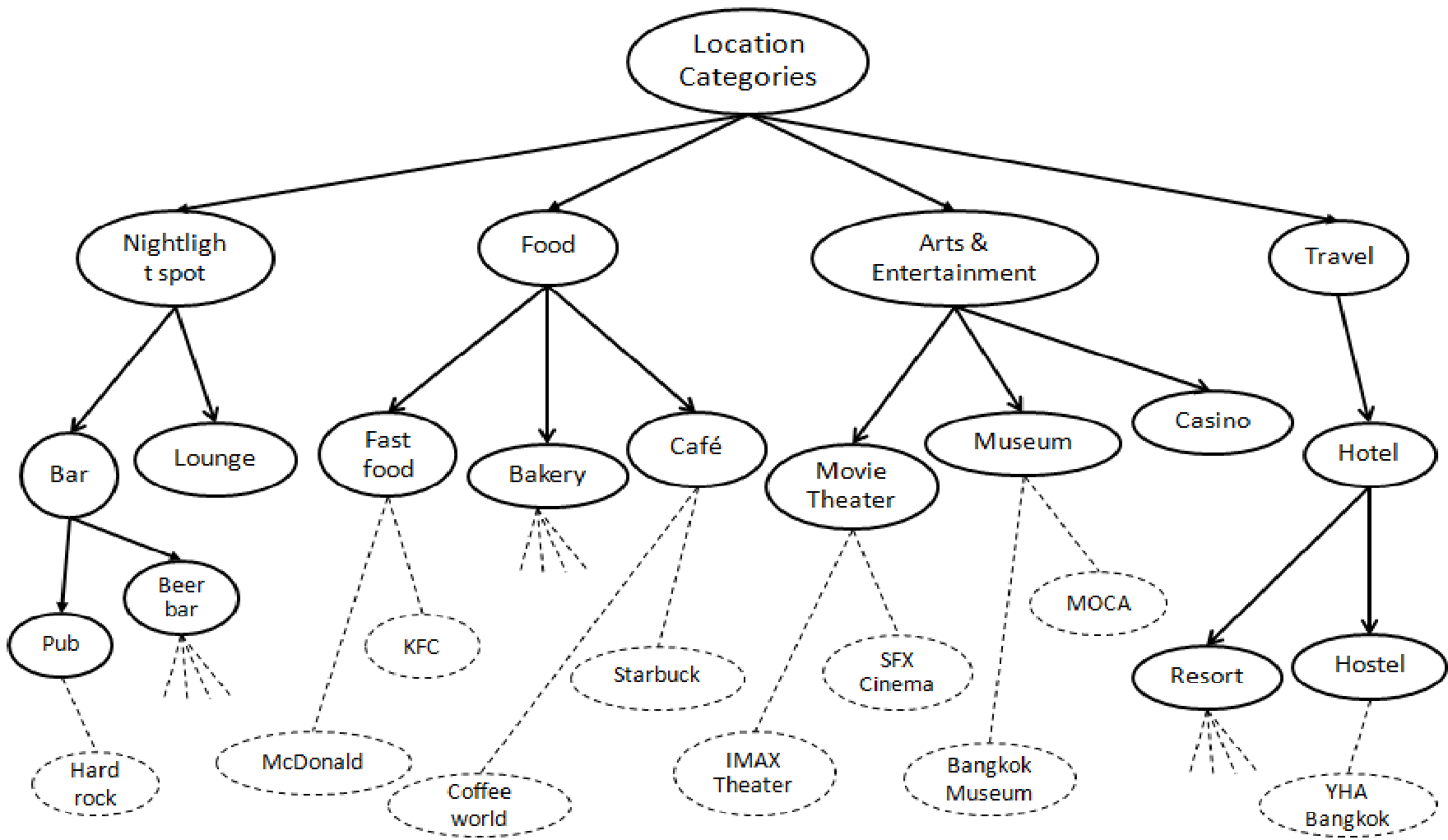 Figure 2: Foursquare's category hierarchy allows specific venues to be generalized into broad interest groups.
Weights are propagated upward through the hierarchy using the formula: This ensures that the "interest weight" of a category like "Food" reflects both the frequency of visits and the distinctiveness of that interest.
3. Fusing Opinions for Recommendation
Once user similarity is established in this semantic space, the system identifies "Candidate Venues" within a radius of the user's current location and aggregates the scores from the top-Q similar users who have visited those specific spots.
Performance Benchmarks
The model was tested against standard Location-based CF (LCF) and SVD-based Matrix Factorization.
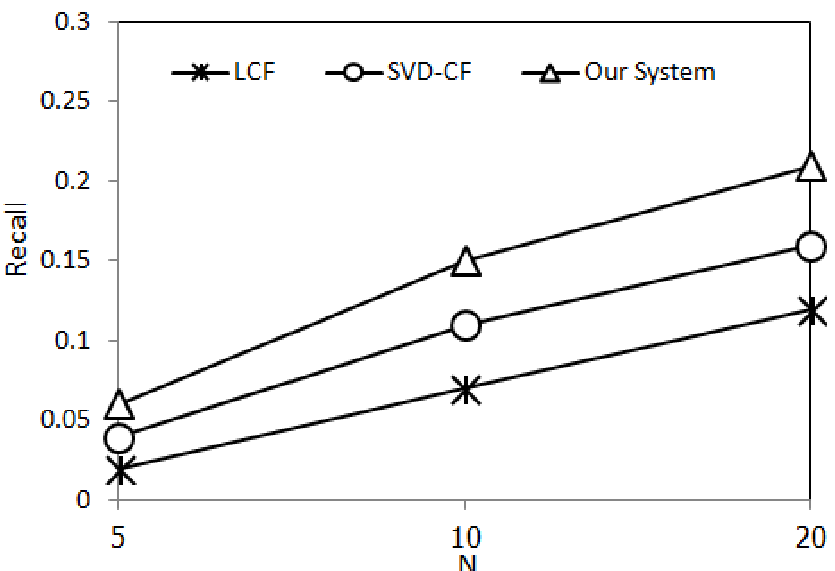 Figure 4: Average Precision@N for Tokyo and New York datasets.
Key Findings:
- New York Dataset: Achieved a peak F-score of 0.551, significantly higher than SVD alternatives.
- The "Top-M" Effect: Interestingly, the authors found that using all visited locations actually decreased accuracy. The best results came from using only the top 20-30 most significant locations, proving that our "routine" locations often mask our true "interest" signatures.
Critical Analysis & Future Outlook
The beauty of this research is its simplicity and interpretability. While modern deep learning models often act as "black boxes," this category-based approach provides a clear path of reasoning: "We recommend this Gallery because you have a high semantic weight in the 'Arts & Entertainment' node."
Limitations: The current model relies on the static category hierarchy of the platform. It doesn't account for "temporal drift" (interests changing over time) or the specific textual content of user reviews (sentiment).
Future Directions: Integrating Temporal Features (time of day) and User-Generated Tags would likely refine the accuracy further, especially for venues that serve different purposes at different times (e.g., a cafe that becomes a bar at night).
Conclusion
By mining the "Semantic Location History" instead of raw check-in counts, the authors have provided a robust solution to the sparsity problem in LBSNs. It turns out that to know where a user wants to go next, we shouldn't just look at where they've been, but what those places meant to them.