
Mining the Invisible Structure: How Smartphones Map Our Social Life-Facets
Mining smartphone data to classify life-facets of social relationships
This paper presents a machine-learning approach to classify social relationships into three distinct life facets—Family, Work, and Social—using smartphone communication logs. By analyzing 16,940 calls and 63,900 SMS messages from 40 users, the authors achieved up to 90.5% classification accuracy for active contacts using Support Vector Machines (SVM).
TL;DR
Researchers from Carnegie Mellon University have demonstrated that your smartphone metadata—who you call, when you text, and how long you talk—is a powerful predictor of your relationship type. By training machine learning models on communication patterns, they can distinguish between Family, Work, and Social contacts with over 90% accuracy, providing a path toward truly "socially aware" computing.
The "Friend" Problem: Why Manual Grouping Fails
In the physical world, we are chameleons. We perform different roles depending on the context: a strict manager at 10 AM, a doting parent at 6 PM, and a casual teammate on Saturday. However, digital systems like Facebook or standard contact lists suffer from context collapse, treating every connection as a generic "friend."
While platforms offer manual grouping tools, only a tiny fraction of users (less than 5% on Facebook) actually use them. The effort required to categorize hundreds of contacts—and keep them updated as relationships evolve—is simply too high. This paper asks: Can the device itself infer these roles by observing our behavior?
The Method: Decoding Communication Signatures
The researchers analyzed data from 40 participants, looking at 153 distinct features. They didn't just look at how much people talked, but how they talked. They categorized behaviors into five factors:
- Intensity: Total number and duration of interactions.
- Regularity: The "burst-ness" or consistency of contact.
- Temporal Tendency: Time-of-day and day-of-week preferences (the "Weekend vs. Weekday" signal).
- Channel Selection: Whether a contact is "Call-only" (common for parents) or "SMS-heavy" (common for friends).
- Maintenance Cost: How much effort is spent keeping the relationship active.
 Note: The study utilized comprehensive logs of SMS and Voice calls to build these behavioral profiles.
Key Insights: What the Data Says About You
The experiment yielded fascinating insights into the "physics" of our social facets:
- Family (The Deep Dives): Characterized by high call intensity and long durations. If you have "lengthy calls" (over 10 minutes) on a Sunday, there is a 90% chance that contact is a family member.
- Work (The 9-to-5 Grind): These relationships are dominated by weekday communication and are almost non-existent on weekends. Interestingly, call intensity is often lower for work contacts in mobile logs, likely because much work communication shifted to email or face-to-face office interaction.
- Social (The Texting Tribe): Characterized by a strong preference for SMS over voice calls and high activity on Friday/Saturday evenings.
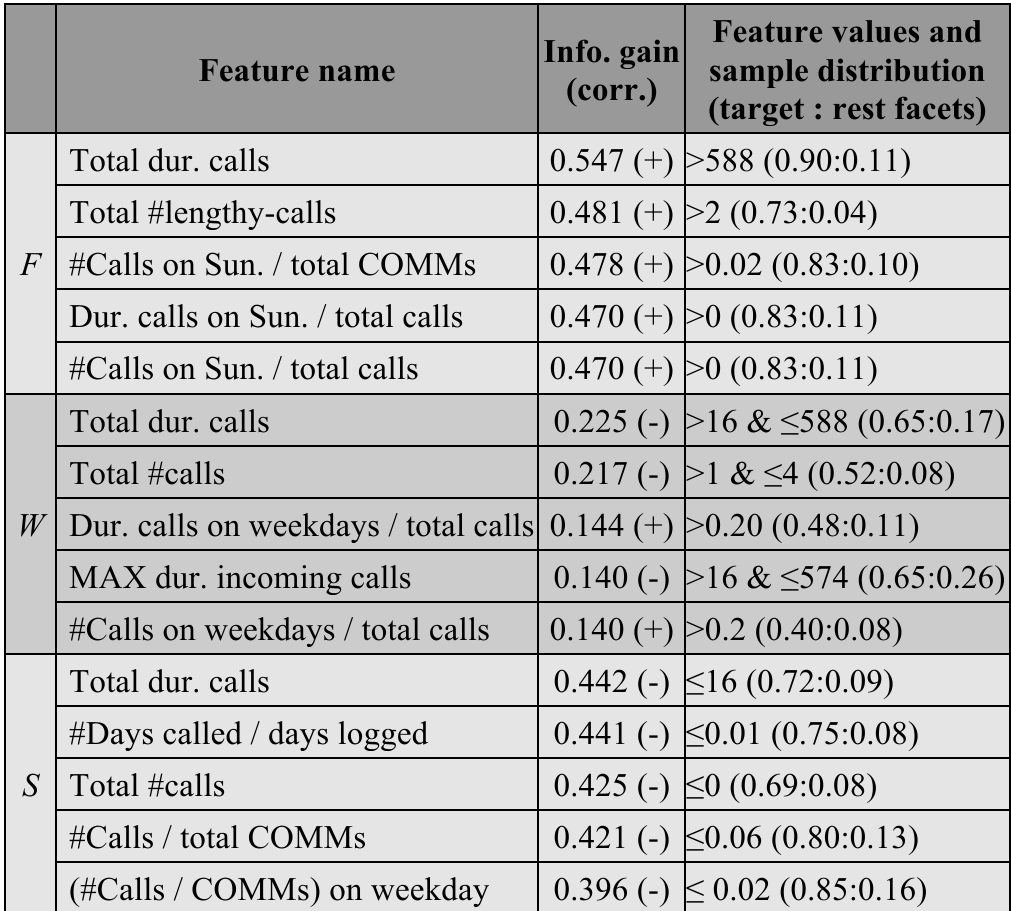 Table: Ranking of features by Information Gain. Total call duration remains the strongest signal for identifying Family.
Results and Performance
Using Support Vector Machines (SVM), the system achieved:
- 90.5% Accuracy for contacts with active communication logs.
- 83.1% Accuracy for the entire phonebook (including "dormant" contacts).
The study found that while profile information (like last names or photos) helps, the mobile communication metadata is the most significant driver of accuracy. Even without knowing the content of a text message, the timing of that message says everything.
Critical Analysis & The Future of Social UX
This work acts as a foundational step for Context-Aware Systems. Imagine a phone that automatically silences "Work" emails during "Family" time on Sundays, or an SNS that warns you before you post a "Social" photo that might be visible to the "Work" facet.
Limitations
- The Medium Shift: The study was conducted when SMS and Voice were dominant. In today's era of WhatsApp, Slack, and Discord, data is more fragmented.
- The "School" Ambiguity: Students often treat school contacts as a hybrid of work and social, leading to classification friction.
Conclusion
The "social role" is an invisible structure that guides our human lives. This paper proves that this structure is not invisible to our data. By mining the metadata of our daily interactions, we can build technology that respects the boundaries of our multifaceted lives, rather than tearing them down.