
Mining the Invisible: Extracting Social Intelligence from Privacy-Preserving Sparse Networks
Mining social interactions in privacy-preserving temporal networks
This paper introduces a computational framework for mining social interactions in highly sparse temporal networks generated by privacy-preserving "by-design" platforms. Using the Nervousnet platform during the 2014 Chaos Communication Congress, it demonstrates that stable social patterns and event correlations can be extracted even when data quality is intentionally degraded for user anonymity.
TL;DR
Is it possible to understand social dynamics without stalking people's every move? This paper proves it is. By analyzing a highly sparse, anonymized temporal network from a major tech conference, researchers demonstrated that we can detect stable social groups and correlate event dynamics even when half the data is "missing" by design to protect user privacy.
Academic Context: This work sits at the intersection of Temporal Network Analysis and Privacy-by-Design, moving away from absolute geolocation (like GPS) toward relative proximity sensing (Bluetooth beacons).
The Paradox of Privacy vs. Utility
We live in an era of "Surveillance Capitalism," where every social interaction is a data point. While fine-grained data collection empowers analytics for disease spreading or urban planning, it threatens individual autonomy.
The authors tackle a specific challenge: Self-determined privacy. In the Nervousnet platform used in this study, users decide what and when to share. This creates "Sparse Temporal Networks"—mathematical maps of interactions that are riddled with holes. The central question is: If the data is intentionally bad (sparse), can the science still be good?
Methodology: Taming Sparsity
The authors propose a robust pipeline to handle the inherent noise of privacy-preserving data.
1. The Quality Index
To understand what they were working with, they defined a quality index to measure user activity. This allowed them to find the "sweet spot" in time resolution where information aggregation balances out data loss.
2. Event Correlation
Instead of treating time as a flat line, the authors treat it as a series of non-homogeneous "events" (e.g., Lecture vs. Coffee Break). They measure the "Earlier," "Current," and "Following" snapshots of an interaction to ensure temporal consistency via the Jaccard distance triangle inequality.
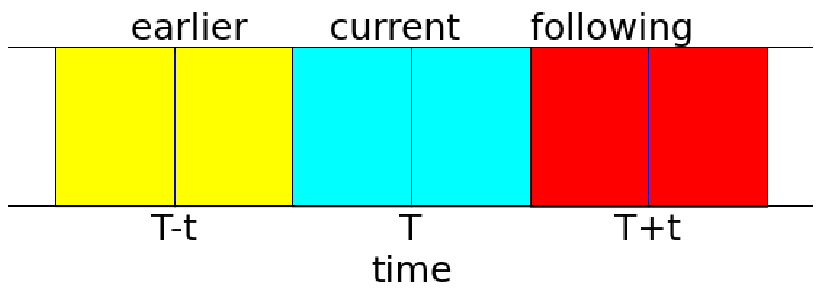 Figure 1: The temporal segmentation used to define event dynamics (Earlier, Current, Following).
3. Stable Group Detection
Traditional community detection fails on sparse data because "weak" or accidental links look the same as "real" social groups. The authors introduced a Multiplicity Filter: only interactions that repeat across multiple time windows (strength threshold) are considered "socially significant."
Experimental Insights
The study utilized real-world data from the 2014 Chaos Communication Congress, a community naturally skeptical of surveillance.
- Internal Consistency: Interaction patterns remain remarkably stable within a specific conference event.
- Event Sensitivity: There is a clear "phase shift" in networking behavior when transitioning from a formal session to a break.
- The "Core" Detected: After a severe filtering process (only 8% of nodes remained), the model identified three distinct, stable social groups.
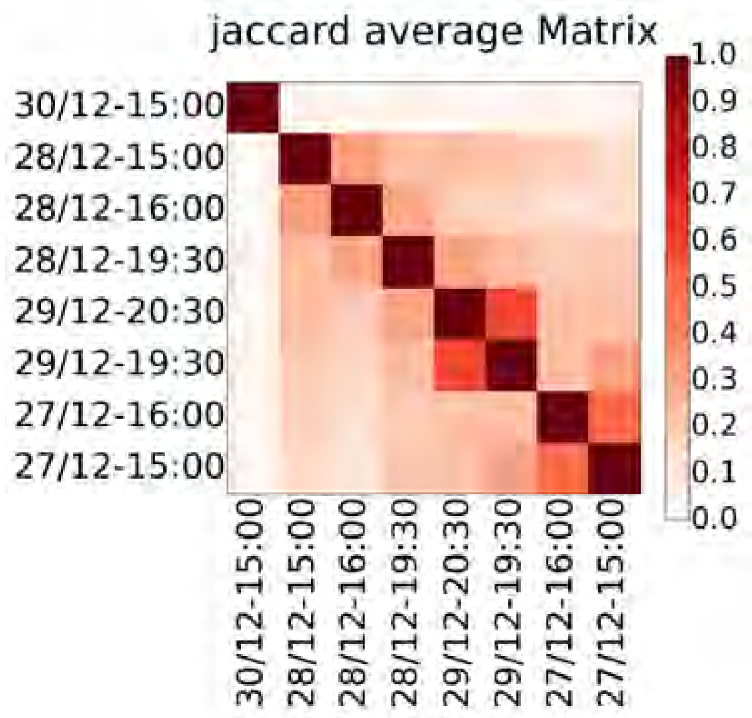 Figure 2: Correlation matrices showing that while internal event stability is high, global interaction patterns vary significantly across the 4-day congress.
Critical Analysis & Conclusion
Takeaway
The most striking find is that time is a stronger predictor than topic. Users were more likely to interact with the same people because they were nearby in time, rather than because they were attending a similar themed workshop. This reinforces the "temporal" nature of social proximity.
Limitations
- Scale: With only 154 participants, the detected stable groups were very small (9 nodes). Applying this to a city-scale network would require much higher computational overhead.
- Severe Filtering: To find "truth," the authors had to discard 92% of the nodes. Future work needs to find ways to extract value from the "gray area" of semi-active users.
Future Outlook: The authors suggest that Recurrent Neural Networks (RNNs) could be the next frontier in predicting shifts in these sparse networks, potentially filling in the gaps left by privacy-preserving filters without compromising the users' original anonymity.