
Automated Social Network Mining: Turning the Web into a Conference Assistant
Mining social network of conference participants from the Web
This paper introduces a system for automatically mining the social networks of conference participants from the Web using search engine results. By leveraging names and affiliations, the method reconstructs a graph where nodes represent participants and edges represent various relationship types like "Co-author," "Lab Member," or "Project Member" identified via C4.5 classification rules.
TL;DR
Researchers have developed a way to map out the complex social connections of conference attendees by simply "googling" them. By analyzing co-occurrences of names and the context of the web pages they appear on, the system can distinguish between co-authors, lab-mates, and committee members. This provides a "social map" that can fuel smarter networking recommendations and personalized information services in ubiquitous computing environments.
Background: Beyond Simple "Interests"
In a world of smart devices and context-aware apps, knowing a user's location or interests is only half the battle. If a system recommends you talk to a researcher because you share interests, it might accidentally suggest your own boss or a close colleague—recommendations that are redundant at best. To be truly "smart," systems need to understand the Social Context.
This paper targets academic conferences, using pre-registered lists of participants to mine the vast evidence of their professional lives available on the open Web.
Methodology: How to "Learn" a Relationship
The extraction process follows a two-step pipeline:
- Node and Edge Discovery: The system queries a search engine for pairs of participant names (X and Y). It calculates a modified Jaccard Coefficient based on hit counts. If the names appear together frequently enough relative to their individual search volume, a social "edge" is created.
- Edge Labeling via Content Analysis: Not all connections are equal. To distinguish a "Co-author" from a "Lab Member," the system fetches the top search results and extracts features like:
- SameLine: Do the names appear side-by-side (likely co-authors)?
- Keyword Groups: Does the page mention "publication" and "papers" (Group A) or "laboratory" and "institute" (Group B)?
By feeding these features into a C4.5 decision tree algorithm, the system generates logical rules for relationship classification.
 Description: C4.5 classification rules used to differentiate relationship types such as Coauthor, Lab, and Project.
Experiments and Insights
The researchers tested their system on participants from the JSAI 2002 conference (470 nodes).
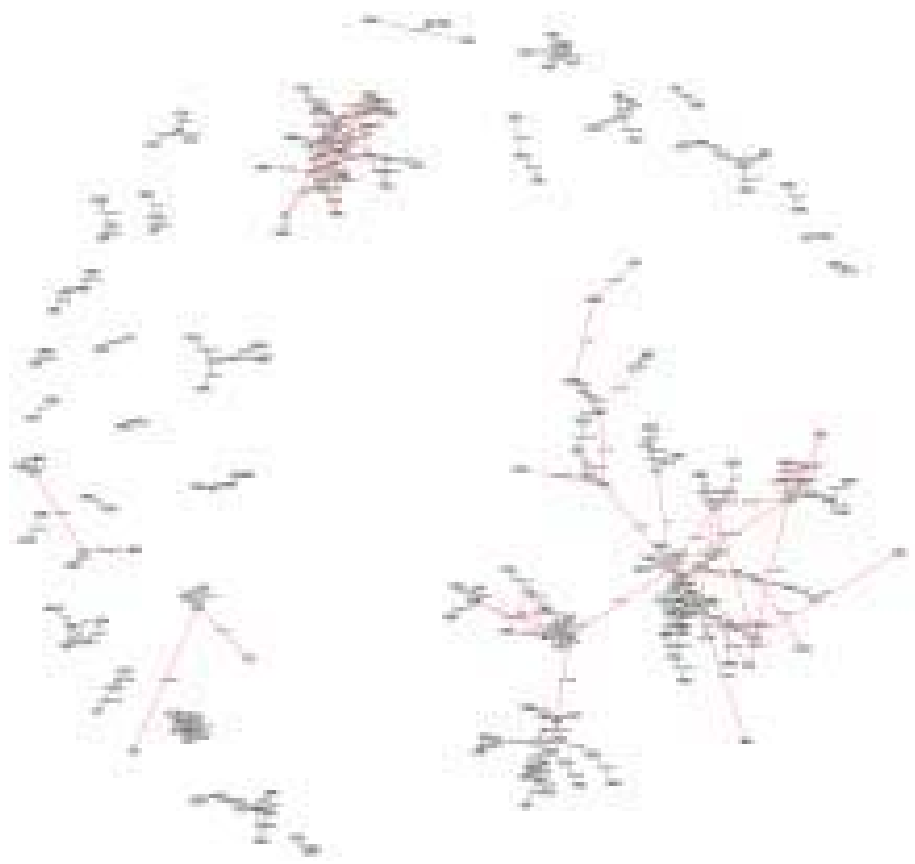 Description: The visualized social network showing clusters of researchers and "connectors" between different groups.
Key Findings:
- High Precision: For "Co-author" and "Conference Member" labels, precision reached 96% to 100%. This means if the system says you are co-authors, it is almost certainly right.
- Recall Challenges: While identifying lab members was successful (87% recall), identifying "Project Members" was much harder (12.5% recall). This suggests project-specific information is often trapped in private intranets or less indexed web pages.
- Network Layout: Visualization reveals distinct clusters and "bridge" individuals—highly valuable for users looking to find a common acquaintance to introduce them to a stranger (the "introducer/negotiator" use case).
Conclusion and Ethical Considerations
The paper successfully demonstrates that the Web provides a rich "shadow" of our professional social lives. However, the authors rightly point out the Privacy Paradox: many participants may be unaware that their professional hierarchies are being mapped.
As we move into an era of even more powerful data mining, this foundation provides a roadmap for building services that help us find the "weak ties" that provide the most value, while reminding us that our web footprint is more descriptive of our social status than we might realize.