
Mining Social Networks for Anomalies: A Structural and Behavioral Deep Dive
Mining social networks for anomalies: Methods and challenges
This paper provides a systematic and comprehensive review of anomaly detection within Online Social Networks (OSNs). It introduces a multi-level taxonomy to categorize state-of-the-art methods based on input network types (static vs. dynamic, attributed vs. unattributed), anomaly types (nodes, edges, subgraphs, events), and technical approaches (community-based, structure-based, tensor decomposition, etc.).
TL;DR
As Online Social Networks (OSNs) weave into every facet of modern life, they become prime targets for illegal activities. This seminal review by Bindu and Thilagam provides a roadmap for Graph Anomaly Detection (GAD), categorizing how we can identify malicious nodes, edges, and subgraphs using everything from spectral analysis to Bayesian probability.
Academic Positioning: This work serves as a foundational survey that bridges classical graph theory with modern data mining, specifically focusing on the transition from static snapshots to dynamic, evolving streams.
Problem & Motivation: The Identity Crisis in Social Data
Why is social network anomaly detection harder than finding a needle in a haystack? In traditional datasets (like sensor logs), an outlier is a point far from the cluster. In a social network, an anomaly is often a relationship or a sub-structure that "looks" normal but behaves suspiciously.
The authors identify two key challenges:
- Adversarial Camouflage: Malicious users (e.g., sybil attackers) don't just act weird; they try to look like your average friend-group to bypass filters.
- Structural Dependencies: Unlike i.i.d. data, changing one node affects the entire neighborhood's "normality."
Methodology: The Taxonomy of Discovery
The paper categorizes the GAD field into three major dimensions: the Network Nature, the Anomaly Target, and the Detection approach.
1. Static vs. Dynamic Networks
Static analysis looks at a "frozen" moment (e.g., finding the "OddBall" in a single snapshot). Dynamic analysis (Streaming Tensor Analysis) tracks how the network breathes, identifying Events—moments where the reconstruction error of the graph's matrix representation spikes unexpectedly.
2. Architecture & Approach
The methodology relies on three distinct "intuitions":
- Community-based: Anomalies are the "bridges" that don't belong to any cluster or nodes that violate community evolution trends.
- Structure-based: Uses the Egonet (a node and its immediate neighbors). If an egonet follows a star pattern instead of the "friends of friends are friends" clique pattern, it is flagged.
- Decomposition-based (Spectral): By decomposing a graph into its principal components (SVD or Tensor decomposition), we can see the "background noise." Anything that cannot be accurately reconstructed by the top components is likely an anomaly.
 Figure 1: Multi-level taxonomy of anomaly detection in social networks.
Experiments & Results: Fighting Fraud in the Real World
The paper reviews cross-domain performance, highlighting several SOTA achievements:
- Auction Fraud: Systems like NetProbe use Markov Random Fields and Belief Propagation to catch "accomplice" nodes that hyper-inflate seller ratings.
- Insider Threat: Graph-Based Anomaly Detection (GBAD) uses the Minimum Description Length (MDL) to find subtle deletions or insertions in a company's interaction graph.
- Efficiency: Techniques like CMD (Compact Matrix Decomposition) allow for analyzing massive networks by significantly reducing the memory footprint of SVD.
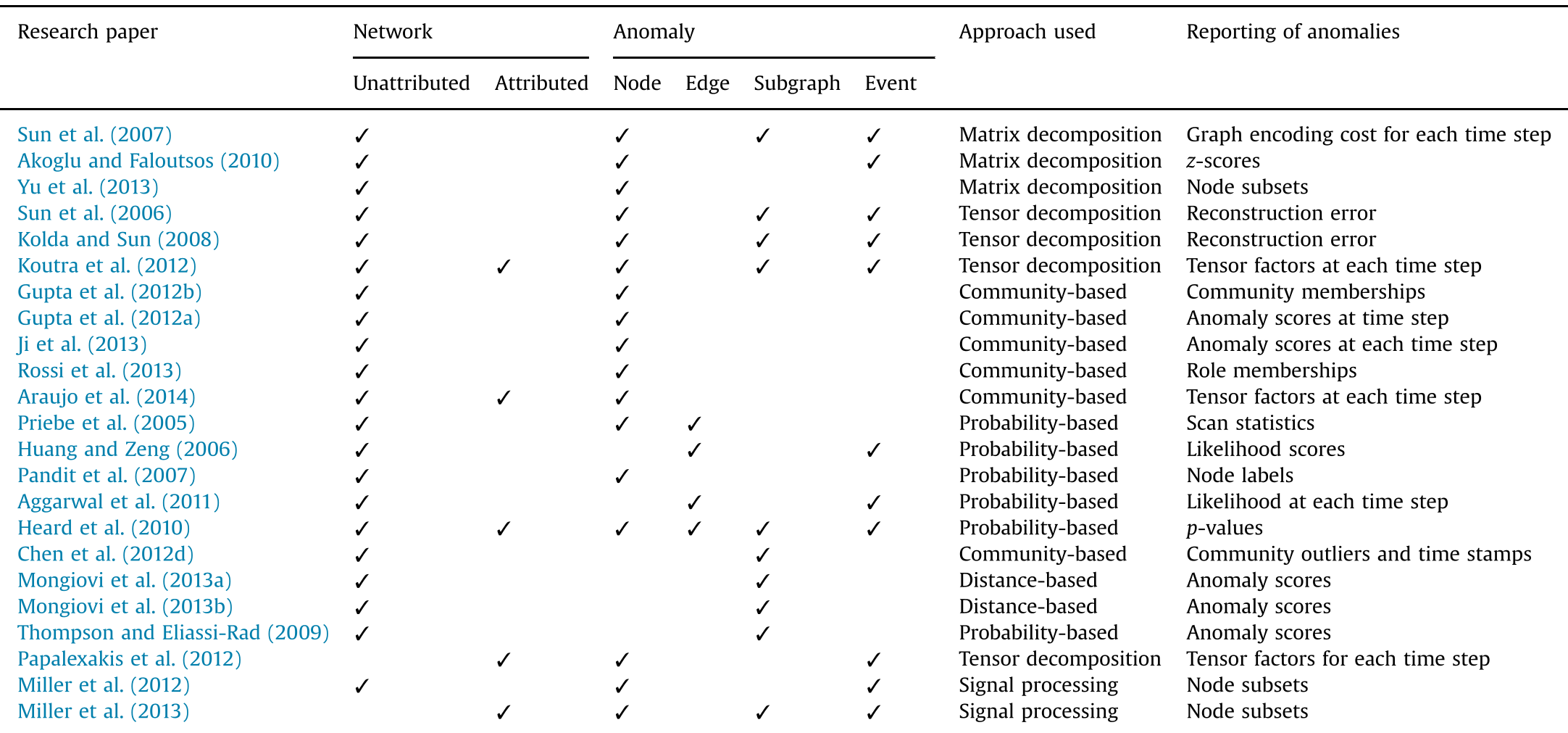 Table 1: Qualitative comparison of dynamic anomaly detection methods.
Critical Analysis & Conclusion
While the paper provides a masterclass in taxonomy, it reveals a glaring gap in the literature: Dynamic Attributed Networks. Most current methods can handle the graph shape changing, or the labels changing, but rarely both at the same time at scale.
The Takeaway: For the next generation of AI safety and digital forensics, we must move beyond simple graph snapshots. The future lies in Multi-layer Social Networks—tracking an actor's behavior across Twitter, Facebook, and LinkedIn simultaneously to find the hidden "signature" of a coordinated attack.
Limitations: The field suffers from a "Ground Truth" problem. Most papers use synthetic injections because real-world malicious data is rarely labeled, making apples-to-apples performance comparisons difficult.