
Heat Diffusion in Social Networks: A Thermal Physics Approach to Viral Marketing
Mining social networks using heat diffusion processes for marketing candidates selection
This paper introduces a novel framework for social network marketing by modeling information propagation as a Heat Diffusion Process. It proposes three diffusion models tailored for different network types and develops an "Enhanced k-Step Greedy Algorithm" to identify top influential candidates for viral marketing.
TL;DR
Researchers from the Chinese University of Hong Kong have repurposed classical thermodynamics to solve modern marketing problems. By treating "influence" as "heat," they've created a diffusion model that accounts for the timing of adoptions, network clusters, and—most importantly—the spread of negative reviews. Their Enhanced k-Step Greedy Algorithm provides a mathematically robust way to pick marketing "seeds" that maximize reach while avoiding redundant targeting.
Problem & Motivation: Beyond "Coarse" Marketing
Why do some products go viral while others flop? Early marketing models (like the Bass model) were purely descriptive; they could show you the "S-curve" of adoption after the fact but couldn't help you pick which 20 people to give samples to today.
The authors identified three critical gaps in previous SOTA (State-of-the-Art) research:
- Temporal Neglect: Adoption isn't instantaneous; it happens in waves.
- Community Blindness: Selecting the "most connected" people often leads to targeting the same friend group (cliques), wasting resources.
- The "Negative" Factor: In the real world, a bad review is often more powerful than a good one. Most models assumed every adopter becomes a positive advocate.
Methodology: The Physics of Influence
The core innovation is the application of the Heat Equation to a social graph. In physics, heat flows from high-temperature zones to low ones. In social networks, "innovators" act as heat sources.
The Heat Diffusion Equation on Graphs
The paper translates the second-order differential equation into a matrix form suitable for social graphs: Where:
- : The "influence level" (temperature) of users at time .
- : The Laplacian-like matrix representing the network structure.
- : Thermal conductivity (how fast news travels in that specific network).
Architecture & Selection
The authors propose the Enhanced k-Step Greedy Algorithm. Unlike naive sorting, this algorithm recalculates the "heat" of the entire network every time a new candidate is picked. This ensures that the next person chosen provides the maximum uncovered influence.
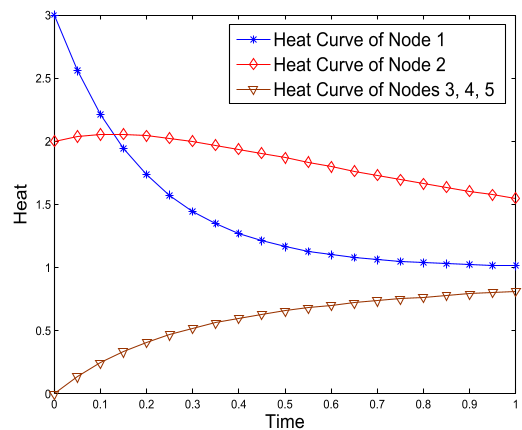 Figure 1: Visualization of heat diffusing from sources (Nodes 1 & 2) to the rest of a small social graph over time.
Experiments & Results: Performance on Epinions
The model was tested on a massive crawl of Epinions, a "Web of Trust" where users explicitly trust or block others.
Key Findings:
- Superior Coverage: The Enhanced Greedy method significantly outperformed the "Top-k" approach (which just picks the most popular people).
- Community Distribution: The algorithm automatically spread candidates across different network communities rather than huddling them in one "hot" spot.
- Scaling: By using discrete approximations, the complexity remains , where is the number of edges, making it scalable to millions of users.
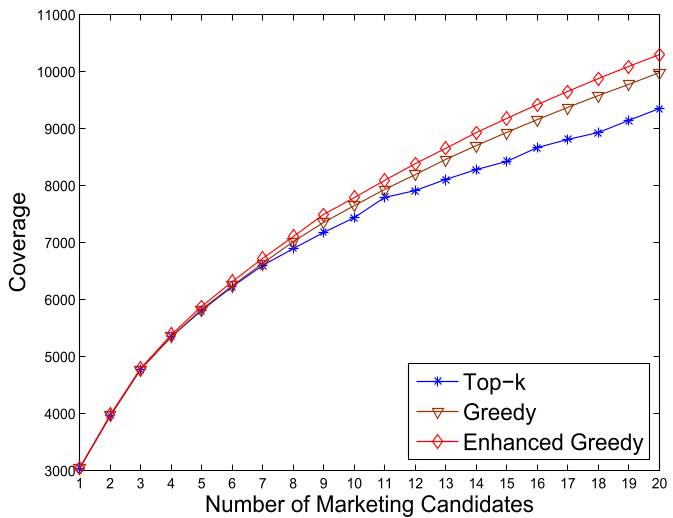 Figure 2: Performance (Coverage) comparison showing the Enhanced Greedy algorithm (diamond line) consistently outperforming baselines as the number of samples () increases.
Defending Against the "Haters"
The paper is a pioneer in modeling negative influence. If a chosen candidate dislikes a product, they diffuse "cold" (negative heat), suppressing the adoption of their neighbors. The authors proposed a defense: identifying "complementary" candidates near the hater to neutralize the negative signal with positive reinforcement.
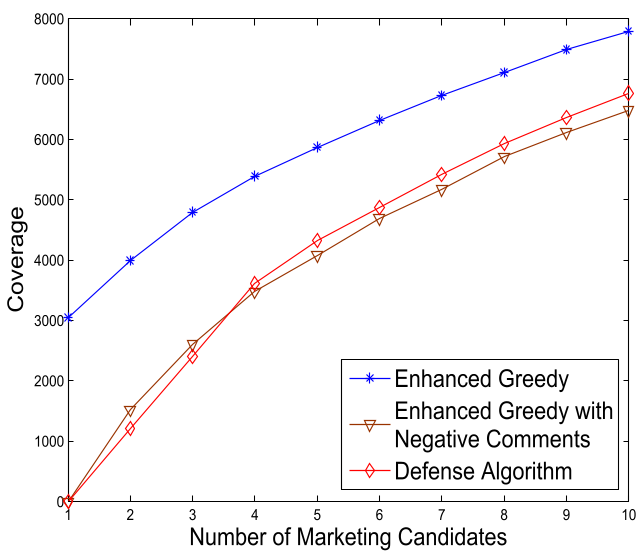 Figure 3: The impact of negative information on adoption and the effectiveness of the proposed defense heuristic.
Critical Analysis & Conclusion
Takeaway: This work proves that physical diffusion models are not just analogies—they are computationally efficient tools for predicting information flow. By incorporating a time factor (), it allows marketers to plan multi-phase campaigns rather than "shotgun" approaches.
Limitations: The model currently treats the social network as static. In modern contexts (like TikTok or X), the network topology changes hourly. Future work needs to integrate Dynamic Graph updates into the diffusion kernel.
Future Outlook: The concept of "negative diffusion" is more relevant today than in 2008. Applying this heat-diffusion defense to modern social media "echo chambers" to combat misinformation remains a high-value research path.