
Mining Social Networks: The Secret to Solving Email Overload
Mining social networks for personalized email prioritization
This paper introduces a personalized email prioritization (PEP) framework that combines lexical content with social network features. By utilizing Newman clustering, centrality measures, and a novel Semi-supervised Importance Propagation (SIP) algorithm, the system ranks emails into five importance levels while maintaining strict user privacy.
TL;DR
Researchers from Carnegie Mellon University have developed a way to prioritize your inbox by looking at who sends you messages, not just what they say. By building a personal social graph for every user, their system can predict message importance with significantly higher accuracy than text-only filters, even with very few labeled examples.
The Motivation: Why Your Inbox is a Mess
Email is a victim of its own success. Unlike a phone call, which requires synchronous attention, anyone can "flood" your inbox at zero cost. Previous attempts at Personalized Email Prioritization (PEP) failed because they either ignored the user's social context or required massive datasets that violated personal privacy.
The authors identify a specific technical hurdle: Data Sparsity. If your boss sends you a message from a new project-specific alias, a traditional system might ignore it. But in a social network, that alias is connected to people you already know—this "social link" is the key to smarter prioritization.
Methodology: Beyond Bag-of-Words
The core innovation lies in the Enriched Vector Representation. Instead of just looking at keywords, the SVM classifier receives three types of "Social Intelligence":
1. Social Clustering (The Newman Algorithm)
The system groups your contacts into "clusters" (e.g., family, project team, bowling club) using the Newman clustering method. If a member of your "Inner Circle" cluster sends an email, the system can infer its importance even if you've never interacted with that specific sender before.
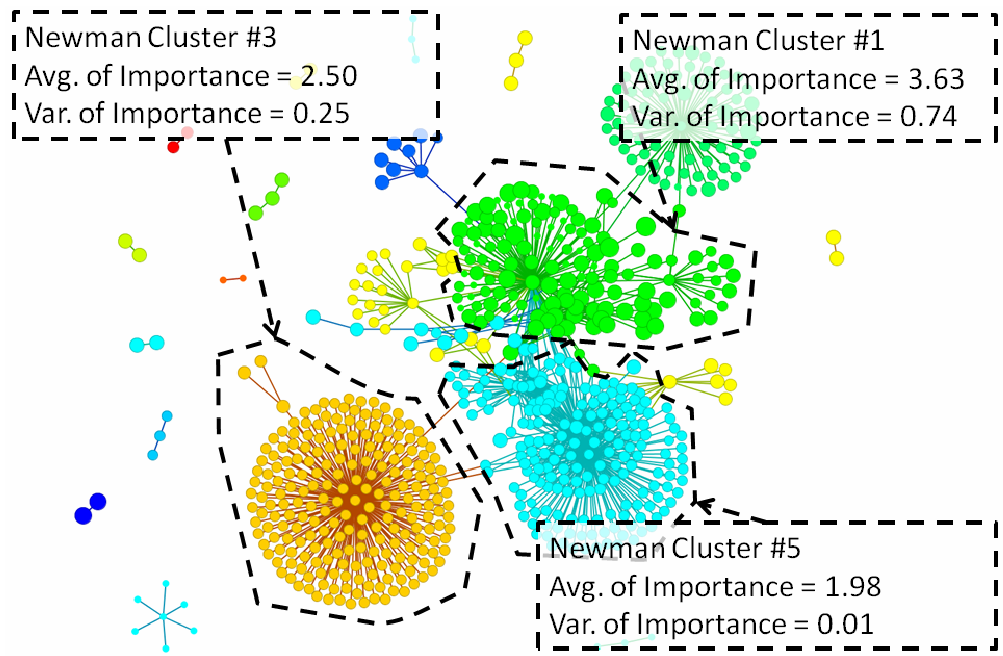 Figure 1: Visualization of a user's contact clusters. Node size reflects the average importance of cluster members.
2. Social Importance (Centrality Metrics)
The paper employs eight different graph metrics to identify "VIPs" in your network:
- In-Degree/Out-Degree: How many people they talk to.
- Betweenness: Do they act as a bridge between different social groups?
- HITS Authority: A recursive metric similar to PageRank that identifies influential figures.
3. Semi-supervised Importance Propagation (SIP)
This is the "secret sauce." The authors treat email interactions as a Bipartite Graph (Nodes = People and Messages).
- If a Message is labeled important, that "importance" flows to the Sender.
- The Sender then distributes that importance to all other Messages they have sent.
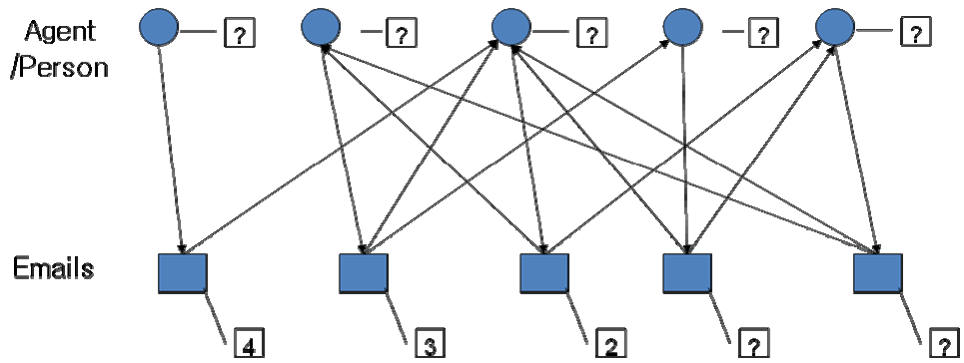 Figure 2: The bipartite graph model showing the propagation of importance labels between people and messages.
Experiments & SOTA Results
The researchers didn't just test this in a lab; they recruited real users (faculty, staff, and students) to label their actual inboxes. The results were clear: Text (BF) is not enough.
- Micro-average MAE: 31% error reduction.
- Macro-average MAE: 14% error reduction.
The study found that "Social Importance" (SI) features were the most powerful when users had provided very little training data (the 20-50 email range), making the system usable almost immediately.
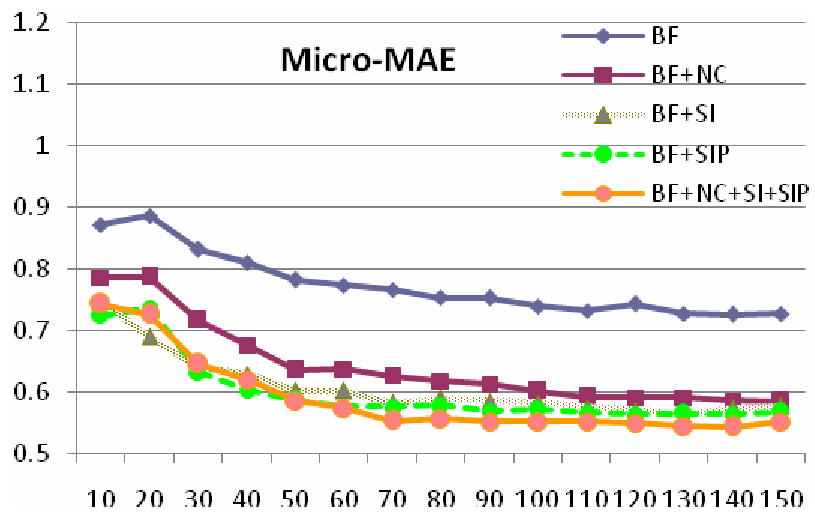 Figure 3: Error reduction curves showing that the combination of features (BF+NC+SI+SIP) consistently outperforms text-only baselines (BF).
Conclusion: The "Personal" in Personalization
This paper serves as a blueprint for privacy-preserving AI. By running the social analysis locally on a user's own data, we can achieve high-performance prioritization without "leaking" private data to a central server.
Future Outlook: As we move into an era of LLMs, this work reminds us that the structure of our human relationships is often just as informative as the content of our conversations. Future agents should not just read our emails; they should understand our social world.