
Mining Social Networks with Wave Physics: A Stable Approach to Information Tracing
Mining social networks using wave propagation
The paper introduces a novel framework for mining large-scale social networks using a Wave Propagation model. By treating information flow as a physical wave, the authors effectively address the Message Broadcasting and Rumor Spreading (source detection) problems in both undirected and directed graphs.
TL;DR
Information in social networks behaves less like spreading heat and more like propagating waves. This paper proposes a Wave Propagation model to simulate how messages travel through large networks. By leveraging the physical properties of waves, the authors solve the Message Broadcasting problem (who should start the message?) and the Rumor Spreading problem (who started the rumor?) with high scalability and mathematical stability.
The Problem: The Instability of "Heat"
In the realm of Viral Marketing and Social Network Analysis (SNA), researchers often use Heat Diffusion models. However, these models have a critical flaw: instability in reverse. If you treat a rumor like heat, trying to figure out where it started is like trying to un-mix cream from coffee—it is mathematically "ill-posed."
The authors argue that information sensitivity has an "amplitude" and a "velocity," making the Wave Equation a superior fit. Unlike heat, waves maintain a clearer "memory" of their origin, allowing researchers to run the simulation backward in time to find the original source.
Methodology: Social Physics
The core of the paper lies in mapping social actors to nodes and relationships to edges . The "Message Sensitivity" of each person is represented by an amplitude function .
The Forward Process
The message transmitting process is modeled using the discrete form of the Wave Equation: Where is the discrete Laplace-Beltrami operator. By transforming this into an iterative form, the model can simulate how a message moves from a CEO to directors, and then to managers, step-by-step.
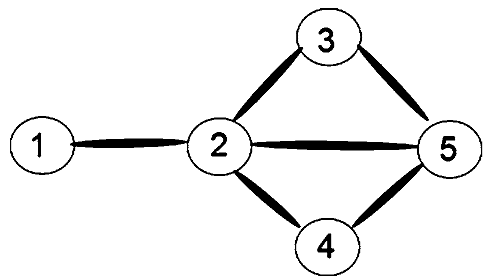 Figure: The basic interaction between nodes and the resultant wave amplitude curves showing message sensitivity over time.
The Inverse Process (Rumor Detection)
To find a rumor maker, the authors run the wave equation backward: The "Source" is identified at the specific point in time where the number of nodes with high amplitude is at its absolute minimum.
Experimental Evidence: The Enron Case Study
The authors applied their model to the famous Enron Email Dataset, consisting of over 36,000 email addresses.
1. Broadcasting Optimization
They aimed to find the most influential people to maximize message coverage. The results showed a "tipping point" dynamic: as simulation time increased slightly, the coverage grew exponentially, demonstrating the "clustering" properties the wave model captures.
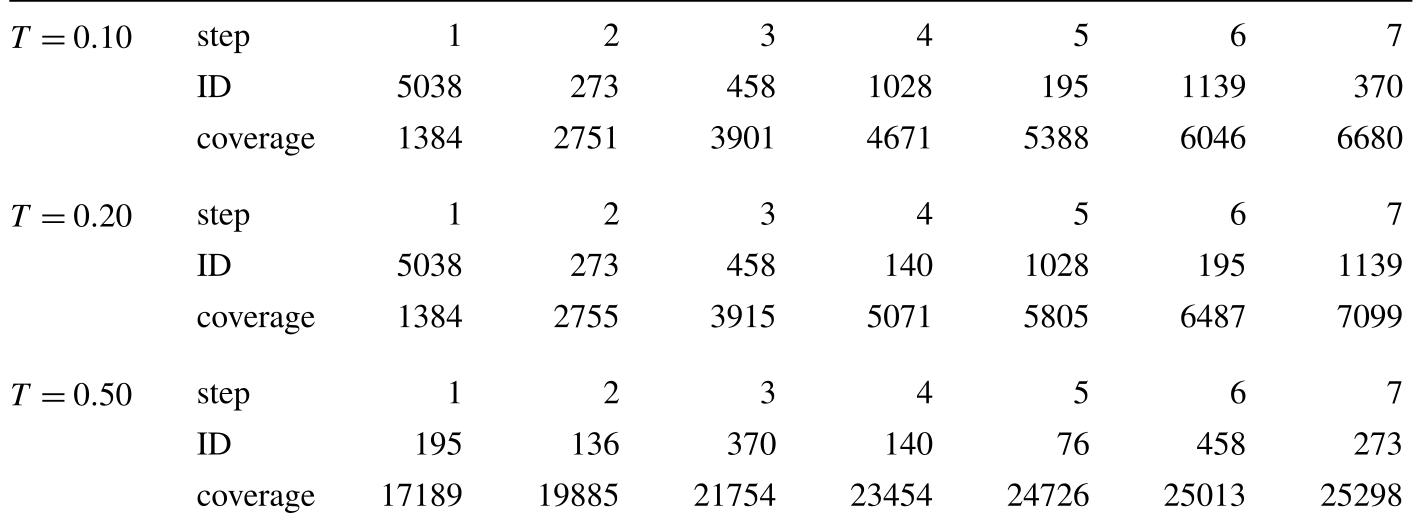 Table: Coverage vs. Time. Note how at T=0.5, 7 nodes can influence nearly 70% of the entire network.
2. Rumor Maker Detection
Starting from a "current state" where 29,901 nodes were aware of a rumor, the algorithm iteratively worked backward. It successfully filtered through the noise to pinpoint exactly two rumor makers (nodes 28521 and 28522).
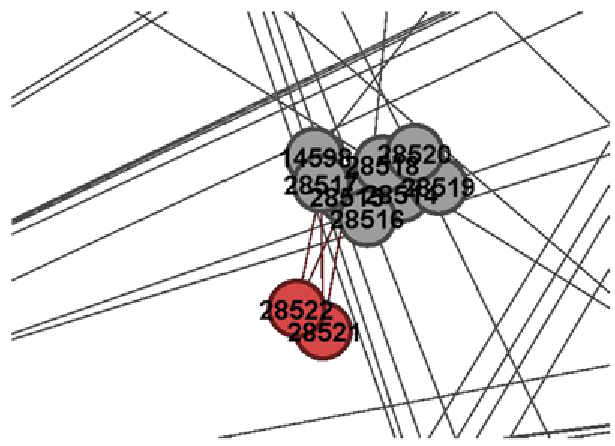 Visualizing the inverse process: Red nodes (active) decrease as the algorithm moves back to the initial sources (bottom right).
Critical Analysis & Takeaways
This work is a significant shift from purely statistical methods to a physics-informed approach to social networks.
- Scalability: The complexity is manageable for large datasets because the Laplacian is typically sparse.
- Stability: The most vital contribution is proving that the wave model satisfies the Courant-Friedrichs-Lewy condition, ensuring that the results don't "blow up" during computation.
- Limitations: The model assumes a constant wave velocity (), which might not reflect reality where some relationship "conduits" (e.g., close friends) transmit information much faster than others.
Future Outlook: Integrating this wave approach with modern Machine Learning (like Graph Neural Networks) could lead to highly accurate real-time monitoring of misinformation spreading on platforms like X (Twitter) or Mastodon.