
Mining the Stream: Real-Time Twitter Credibility through Generative Modeling
Mining Streaming Tweets for Real-Time Event Credibility Prediction in Twitter
This paper introduces a generative probabilistic model for real-time event credibility prediction on Twitter. By modeling individual tweets and community interactions (retweets/favorites) as a streaming generative process, the authors achieve high-accuracy credibility assessment without waiting for a complete event dataset.
TL;DR
Researchers from Georgia Tech have developed a probabilistic framework that predicts whether a trending Twitter event is true or false in real-time. Unlike traditional "post-mortem" analyses, this method uses a generative probabilistic model and online Bayesian updates to reach high-accuracy results (82%) using only a few hundred initial tweets, effectively "racing" against the speed of misinformation.
The "Lag" Problem in Rumor Detection
Social media is the heartbeat of real-time news, but it is also a breeding ground for rumors and "fake news." Historically, detecting these rumors required Offline Aggregation Analysis. Researchers would wait for an event to conclude, map out the entire retweet propagation tree, and then decide its validity.
The Problem: By the time you have a "complete set" of tweets to analyze, the rumor has already reached millions. We need a way to judge credibility while the event is unfolding.
Methodology: Capturing the "Generative DNA" of Tweets
The core insight of this paper is that a tweet's "DNA"—its author characteristics and content—differs fundamentally between true and false news. Furthermore, how the community reacts (the "feedback loop") is a strong signal.
1. The Generative Process
The authors model the label of an event () as a Bernoulli variable. Each message has a feature vector (registration age, followers, sentiment, URLs, etc.).
- If the event is True, is drawn from distribution .
- If the event is False, is drawn from distribution .
2. Community Reaction as a Signal
The model accounts for "Positive Feedback" (retweets/favorites). Interestingly, the research acknowledges that the community questions rumors more than true news. This is captured by a sigmoid function , where the weights represent how the community interacts differently with truth vs. falsehood.
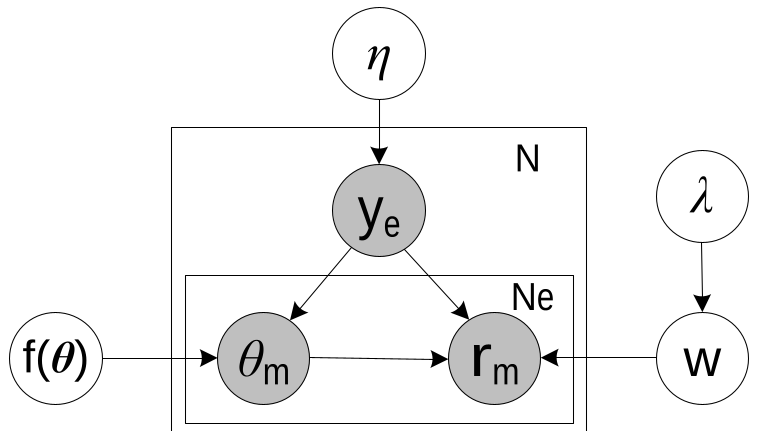 Figure 1: The probabilistic graphical model showing the relationship between event labels, features, and community feedback.
Real-Time Online Prediction
To avoid storing or reprocessing thousands of tweets, the authors use an Online Streaming Prediction Algorithm.
- Step 1: Initialize a prior for the event label.
- Step 2: As a batch of tweets arrives in period , calculate the posterior probability.
- Step 3: Use this posterior as the prior for the next time interval .
This recursive approach allows the system to update its "belief" in the truth of an event continuously.
Experiments & Results
The authors tested their model on a curated dataset of 104 events (52 true, 52 false) involving nearly 30,000 tweets.
Batch Performance
When given the full dataset, the proposed model achieved 82.3% accuracy, significantly higher than standard SVM (77.1%) or Decision Trees (72.5%).
The "Speed" of Accuracy
The most impressive result is the Online Convergence. As seen in the figure below, the accuracy jumps to nearly 78% within the first 200 tweets.
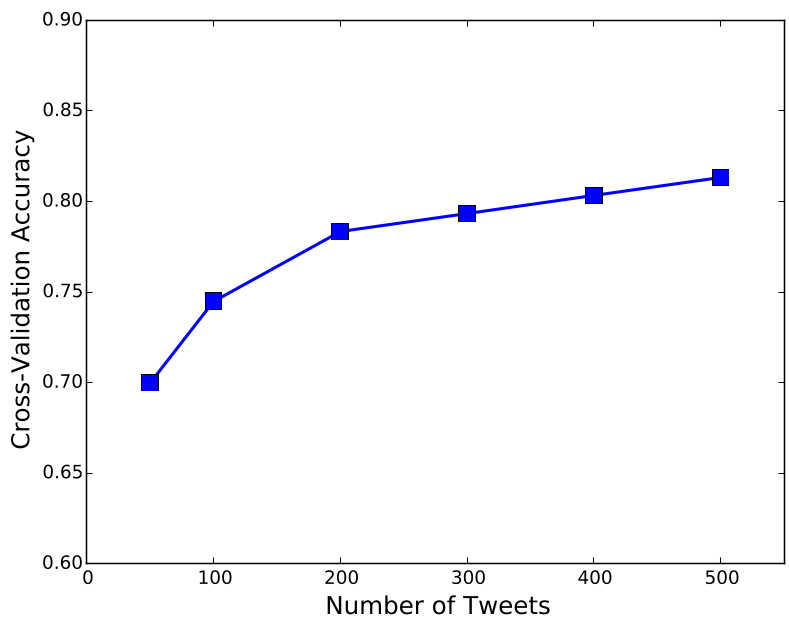 Figure 2: Accuracy vs. Number of Tweets. Note how quickly the model reaches its performance ceiling.
Critical Insight & Conclusion
By moving away from "topological" features (which require long-term observation) to "point-in-time" generative features, this model proves that misinformation has a distinct signature from its very first breath.
Limitations: The study relies on hand-crafted features (registration age, question marks) which can be gamed by sophisticated bot networks. Future work would benefit from incorporating Modern NLP (Embeddings) to capture more subtle linguistic nuances in the generative distributions and .
Final Takeaway: Real-time defense against rumors is mathematically feasible. We don't need to wait for the "tree" to grow to know if the "seed" is rotten.