
Predicting Habitual Venues: Mining User Check-in Features for LBSN Classification
Mining user check-in features for location classification in location-based social networks
This paper introduces a novel location classification task for Location-Based Social Networks (LBSNs) that predicts whether a user's first-time "new" check-in will evolve into a long-term frequent visit. Utilizing a Support Vector Machine (SVM) and 16 multi-dimensional features, the method achieves significant performance gains over traditional baseline models on the Brightkite dataset.
TL;DR
Can we predict if a user will become a "regular" at a coffee shop the very first time they check in there? This paper moves beyond simple location recommendation to Location Classification. By analyzing 16 features across global, social, and personal dimensions, the researchers developed an SVM-based model that identifies future "frequent" venues with high precision, outperforming standard baselines by over 60% in F1-score.
The Motivation: Habits vs. Randomness
In the world of Location-Based Social Networks (LBSNs) like Foursquare or Brightkite, our digital footprints reveal a stark reality: we are creatures of habit. While we might check into dozens of unique locations, 98% of those are "one-offs" or infrequent visits. Only 2 or 3 locations truly dominate our daily lives (e.g., home, gym, favorite office spot).
The authors argue that identifying these Frequent Check-in Venues early—specifically at the moment of the first check-in—is the "Holy Grail" for targeted advertising and personalized services. The challenge? The massive class imbalance. Since frequent venues are so rare (approx. 2% of total venues), a naive model could guess "not frequent" every time and be 98% accurate while being 100% useless.
Methodology: The Power of Personal Context
The researchers categorized potential predictors into three "Knowledge Areas":
- Global Knowledge (GK): How popular is this place among everyone?
- Friends' Knowledge (FK): Do the user's friends hang out here?
- User's Personal Knowledge (UK): Does this check-in fit the user's historical time and space patterns?
Feature Engineering & Architecture
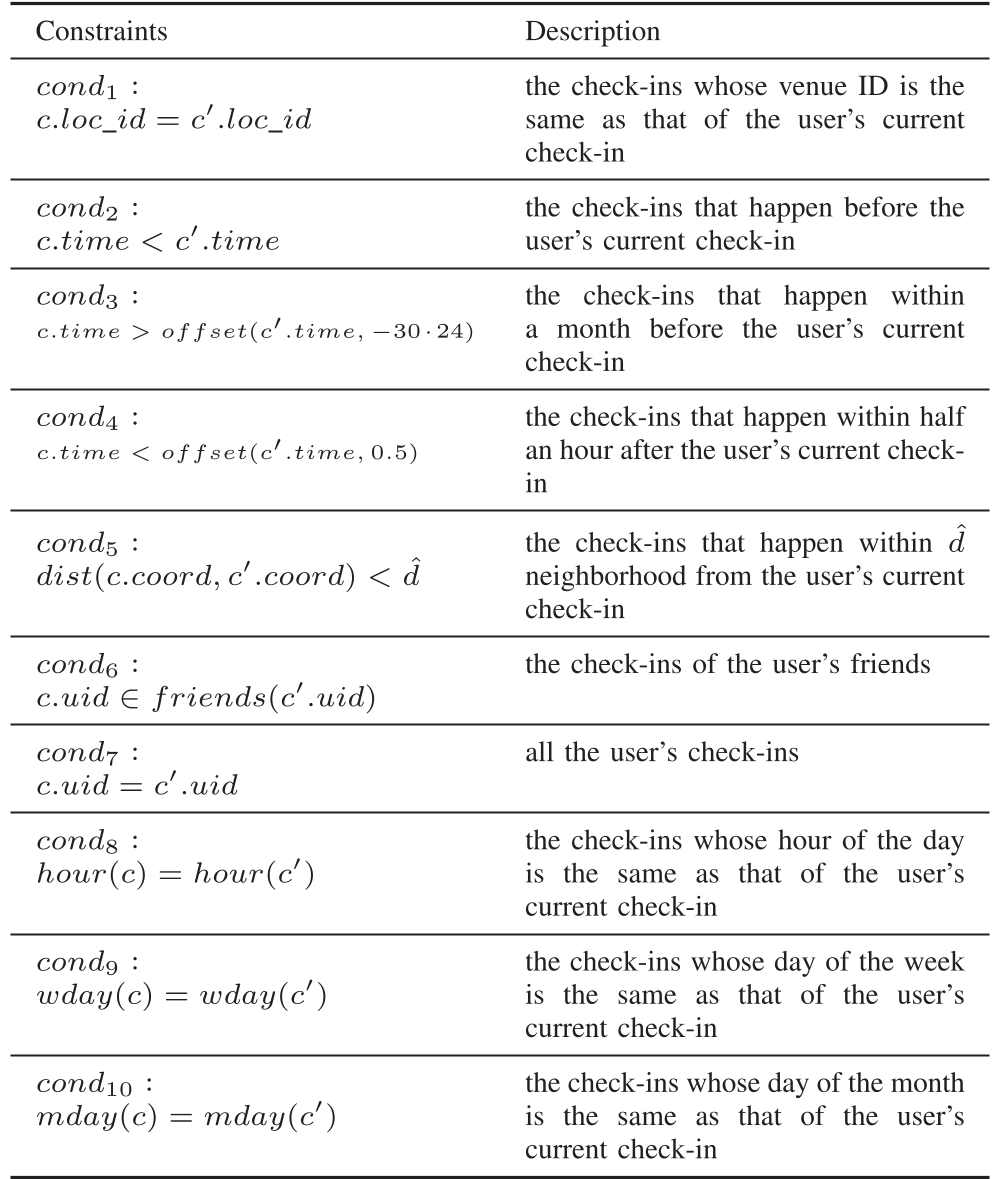
The authors defined 16 distinct features (e.g., historical check-in frequency at the venue, around the venue, and temporal distribution). They utilized a Support Vector Machine (SVM) due to its robustness against overfitting in high-dimensional spaces.
The "Top 4" Insight
Through Recursive Feature Elimination (RFE), a surprising finding emerged: Global popularity matters the least. The top 4 features that actually drive prediction are:
- HCFM'': Historical check-in frequency for the same Day of Month.
- HCFW'': Historical check-in frequency for the same Day of Week.
- RCF': Recent check-in frequency of friends at the venue.
- RCFN'': Recent check-in frequency of the user in the neighborhood.
This proves that habit formation is deeply tied to the user's personal temporal rhythm and the immediate influence of their social circle.
Experimental Results
The study used the Brightkite dataset (4.7 million check-ins). To combat the class imbalance, they employed SMOTE (Synthetic Minority Over-sampling Technique) to balance the training data.
Key Performance Metrics:
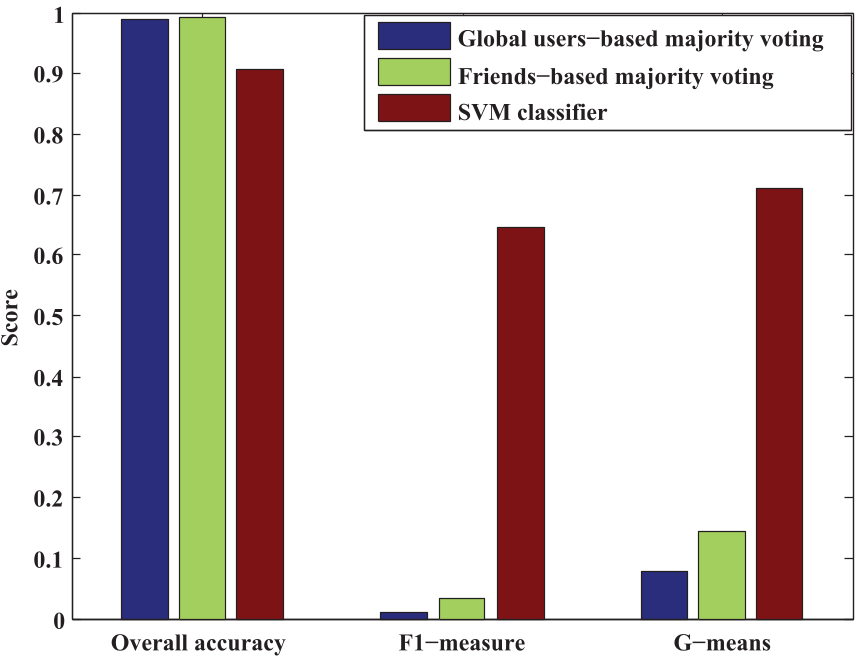
- F1-Measure Improvement: 61.1% to 63.5% over majority voting baselines.
- G-Means (Balance metric): 56.6% to 63.3% improvement.
- Accuracy: Maintained above 90% even with the challenging 1:50 class ratio.
The results showed that while friends' activity (FK) provides some "social proof" that a user might return, the individual’s own historical temporal patterns (UK) are the strongest indicators of future loyalty.
Critical Analysis & Future Outlook
This work successfully shifts the focus from "what is popular" to "what will be meaningful to this user."
Strengths:
- Feature Pruning: By identifying that only 4 features are truly necessary, the authors provide a computationally efficient path for real-time mobile applications.
- Imbalance Awareness: The use of G-means and SMOTE shows a sophisticated understanding of the pitfalls in LBSN data.
Limitations:
- Feature Staticity: The model relies on historical averages. It may not capture sudden lifestyle changes (e.g., starting a new job or moving house).
- Cold Start: For a brand-new user with no personal history (UK), the model's accuracy would likely drop significantly, falling back on the less effective Global Knowledge.
Takeaway for the Industry: If you are building a recommendation engine, stop looking at "trending" locations for all users. Look at the temporal alignment of a user's new check-in with their existing lifestyle patterns. If someone visits a new park on a Tuesday at 6 AM—a time they usually exercise—they are far more likely to return than someone visiting a "top-rated" bar at a random hour.