
TopicBlock: Unifying Text and Links via Latent User Inner Interests
Topic Block: Mining User Inner Interests for Text and Link Analysis in Social Networks
This paper introduces TopicBlock, a unified generative probabilistic model designed to mine user inner interests by jointly analyzing text corpus and link networks in social networks. By integrating Latent Dirichlet Allocation (LDA) for content and Mixed Membership Stochastic Blockmodels (MMSB) for topology, it achieves state-of-the-art performance in both topic discovery and community detection.
TL;DR
Understanding user behavior in social networks requires looking at two things: what they say (text) and who they talk to (links). TopicBlock is a generative model that bridges these two worlds using a hidden concept called "User Inner Interests." By treating interests as the root cause of both content and connections, TopicBlock outperforms classical models like LDA and MMSB, especially in noisy and sparse environments.
Problem & Motivation: The Silo Effect in Social Mining
In the era of big social data, information is often sparse (few links) and noisy (random text). Traditionally, researchers used LDA for topics or MMSB for communities. However, these methods operate in silos:
- Text-only models ignore the social structure that influences what people discuss.
- Link-only models miss the semantic context that explains why a connection exists.
The authors argue that topics and communities are two sides of the same coin—User Interests. Without a unified model to tie them together, we lose the "why" behind the data.
Methodology: The Core Architecture
TopicBlock integrates the strengths of content modeling and structural modeling. The generative process assumes a user first draws an "inner interest" distribution, which then dictates both the words they write and the links they form.
The Generative Logic
- Step 1: For each node, sample an interest vector from a Dirichlet prior.
- Step 2 (Links): Use to sample community indicators for pairs of nodes, determining the probability of a link based on a community interaction matrix .
- Step 3 (Text): Use the same to sample topic assignments for words in the user's documents.
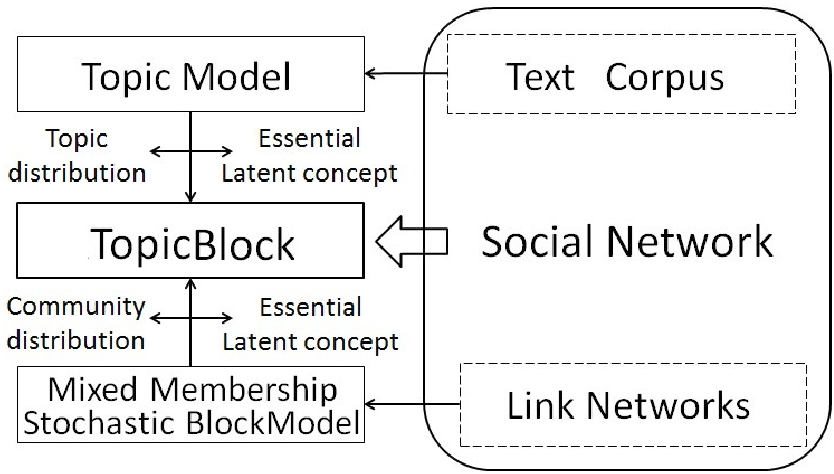 Figure 1: The TopicBlock Framework connecting LDA and MMSB.
The Scaling Factor ()
A unique feature of TopicBlock is the parameter , which acts as a weight to balance text vs. link information. The authors found that text often contains richer information, so setting between 2 and 3 usually yields optimal results.
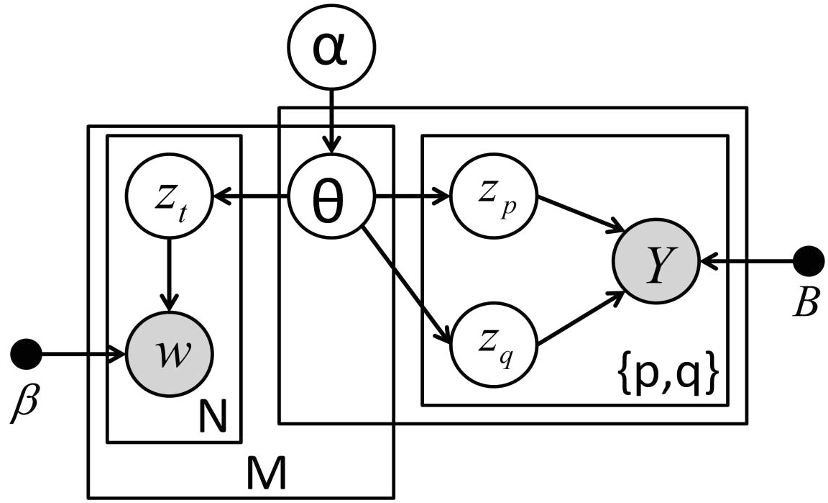 Figure 2: The PGM showing how latent interests influence both (words) and (links).
Experiments & Results
The model was tested on three datasets: Enron (emails), Author Collaboration, and CiteSeer (citations).
1. Superior Link Prediction
TopicBlock achieved significantly lower perplexity in link analysis compared to the Relational Topic Model (RTM). This suggests that by understanding the "interests" of a user through their text, the model can much more accurately predict who they will link to in the network.
2. Meaningful Communities
In the CiteSeer experiment, TopicBlock didn't just find clusters of nodes; it found clusters with meaning. For example, "Community 4" was naturally associated with top words like reinforcement, learning, and approach, matching the actual research labels in the dataset.
 Table 1: Perplexity comparison across three datasets. Lower is better.
Critical Analysis & Conclusion
Takeaways
TopicBlock proves that modeling the latent intent (interest) is more effective than simply concatenating text and link features. It provides a mathematically rigorous way to handle the heterogeneity of social networks.
Limitations & Future Work
The model is currently static. Social interests evolve over time (e.g., a student's interests change after graduation). The authors acknowledge that the next frontier is incorporating temporal information to create a dynamic version of TopicBlock.
For practitioners in recommendation systems or social group discovery, TopicBlock offers a blueprint for how to leverage "multi-source" social data to build more accurate user profiles.