
Mining the Real Social Circle: Beyond the Clutter of Microblog Follower Lists
Mining User's Real Social Circle in Microblog
This paper introduces an ego-centric community detection algorithm to identify a user's real-world social circles on Sina Weibo. By utilizing bilateral following relationships and shared neighbor densities, the method automatically groups friends into multiple circles, achieving an absolute 14% improvement in F-measure over K-means.
TL;DR
Microblogging platforms like Sina Weibo are often a chaotic mix of celebrity updates, news media, and genuine personal interactions. This paper presents an algorithm designed to cut through the noise by identifying a user's real social circles—grouping actual friends into categories like "classmates" or "colleagues" based on the density of their mutual bilateral connections.
Positioning: This work is a targeted improvement in Personalized Community Detection, moving away from global network analysis to a user-centric (ego-network) perspective.
The "Celebrity" Problem in Social Graphs
Most social media algorithms treat "following" as a generic edge in a graph. However, the authors argue that microblogs are unique: they are both social networks and news media. A user might follow 500 accounts, but 450 of them could be one-way "parasocial" relationships with celebrities or news outlets.
The real challenge lies in:
- Isolating Genuine Friends: Only bilateral (two-way) follows usually signify real-world acquaintances.
- Handling Overlap: A "high school friend" might also be a "current colleague." Traditional clustering methods like K-means often struggle to place one person in two distinct circles simultaneously.
Methodology: The Math of Mutual Friends
The core insight is that a "social circle" in the real world is essentially a complete graph (where everyone knows everyone). On microblogs, this translates to an approximate maximum complete cluster.
The Ranking Mechanism
The algorithm first filters for bilateral friends and then ranks them based on a similarity score , which is the count of common neighbors shared with the central user.
Dynamic Cluster Assignment
Instead of forcing every user into a single bucket, the algorithm uses a normalized distance metric to decide if a new user "fits" into an existing circle based on their familiarity with the members already inside.
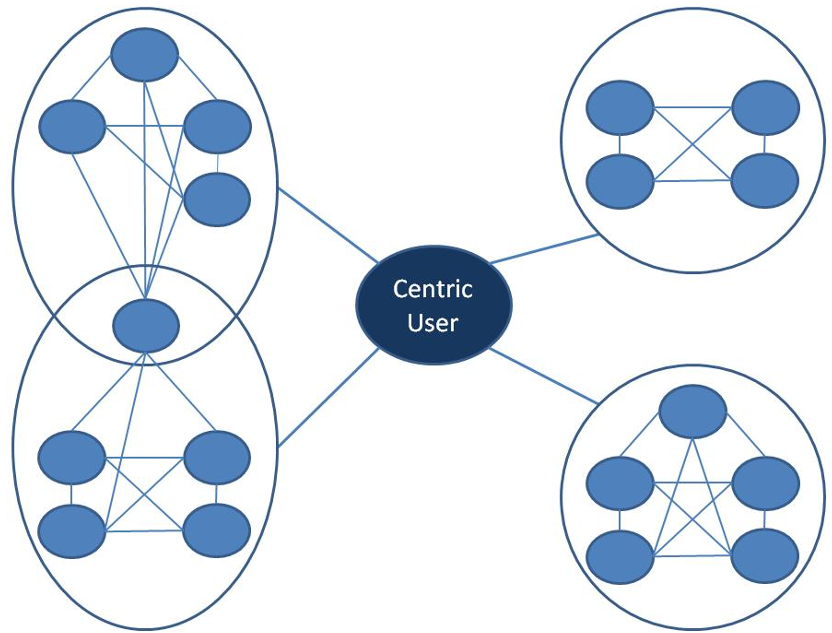 Figure 1: Visualization of how a central user connects multiple distinct but overlapping social clusters.
Validating with "Weibo Group Picture"
To move beyond theoretical math, the authors built a real Weibo application. This allowed users to see their predicted circles (visualized as bunches of balloons) and manually correct them.
Performance vs. Baselines
The researchers compared their approach against K-means clustering. While K-means is a standard for grouping data, it falters in social networks because it cannot easily handle the overlapping nature of human relationships and requires a pre-defined (number of clusters).
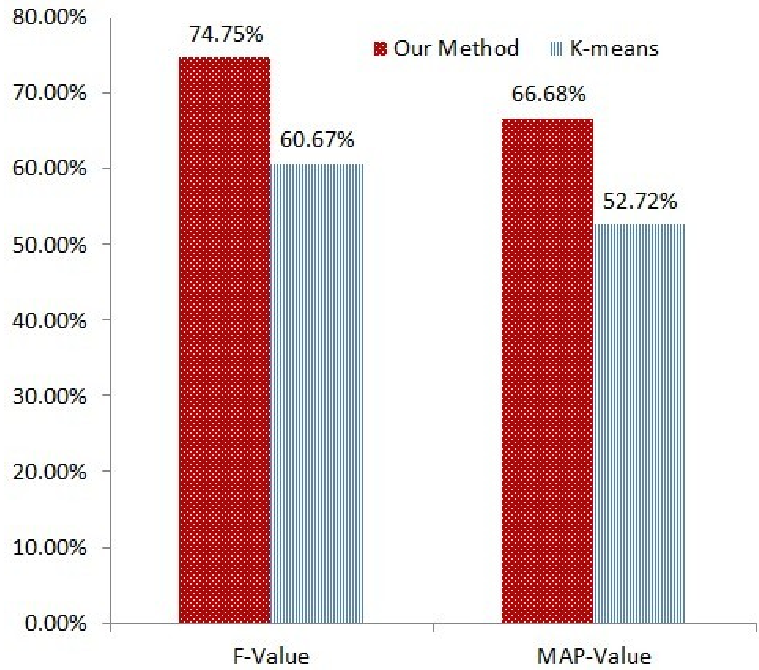 Figure 2: The proposed method shows a clear 14% lead in both F-measure and Mean Average Precision (MAP) over traditional clustering.
Depth Insights & Conclusion
Key Takeaways
- Bilateral follows are the signal; one-way follows are the noise. If you want to find a user's "real" world, look at who follows them back.
- The Threshold of "Friendship": The study found that a similarity threshold () of 0.4 provides the best balance between including actual friends and excluding "friends of friends" who aren't part of the immediate circle.
Limitations & Future Work
While the structural analysis is powerful, it ignores the content of what people post. The authors plan to integrate textual information (NLP) in future iterations to distinguish circles even more accurately—for example, by noticing that one group primarily discusses "coding" while another discusses "soccer."
This research provides a vital step toward creating more "human-centric" social media feeds, where interactions with close friends are prioritized over the endless noise of public broadcasts.