
Mirror Mirror: Crowdsourcing Better Portraits through Active Learning
Mirror mirror: crowdsourcing beer portraits
The paper introduces "Mirror Mirror," a system that uses crowdsourcing and computer vision to evaluate and select attractive facial expressions. By training single-subject and cross-subject regression models on pairwise comparisons, the system provides real-time feedback and automatically identifies the most flattering portraits from large video or photo collections.
TL;DR
"Mirror Mirror" is a pioneering framework designed to help users solve the universal problem of "looking bad in photos." By combining crowdsourced human preferences with machine learning, the researchers developed a system that can predict how attractive a specific facial expression will appear to others. The system doesn't just find smiles; it identifies the subtle muscular movements that make a face look genuine and flattering across different levels of "seriousness."
The "Anxiety of the Lens": Problem & Motivation
Most individuals experience a disconnect between how they feel they look and how they actually appear in photographs. Professional models are trained to manage this, but the average person lacks a feedback loop. While we have tools to fix a photo after it’s taken (e.g., Photoshop, filters), these often feel artificial.
The authors' core insight is that attractiveness is not binary. A "big smile" isn't always the most attractive expression—sometimes a serious, confident gaze for a professional profile is better. However, identifying these "best" versions of ourselves requires external validation, which is where crowdsourcing becomes the ultimate ground truth.
Methodology: The Science of the Perfect Smile
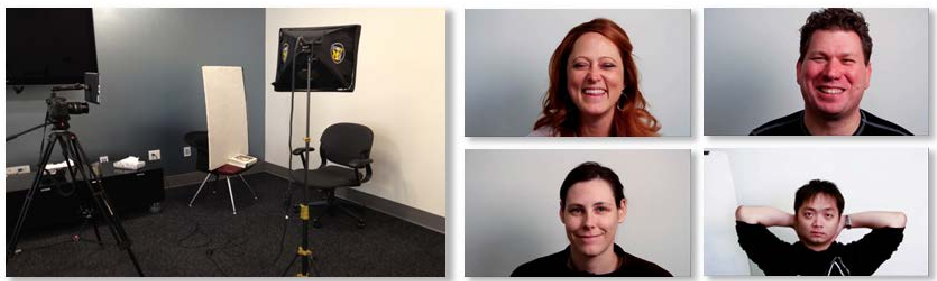
The pipeline begins by capturing a 12-minute video of a subject reacting to various prompts. This ensures a wide "manifold" of natural expressions rather than forced poses.
1. Feature Extraction and Alignment
The system tracks nine facial landmarks to normalize pose and extract Histograms of Oriented Gradients (HOG). These features are specifically weighted—the mouth region is weighted four times as much as other features to capture the nuances of a smile.
2. Active Learning for Efficiency
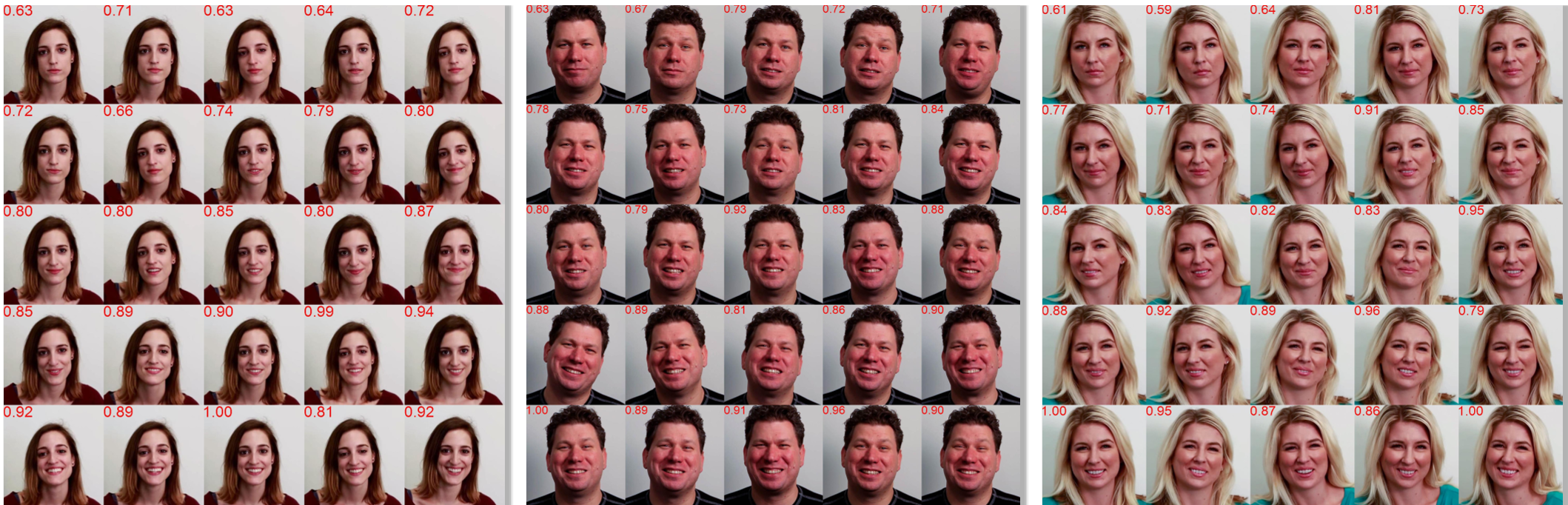
Asking the crowd to rank thousands of images is too expensive. The authors developed an Active Learning scheme that uses a "Cross-Subject" model (trained on previous people) as a prior. It then intelligently asks "the crowd" to compare only the most uncertain or most promising pairs of images. This reduces the cost from nearly 5 per person.
3. The Attractiveness-Seriousness Map
Instead of a single "beauty score," the system plots expressions on a 2D grid. The "Seriousness" axis allows users to find their best "CEO look" versus their best "party look."
Experiments & Results: Beyond Smile Detection
A critical finding of the paper is that standard smile detectors are not beauty detectors. A detector can tell if your mouth is open, but it can't distinguish between a "genuine" Duchenne smile and a "creepy" forced one.
The "Mirror Mirror" single-subject model achieved a 0.88 correlation with human scores, whereas a simple smile/eye detector only hit 0.47.
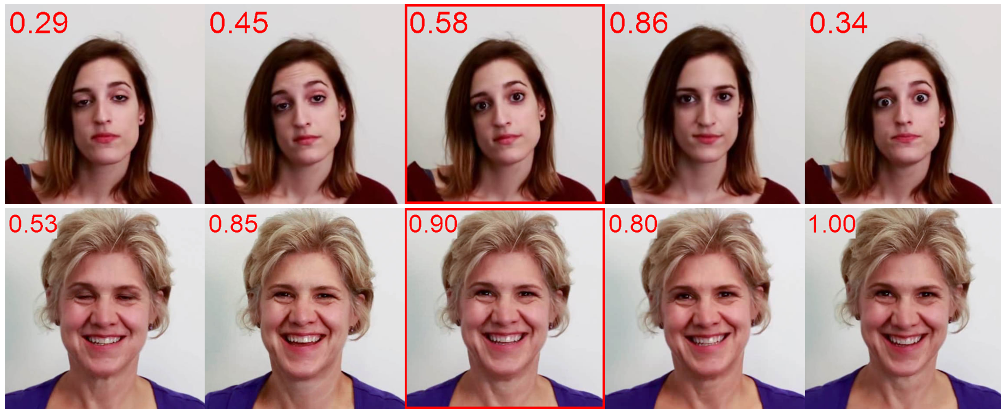
The researchers also discovered the "Squinching" phenomenon: highly attractive expressions often involve raising the lower eyelid slightly, making the eyes look focused rather than "drugged" or "surprised."
Critical Insight: Training the User, Not Just the Model
The most innovative application presented is the "Mirror Mirror" App. It functions as a digital coach. Users select a target "best expression" (validated by the crowd), and the app provides a real-time cross-fade overlay of their current webcam feed versus the target.
Limitations
- Diversity of Environment: The model focuses on facial muscles but doesn't yet account for lighting, hair, or angles.
- Cultural Subjectivity: Attractiveness is subjective and varies across cultures; the current crowd might have a specific Western bias.
Conclusion
This paper shifts the paradigm of computational photography. Instead of asking "How can we fix this bad photo?", it asks "How can we help the user be more attractive in the moment?". By quantifying the "je ne sais quoi" of a great portrait, the authors provide a bridge between clinical computer vision and the human experience of self-image.