
FADE: Exposing the "Plausible" Fake—Why Group Behavior is the Key to Stopping Misinformation
Misinformation Detection and Adversarial Attack Cost Analysis in Directional Social Networks
This paper introduces FADE (Fake Account Detection), a novel framework for identifying coordinated misinformation campaigns in directional social networks like Twitter. Unlike account-level methods, FADE utilizes a two-stage approach—similarity-based clustering followed by cluster classification—achieving SOTA performance in detecting accounts involved in information manipulation.
TL;DR
Social media "weaponization" has moved beyond simple spam bots to sophisticated campaigns where accounts appear individually human but act in a coordinated "choir." FADE (Fake Account Detection) breaks this orchestration by clustering users based on behavioral footprints—specifically account age and message similarity—and using group-wide statistics to unmask malicious clusters. It achieves an 84.7% accuracy on Twitter data, proving that coordination is the attacker's biggest vulnerability.
The "Reciprocity" Trap in Fake Account Detection
Most early sybil detection research assumed that fake accounts find it difficult to make "real" friends. In networks like Facebook, this reciprocal link is a strong defensive signal. However, on directional networks like Twitter or Weibo, any account can follow an influencer or a trending topic without the other party's consent.
The authors argue that in these environments:
- Individual Features are Deceptive: A bot can be programmed to tweet intermittently, use URLs sparingly, and have a unique bio.
- The Power of the Crowd: To gain influence, misinformation campaigns must trade "stealth" for "volume." They need many accounts saying similar things at similar times to overwhelm the truth.
Methodology: The "Separate and Classify" Insight
FADE's core innovation is moving away from the binary "fake vs. real" clustering. Instead, it creates hundreds of small clusters based on a Heterogeneous Feature Similarity Score (HFSS).
1. The Strategy
The system uses Bayesian Optimization to find the "Goldilocks" weights for cluster features. Surprisingly, the research found that Account Creation Time (CreatedTime) and Message Stream Similarity (SourceClaim) are the most potent signals. Features like "Follower Count" or "Reputation" were actually noisy and less effective for initial clustering.
2. Architecture Overview
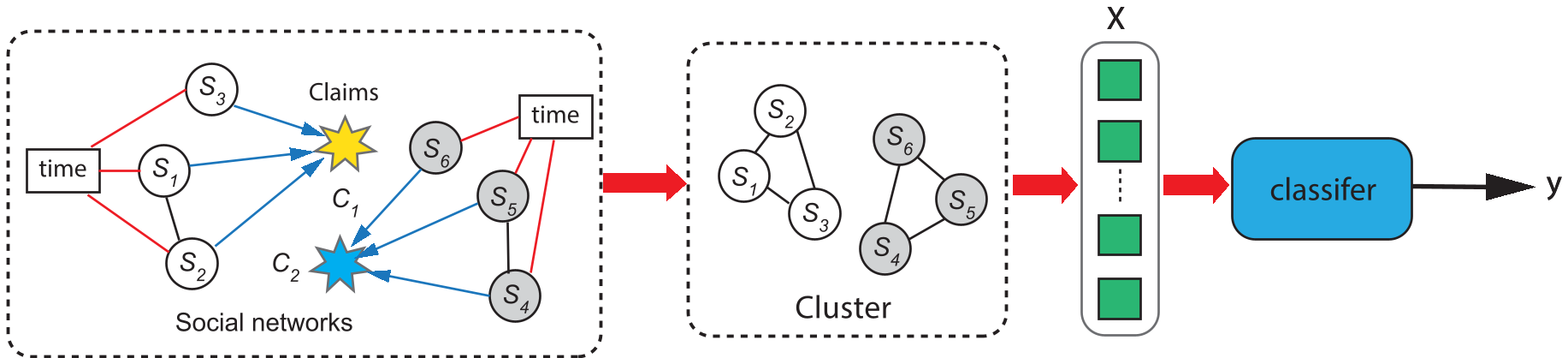
The process follows a clean pipeline:
- Clustering: Grouping users into clusters based on .
- Aggregation: Calculating the mean and variance of features within each cluster.
- Classification: A Random Forest model labels the entire cluster as "Fake" or "Benign." Because it looks at the group average, individual outliers don't trip the system.
Experiments & Real-World Impact
The researchers tested FADE against Twitter datasets involving ISIS campaigns and the Mosul Battle.
SOTA Comparison
As shown in the table below, FADE (RF-FADE) significantly outperformed the digital DNA sequences and simple SVM/Decision Tree models that look at accounts individually.
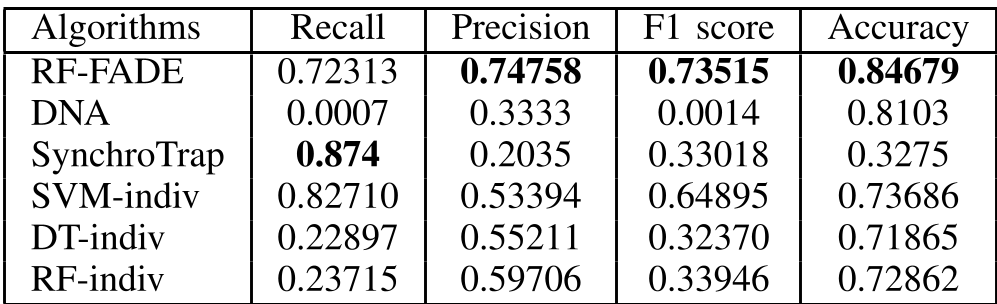
- Precision and F1: FADE achieved the highest overall balance (F1-score of 0.735).
- Real-time Efficacy: The system even caught "sleeper" accounts involved in the 2019 India election stream that Twitter's internal systems had not yet suspended.
The Economics of Evasion: High Attack Costs
The most profound part of this study is the Adversarial Attack Cost Analysis. To beat FADE, an attacker must do two things that are economically "expensive":
- Maintenance Cost: They must create accounts hundreds of days in advance to avoid "creation-time similarity."
- Plausibility Cost: They must send a vast amount of "noise" (real data) to dilute their similarity to other bots.
The graph shows that to reduce detection accuracy by just 15%, an attacker needs to maintain accounts for 100+ days and post 20+ "normal" messages for every 2 misinformation tweets—essentially increasing their operational overhead by 10x.
Deep Insight & Conclusion
FADE proves that context is collective. By aggregating user features, the variance of "noisy" individual signals is smoothed out, leaving the underlying campaign structure exposed.
Limitations: The reliance on hand-crafted features makes it a target for eventual "feature engineering" by sophisticated state actors. Future Outlook: The authors suggest moving toward Graph Neural Networks (GNNs) to automatically learn these coordination patterns, likely removing the need for manual feature selection entirely.