
Decoding the Young Reader: Advanced Mispronunciation Detection in Children's Speech
Mispronunciation Detection in Children's Reading of Sentences
This paper presents a two-stage framework for automatic mispronunciation detection in children’s oral reading, combining a syllable-based HMM-GMM segmentation stage with a multi-feature classification stage. The approach successfully tracks repetitions, false starts, and intra-word pauses, achieving a word error rate (WER) near 2% and significantly improving mispronunciation detection via multi-feature fusion.
TL;DR
Building an AI reading tutor for children is notoriously difficult because kids don't just "mispronounce" words—they stutter, repeat syllables, and pause mid-word. This paper proposes a robust two-stage system: first, a syllable-based segmentation that flawlessly handles disfluencies, and second, a multi-feature classifier that combines acoustic likelihoods with phonetic edit distances to catch errors that standard models miss.
The "Child Speech" Problem: Beyond Standard ASR
Standard Automatic Speech Recognition (ASR) systems are trained on adult speech, which is generally fluent. Children, especially those aged 6-10, exhibit unique patterns:
- Intra-word pauses (IWP): Reading "e-le-tri-ci-dade" syllable by syllable.
- False starts (PRE): Starting a word, stopping, and restarting.
- High Acoustic Variability: Developing vocal tracts lead to inconsistent phonemes.
Prior SOTA methods often treated these as "noise" or used word-based HMMs that failed when a child paused for 200ms in the middle of a word.
Methodology: The Two-Stage Approach
1. Syllable-Based Segmentation
Instead of forcing the model to recognize full words, the authors break the prompt into syllables. The decoding grammar allows optional silence between every syllable. This "loose but constrained" approach ensures that even if a child struggles through a word, the system can still align the attempt to the correct reference word.
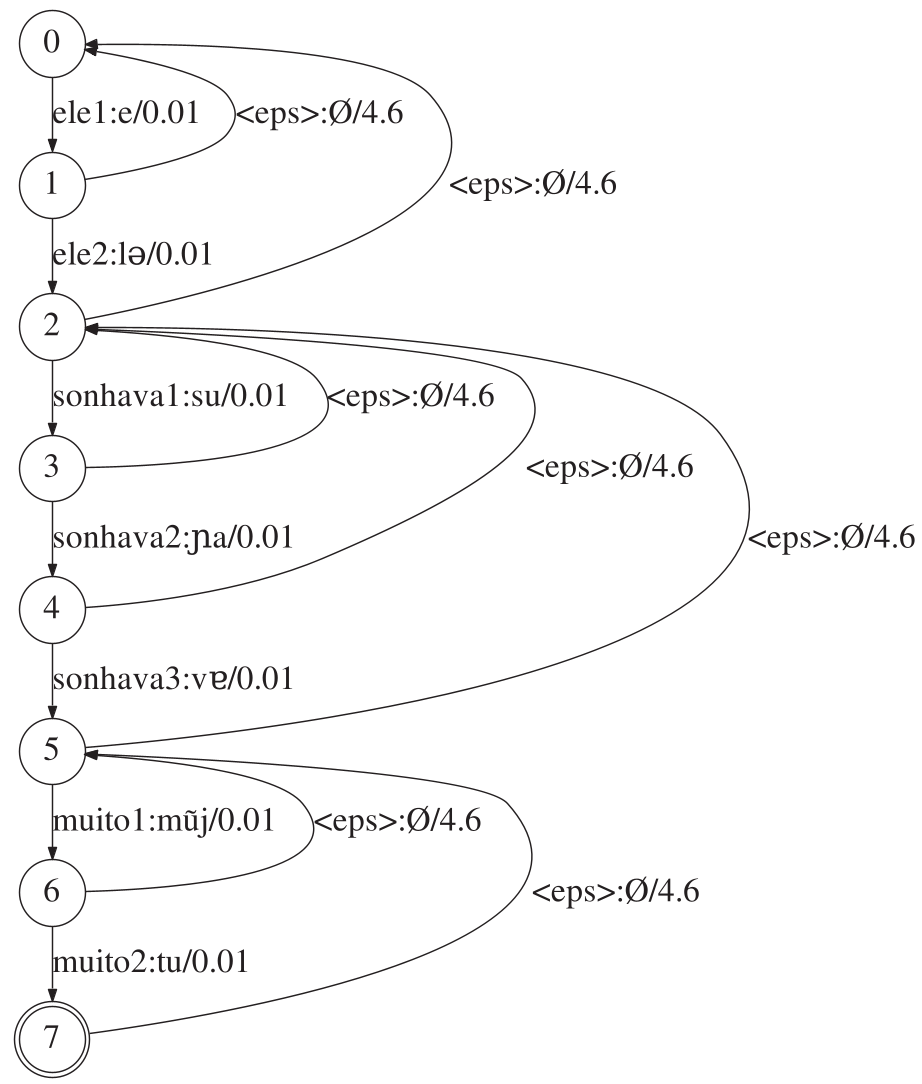 Figure: The syllable-based lattice allows for repetitions and intra-word silences, drastically reducing WER.
2. Multi-Feature Classification (The "Secret Sauce")
Once a segment is found, the system doesn't rely on just one metric. It calculates:
- LLR-spotter: A log-likelihood ratio that finds the best "fit" for a word in a specific audio window.
- Phonetic Lattice (PL) Distance: A clever constrained decoder that asks: "If I force the model to try and hear the correct word, how much does the actual audio deviate?"
- GOP (Goodness of Pronunciation): Traditional state-level posterior probabilities.
Experiments & Results
The researchers tested their system on the LetsRead corpus (European Portuguese).
Alignment Performance: The syllable-based approach achieved a Word Error Rate (WER) of 2.17%, significantly better than baseline word-aligners.
Mispronunciation Detection: The most striking result came from feature fusion. While a single LLR-spotter feature is a strong baseline, combining it with Levenshtein distances and GOP metrics via a Neural Network reduced the miss rate from 34.03% to 27.79% (at a fixed 5% False Alarm rate).
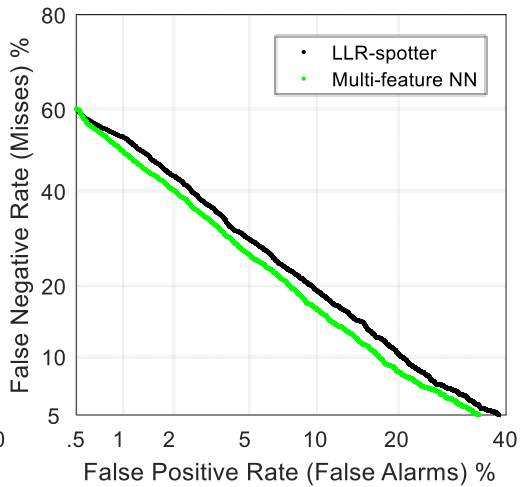 Figure: Detection Error Trade-off (DET) curves showing the superiority of Multi-feature NNs over individual metrics.
Critical Insight: Why it Works
The genius of this paper lies in the Phonetic Lattice (PL). By comparing a "Bigram" model (which has total freedom to hear any phoneme) with a "Constrained Lattice" (which wants to hear the correct word), the delta between their outputs becomes a high-signal feature for mispronunciation. If the Bigram model hears "cat" but the Constrained model is forced to hear "car," the resulting Levenshtein distance is a clear "smoking gun" for an error.
Conclusion & Future Outlook
This work proves that for "messy" speech, structural inductive biases (like syllable-based grammars) are more effective than simply throwing more data at a standard word-level model.
Limitations: The system still struggles with low-vocal effort (whispering) and ambient noise. Future iterations could benefit from Wav2Vec 2.0 style self-supervised embeddings to replace the GMM-HMM acoustic backbone, potentially driving the miss rate even lower.