
Scalable Link Prediction: Matrix Completion for Million-Node Social Networks
Missing Link Prediction in Social Networks
The paper proposes an efficient imputation-based Matrix Completion algorithm for link prediction in large-scale social networks. By leveraging a sparse SVD solver and custom function handles, the method achieves SOTA performance on coauthorship datasets and high rankings in international social network challenges.
TL;DR
This research demonstrates that Matrix Completion via Low-Rank Approximation is not just a theoretical curiosity but a powerful, scalable tool for real-world social networks. By optimizing Singular Value Decomposition (SVD) for sparse environments, the authors achieved top-tier rankings in global challenges and developed a functional recommendation engine for GitHub.
Background Positioning: This work sits at the intersection of classical Collaborative Filtering and modern Large-Scale Data Mining, proving that refined traditional methods can often outperform complex contemporary models in efficiency.
Problem & Motivation
Social network links (like Facebook friendships or GitHub stars) can be represented as an adjacency matrix . However, predicting missing links is notoriously difficult because:
- Sparsity: Most users only interact with a tiny fraction of the network (e.g., a sparsity level of 1/33545 in the GitHub case).
- Binary Nature: The matrix elements are strictly 0 or 1, requiring specific handling to avoid treating "not yet linked" as "never will be linked."
- Scale: With millions of nodes, a standard approach is computationally impossible on a standard PC.
The authors' insight was to treat link prediction as a Matrix Imputation problem, iteratively refining a low-rank estimate using only the known sparse signals.
Methodology: The Core
The heart of the paper is an efficient iteration consisting of three steps:
- Low-Rank Approximation: Factoring the matrix .
- Prediction: Setting the approximation as the new candidate matrix.
- Adjustment: Re-inserting the known ground-truth values back into the predicted matrix.
Architectural Optimization
To solve for matrices as large as 1M x 1M, the authors utilize the PROPACK library. Instead of building the full matrix, they define function handles for and .
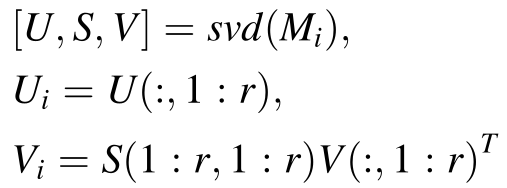
By only storing matrices () and (), the memory footprint stays manageable. For a rank , even a million-node network fits comfortably in memory.
Experiments & Results
The authors validated their approach on two major benchmarks:
1. NIPS Coauthorship
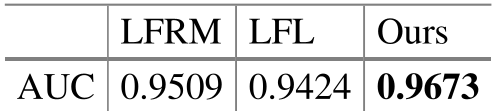
In predicting which researchers would collaborate, the team's Matrix Completion approach (AUC 0.9673) significantly surpassed established methods like Latent Feature Relational Models (LFRM).
2. IJCNN Social Network Challenge (Flickr)
Facing over 100 teams, the algorithm achieved a mean AUC of 0.9326, placing it in the Top 5. Notably, this was achieved without the "blending" tricks (ensembling) common in competitions, highlighting the robustness of the underlying math.
Real-World Application: GitHub Recommender
The authors translated this methodology into a commercial application for GitHub. By processing 3.2 million "Star" events, the system provides:
- Repo-to-Repo Similarity: "Coders who starred this also starred..."
- User-to-Repo Recommendation: Predicting which unseen repositories a specific user will likely appreciate.
Evaluation Insight: Their method provided a 15% performance boost over the popularity-based baseline, particularly excelling for "long-tail" (less active) users where simple popularity metrics fail.
Critical Analysis & Conclusion
Takeaway
The paper confirms that link prediction can be effectively solved through low-rank matrix factorization if implemented with memory-efficient SVD solvers. The success on GitHub data proves its commercial viability.
Limitations
- Static Context: The current iteration doesn't fully account for the "time" dimension (temporal dynamics) beyond basic preprocessing.
- Feature Blindness: The model relies purely on the link structure (topology) and does not incorporate node features (e.g., repository language or user profile), which could further improve accuracy.
Future Outlook
The next frontier for this work involves integrating community-aware features or moving toward Time-Aware Recommendation Systems (TCARS) to capture how user interests evolve on platforms like GitHub.