
Mistaking Friends for Foes: Why Betweenness-Based Sybil Defenses Fail in the Real World
Mistaking friends for foes: an analysis of a social network-based Sybil defense in mobile networks
This paper critically evaluates MobID, a social network-based Sybil defense designed for mobile networks that utilizes betweenness centrality to distinguish honest nodes ("friends") from Sybil identities ("foes"). By analyzing real-world social network traces, the authors demonstrate that the fundamental topological assumptions of MobID are flawed, leading to a high rate of false positives where honest nodes are incorrectly rejected.
TL;DR
In the decentralized world of mobile networks, identifying "Sybil" nodes (fake identities created by an attacker) is a high-stakes game of trust. This paper provides a rigorous "reality check" for MobID, a defense mechanism that uses Betweenness Centrality to verify users. The verdict? MobID is largely inapplicable to real-world social structures, often rejecting up to 90% of legitimate users because it relies on topological properties that simply don't exist in natural social graphs.
The "Common Friend" Bottleneck
To understand why MobID fails, we must look at its core logic. When a "Suspect" wants to interact with a "Verifier," MobID requires the suspect to prove their "goodness" based on their position in a social graph.
The authors identify two fatal flaws:
- The Common Friend Problem: For the Verifier to even start a calculation, the Suspect must share at least one (and usually many) mutual friends. In a sparse network, two honest people are often separated by 3 or 4 hops, meaning they share zero immediate neighbors. Under MobID, they are "foes" by default.
- Shortest-Path Fragility: Betweenness is calculated based on how many "shortest paths" pass through a node. If you aren't on the absolute most efficient route between two other people, your betweenness is zero—even if you are a well-connected, honest member of the community.
Methodology: Testing Against Reality
The authors didn't just theorize; they processed eight significant real-world datasets, ranging from Facebook to DBLP (academic collaborations), categorizing them by their "community structure" (Type 1: Strong communities, Type 3: Flat/Small diameter).
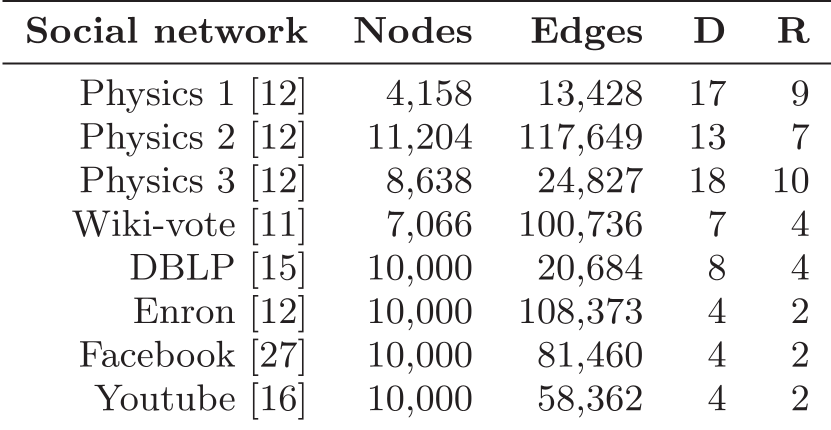
By calculating the betweenness centrality of every node in these networks, they aimed to see what percentage of honest nodes would actually pass a "Goodness" test.
The Architecture of Failure
The paper uses a clear example to demonstrate the "Shortest Path" logic trap. Consider a scenario where a suspect (Node A) is well-connected but isn't the most direct link between two groups.
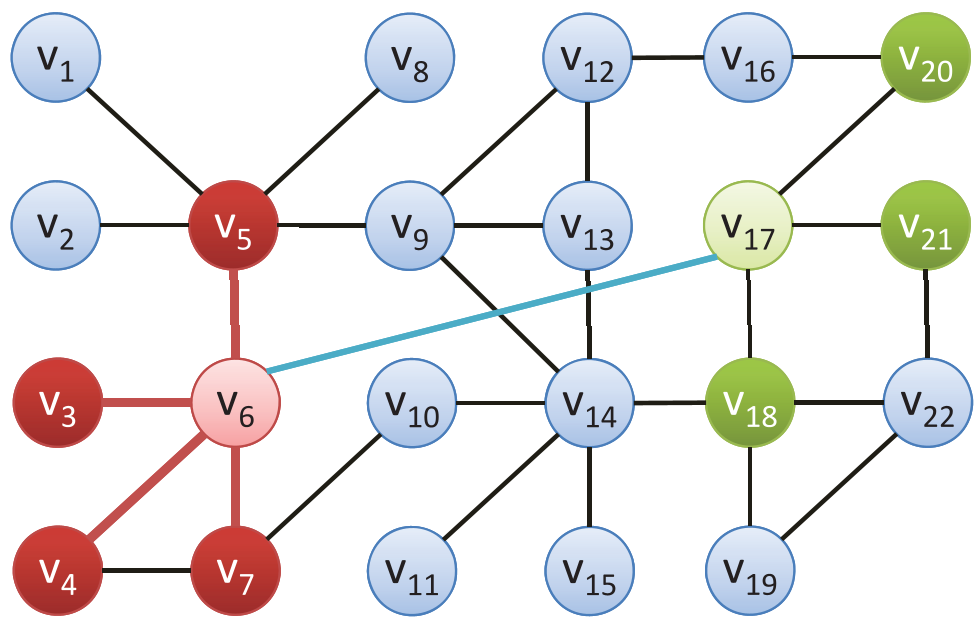 In this figure, node v14 is an honest node with many friends. However, because v17 (the verifier) has a more direct route to its targets, v14 is assigned a betweenness of zero and rejected as a Sybil.
Experimental Evidence: A Dramatic Loss in Performance
The experimental results are striking. In networks with strong community structures (like the Physics datasets), nearly 50% of the network has a betweenness of zero.
When the authors applied a moderate threshold (), the results were catastrophic for usability:
- Youtube: Only 8% of honest nodes were accepted.
- Epinions/Facebook: Only 20% were accepted.
- DBLP: Only 25% were accepted.
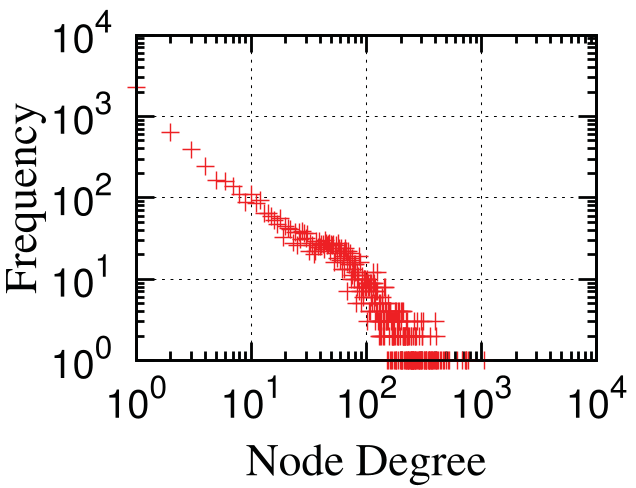 The Cumulative Distribution Function (CDF) plots show that a massive portion of the population (the flat lines on the left) sits at zero or near-zero betweenness.
Deep Insight: Why Did This Happen?
The original designers of MobID likely over-relied on mobile encounter traces—data from people physically bumping into each other. While those traces might show frequent "common" sightings, they don't represent the trust-based social graphs required for security.
The authors conclude that while the intention of moving away from "fast-mixing" assumptions (like those in SybilLimit) was noble, choosing Betweenness was a step in the wrong direction. Betweenness is a measure of "influence" or "bottlenecking," not a measure of "honesty."
Critical Summary & Future Work
The primary takeaway is a warning to the academic community: Algorithmic properties must be validated against realistic social topologies before being proposed as security defenses.
Limitations: The study uses static snapshots of graphs, whereas mobile networks are dynamic. However, the author's point remains: if the static foundation is broken, the dynamic application is unlikely to fare better.
The Path Forward: Instead of looking for "optimal paths," future Sybil defenses should leverage Community Detection (identifying tight-knit groups) or Credit-based flows (like SumUp), which are far more resilient to the "zero-betweenness" trap.