
Confident Decoding: Bypassing the Alignment Tax for Peak LLM Reasoning
Deeper is Not Always Better: Mitigating the Alignment Tax via Confident Layer Decoding
The paper introduces Confident Decoding, a training-free, drop-in strategy that improves LLM reasoning by dynamically selecting the most reliable near-final layer for token prediction. Experiments across dense and MoE models (e.g., Qwen, Gemma) show significant gains on GPQA-Diamond and Omni-MATH, achieving SOTA reasoning performance without extra memory and with <2% latency.
TL;DR
Modern Large Language Models (LLMs) are like over-coached students: they might internalize a complex math solution in their "intermediate thoughts," but at the last second, they swap specific technical terms for generic "safe" words to please their teachers. Confident Decoding is a new, training-free method that identifies these last-minute mistakes by looking at predictive entropy. By stopping just a few layers early when the model is most "confident," it unlocks significant gains in reasoning, coding, and math without requiring any retraining or meaningful extra compute.
The Problem: The "Planning-Pragmatics Tradeoff"
We usually assume that in a Transformer, the deeper the layer, the better the answer. This is the monotonic-depth assumption. However, the authors discover a three-phase dynamic:
- Phase I (Guess): Shallow layers make a rough statistical stab at the token.
- Phase II (Refine): Intermediate layers do the heavy lifting, integrating context and logic.
- Phase III (Perturb): The final layers, heavily influenced by RLHF and safety alignment, often rotate the representation toward a generic "safe" distribution.
For complex reasoning, this last phase acts as an Alignment Tax. The model might have a precise scientific term ready at layer 38, but layer 40 shifts it to a common punctuation mark or a generic word like "is" or "the" to match the "safe and helpful" style it was trained on.
Methodology: The Entropy Valley
How do we know when to stop? The authors use Shannon Entropy as a proxy for confidence.
Instead of a "Static Early Exit" (which kills performance by stopping too early on hard tokens), Confident Decoding uses a Conservative Backward Search.
- It starts at the final layer .
- It looks back at candidate layers (e.g., to ).
- It searches for the Entropy Valley—the layer where the prediction is sharpest (lowest entropy) before the final layers start introducing noise.
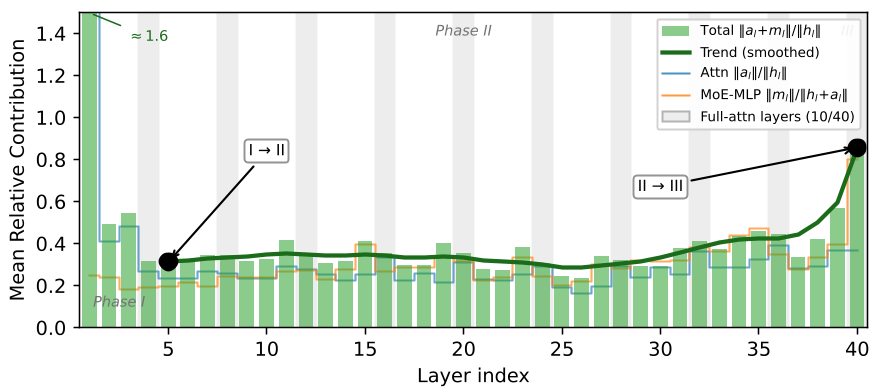 Figure 1: The Relative Contribution Norm shows a sharp resurgence in the final layer (Phase III), indicating a significant representational shift that deviates from the stable refinement phase.
Experiments & Results: Rescuing Logic
The results on reasoning-heavy benchmarks are striking. On GPQA-Diamond (expert-level science), the method boosts Qwen3.5-35B-A3B by +6.5%.
Most impressively, the harder the task, the better this method works. On Omni-MATH Level 4 problems—where standard models often collapse—the intervention rescued fragile logic chains, leading to a +22.4% improvement for the gpt-oss-20b model.
 Table 1: As task difficulty increases (Level 1 to 4), the delta between standard decoding and Confident Decoding grows, proving it acts as a shield for complex logic.
Why it’s Production-Ready
- Zero Memory Overhead: It reuses the same KV-cache.
- Negligible Latency: The mean extra computation is only 0.116 projections per token, leading to a <2% increase in wall-clock time in vLLM.
- Architecture Agnostic: It works on dense models (Gemma) and MoE models (Qwen) alike.
Critical Insight: Alignment vs. Reasoning
A fascinating finding in the paper is the Instruct vs. Base Model comparison. The "Alignment Tax" is significantly higher in Instruct models than in their Base equivalents. This suggests that the very process of making models "safe and helpful" via human preference tuning is what creates the terminal layer perturbation. Confident Decoding effectively lets us have the best of both worlds: the instruction-following of an aligned model with the raw reasoning fidelity of the base representations.
Conclusion
Confident Decoding proves that the "last mile" of an LLM's forward pass can sometimes be its undoing. By mathematically defining the "Entropy Valley," researchers have found a way to filter out the noise of post-training alignment. For anyone building reasoning-heavy AI applications, this training-free "layer surgery" is likely the most cost-effective performance upgrade available today.
Future Outlook: Can we train models to never have this perturbation? Until then, stopping at the valley is our best bet for expert-level AI.