
Mitigating Gender Bias: A Sociolinguistic Framework for "Gender-Proofing" Machine Learning
Mitigating Gender Bias in Machine Learning Data Sets
The paper introduces a cross-disciplinary framework to identify and mitigate gender bias in machine learning training sets by integrating gender theory and sociolinguistics. Using word embeddings (Word2Vec) and rule-based extraction, the authors analyze shifts in gender representation and stereotypical associations across a century of historical fiction and a decade of contemporary news from The Guardian.
TL;DR
This research bridges the gap between AI and gender theory to create a scalable framework for identifying bias in textual data. By comparing 19th-century literature with a decade of modern journalism from The Guardian, the study reveals that gender bias isn't just about "what" words we use, but "how" we structure them—from the order of names in a sentence to the way we modify occupations.
The Hidden Architecture of Bias
Most current efforts to fix "algorithmic bias" treat the symptom rather than the disease. They focus on post-processing models or using simplified word lists. However, language is a complex system where gender ideology is baked into the very syntax. The authors argue that without a foundation in feminist linguistics, we risk building "fair" models on data that remains fundamentally skewed.
The core insight is that even well-meaning data (like news articles discussing the gender pay gap) can reinforce stereotypes. When an article mentions a "female executive" to discuss equality, a machine learning model may simply learn that "executive" is normally male and "female" is an exception.
Methodology: Beyond Simple Word Counts
The researchers utilized a 100-dimensional CBOW Word2Vec model to analyze two massive datasets:
- British Library Corpus: 16,426 volumes of 19th-century fiction (the baseline for traditional bias).
- The Guardian Archive: Every article published between 2009 and 2018.
They looked for four specific linguistic "red flags":
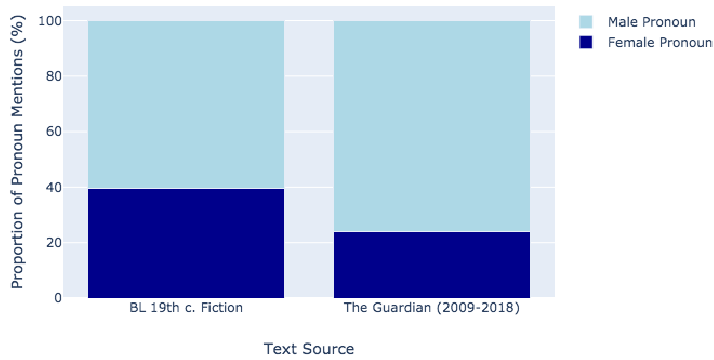
- Presence: The ratio of male to female pronouns.
- Premodification: Adding gender to roles (e.g., "male nurse" vs "nurse").
- Androcentric Generics: Using "mankind" or "statesman" as universal terms.
- Binomial Ordering: The tendency to put men first in pairs (e.g., "Husband and Wife").
Key Findings: The Paradox of Modern Discourse
The study produced several counter-intuitive results that challenge how we think about "clean" training data:
1. The "Default Male" Problem in Occupations
In modern news, the use of gender-premodified occupations actually increased over the last decade. While this reflects a society discussing gender more openly, it provides a "noisy" signal to AI. If a model sees "female doctor" more often than "male doctor," it reinforces the idea that the "standard" doctor is male.
2. The Power of Word Order
One of the most persistent biases found was Binomial Ordering. In 19th-century fiction, men were listed first 87% of the time. Shockingly, in The Guardian in 2018, this figure only dropped to 74%. For "Husband and Wife," the male-first order remained at 84%, indicating that marriage roles are still deeply tied to historical power structures in our language.
3. Emotional and Action Associations
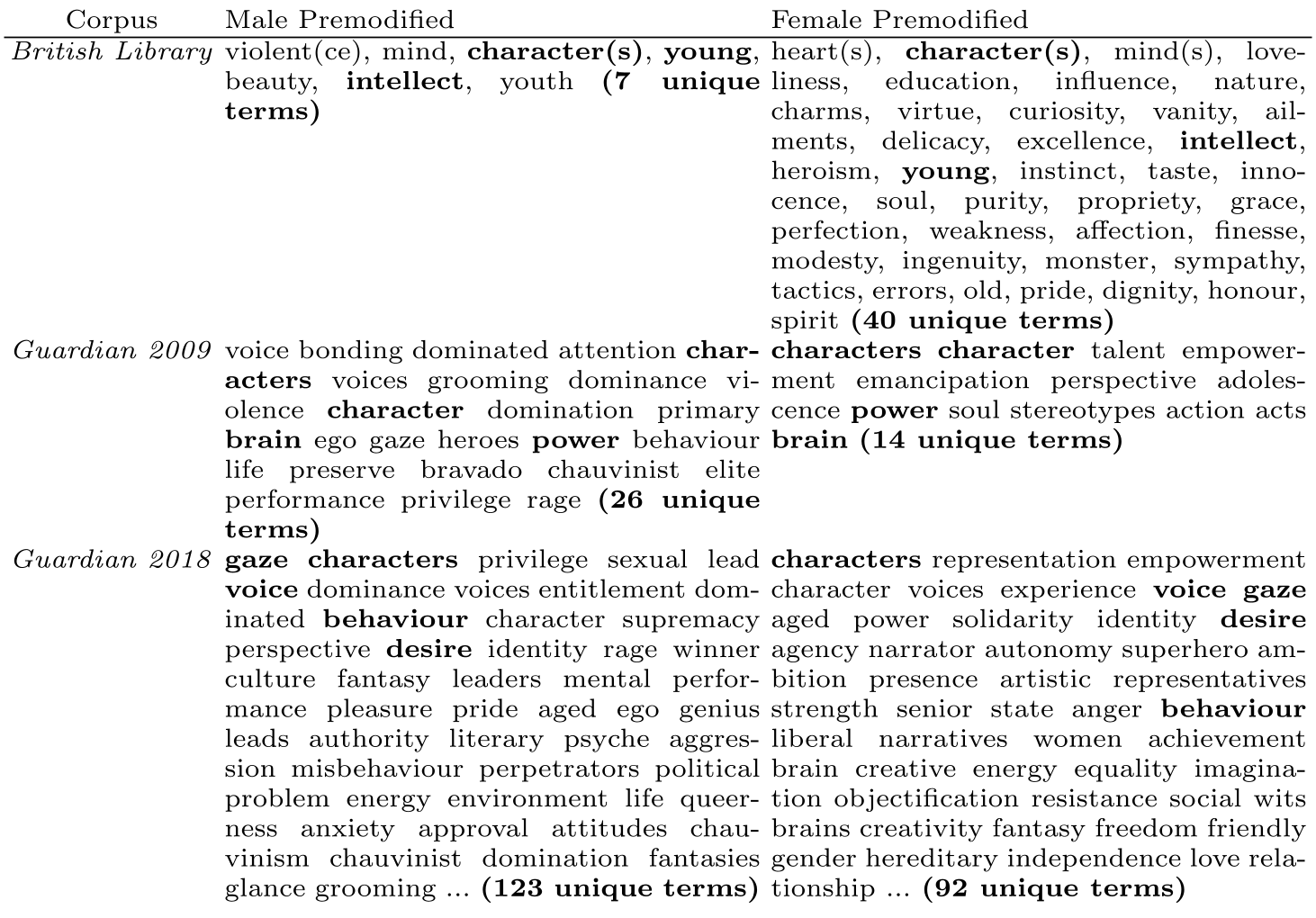
Using cosine similarity, the authors found that in 19th-century data, women were tightly coupled with "passive" emotions (love, flirt, adore), while men were coupled with "active" roles (leader, commander). While modern news has seen these associations equalize in some areas, women are still more frequently associated with parenting status (e.g., "working mother") than men.
Critical Insights & Future Outlook
The most profound takeaway is that neutrality is not enough. If we train models on "natural" language, they will inherently adopt the social hierarchies of the past century.
- Scalability: This framework is not limited to Victorian novels; it can be applied to any large-scale text corpus to "score" its gender bias before it ever hits a GPU.
- The "Hysteria" Risk: The study notes that 2018 data showed an association between "female" and "hysteria" or "fragility" due to news reports critiquing those concepts. Models, lacking a sense of irony or critique, may simply learn the association as a fact.
- Recommendation: Future work should focus on augmenting the data itself—such as swapping gendered binomials (e.g., switching "men and women" to "women and men")—to break the link between word order and social power.
Conclusion
This paper serves as a vital reminder that Machine Learning is not just a math problem—it’s a sociolinguistic one. To build truly fair AI, we must stop treating text as a bag of words and start treating it as a reflection of a power-imbalanced society.