
Mitigating Range Anxiety: Turning EVs into Mobile Charging Hubs via Social Networks
Mitigating range anxiety via vehicle-to-vehicle social charging system
The paper introduces a Vehicle-to-Vehicle (V2V) Social Charging System designed to reduce "range anxiety" by allowing electric vehicles (EVs) with surplus energy to charge those in urgent need. It leverages a location-based social networking framework and a maximum weighted bipartite matching algorithm to coordinate energy exchange between mobile peers and traditional charging stations.
TL;DR
To combat the "range anxiety" that plagues electric vehicle (EV) owners, this paper proposes a decentralized Vehicle-to-Vehicle (V2V) Social Charging System. By leveraging a social-media-style "check-in" mechanism, EVs with excess power can sell energy to those in need. The system uses bipartite matching to optimize transfers, effectively turning every EV into a potential charging station and reducing the need for expensive grid infrastructure.
The "Range Anxiety" Bottleneck
Despite the growth of the EV market, three barriers remain: limited range, long charging times, and the scarcity of charging stations. Most drivers charge at home, but unexpected trips can push batteries to their limits. Building more public stations is costly and static. The authors argue that the solution isn't just more hardware, but a more flexible social distribution of existing energy.
Methodology: Social Networking Meets Energy Transfer
The core innovation is treating energy surplus as a shareable resource managed through a Location-Based Social Network (LBSN).
1. The Check-in Model
Instead of intrusive constant tracking, drivers use a mobile app to check in at locations (like workplaces). They share:
- Current State of Charge (SOC).
- Intended duration of stay.
- Available surplus (energy not needed for the day's commute).
2. Bipartite Matching Optimization
The problem is modeled as a graph where nodes are "Anxious EVs" (Buyers) and "Supplier Nodes" (Sellers or Stations). A buyer can only be matched to a seller if:
- The buyer has enough range to reach the seller.
- The seller has enough surplus to cover the buyer's need plus the seller's own travel costs.
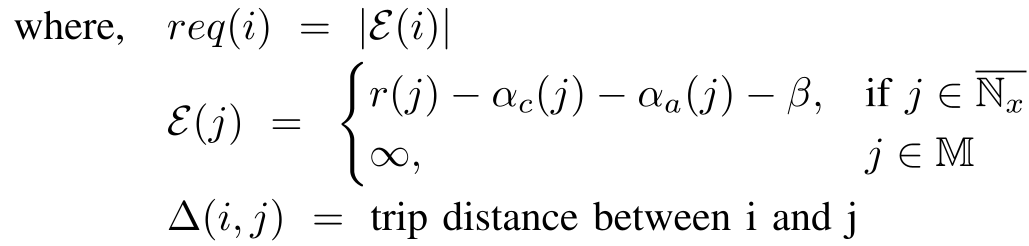
The system solves this using the Ford-Fulkerson algorithm, maximizing the total number of successfully charged vehicles under varying grid and battery constraints.
Evidence from the Richmond Case Study
The researchers simulated the Richmond, Virginia metro area using real-world data for charging station locations and vehicle types (Nissan Leaf, Tesla Model S, etc.).
Key Findings:
- Scaling Gracefully: As the number of EVs in a city grows, fixed charging stations quickly become overwhelmed. In the V2V model, the percentage of "anxious" drivers stays low because the number of potential sellers increases proportionally with the number of buyers.
- The "Tesla" Effect: High-capacity vehicles act as "mobile reservoirs." Including long-range EVs in the network significantly reduces the load on the traditional power grid.
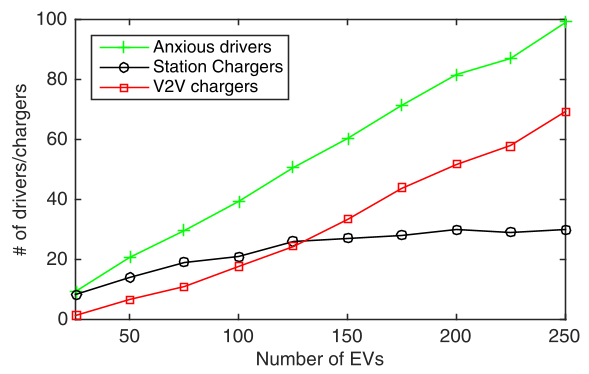 Figure: The percentage of anxious drivers is significantly lower (blue line) when V2V is active compared to station-only charging (red line).
Critical Analysis & Future Outlook
This work provides a compelling case for Distributed Energy Resources (DER). However, several challenges remain:
- Hardware Standardization: While the software is ready, widespread bidirectional charging (like CHAdeMO or J1772 modifications) is still maturing in many EV models.
- Economic Incentives: For this to work in the real world, a robust "social market" with dynamic pricing (auctions) is needed to reward sellers for their battery degradation and time.
- Privacy vs. Efficiency: The "check-in" model is a great compromise, but its effectiveness depends entirely on user participation rates.
Conclusion
The "V2V Social Charging System" represents a shift from a centralized infrastructure mindset to a Colab-Economy mindset. By treating the EV fleet as a collective battery, we can mitigate range anxiety and create a more resilient, grid-independent transportation ecosystem.