
MHAS: Breaking the Resolution Limit with Hybrid Hierarchical Clustering and Swarm Intelligence
An approach based on mixed hierarchical clustering and optimization for graph analysis in social media network: toward globally hierarchical community structure
This paper introduces a Mixed Hierarchical Algorithm (MHA) that integrates bottom-up (agglomerative) and top-down (divisive) clustering to detect community structures in social media networks. By incorporating Swarm Intelligence (SI)—specifically Ant and Bee colony optimization—the method, termed MHAS, successfully navigates local optima to achieve a globally optimal hierarchical community structure.
TL;DR
Determining how social groups form and organize hierarchically is a fundamental challenge in Social Network Analysis (SNA). This paper presents MHAS, a hybrid approach that fuses bottom-up and top-down hierarchical clustering with Swarm Intelligence. By alternating between agglomerative and divisive steps and optimizing via Ant and Bee colony logic, the model achieves a global optimum for community structures, outperforming industry standards like LOUVAIN and INFOMAP in both accuracy and scalability.
Problem & Motivation: The Paradox of Scale
In community detection, we often face a trade-off:
- Agglomerative (Bottom-up): Excellent at finding small clusters but fails to see the "big picture" (the macro-structure) and scales poorly ().
- Divisive (Top-down): Robust for identifying large partitions but often misses small communities, merging them prematurely—a phenomenon known as the resolution limit.
The authors observed that most algorithms are "greedy," meaning they make the best local choice at each step but often miss the globally optimal community distribution. The motivation here was to build a "pseudo-lattice" structure that allows the algorithm to move both ways (merging and splitting) to correct earlier mistakes.
Methodology: The Core Mechanism
The methodology follows a robust three-step process:
1. Advanced Graph Modeling
Instead of relying solely on link existence, the authors introduce a dual-weighting system ():
- Jaccard Similarity: Measures the overlap of neighbors/opinions.
- Covariance Measurement: Qualifies the degree of independence between nodes. This creates a more nuanced "tie strength" between members.
2. The Mixed Hierarchical Algorithm (MHA)
Unlike traditional methods that only go "up" or "down," MHA constructs a lattice. It starts with an initial partition and iteratively applies:
- Agglomerative Algorithm (AgA): Merges nodes with the highest .
- Divisive Algorithm (DivA): Splits nodes with the lowest . The system reaches a "fixed point" when both operators yield the same stable community structure.
3. MHAS: Swarm Intelligence Optimization
To prevent the MHA from getting stuck in local optima, the authors integrated Swarm Intelligence (SI):
- Bee Colony (BEE-C AgA): Bees excel at finding the best "food sources" (optimal merges).
- Ant Colony (ANT-C DivA): Ants excel at finding the path to the best decomposition.
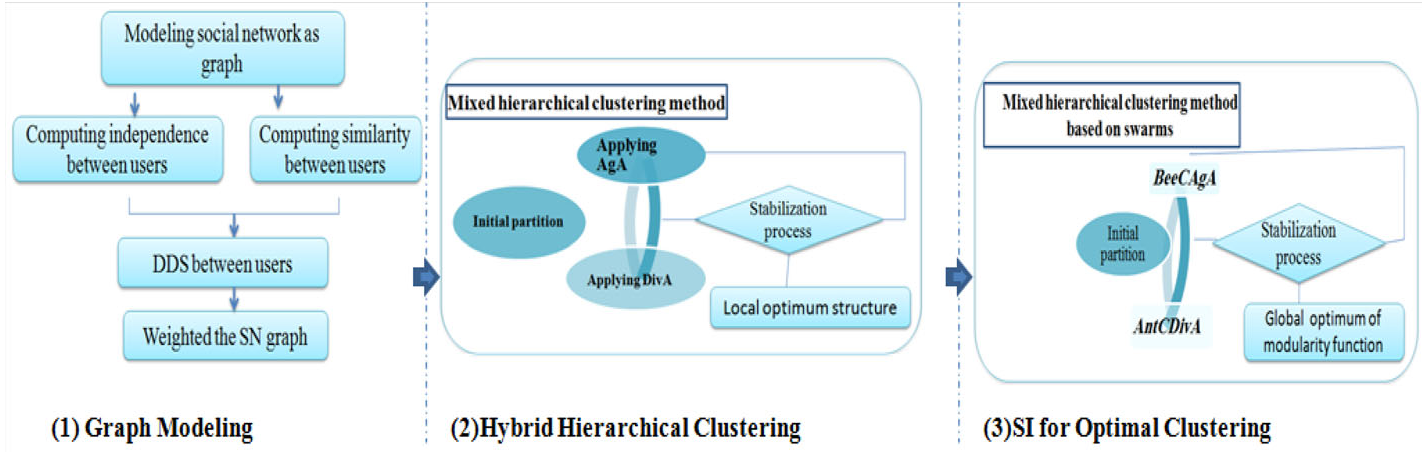 Figure: The flowchart of the proposed mixed hierarchical method.
Experiments & Results: SOTA Performance
The authors tested MHAS against large-scale artificial LFR benchmarks and real-world networks (PGP, Twitter, etc.).
Key Metrics:
- Energy Density (CEC): Lower values indicate a more "natural" fit. MHAS achieved an Energy value of 0.25, significantly lower than LOUVAIN (0.95).
- Silhouette Width: Measures cluster cohesiveness. On the American College Football network, MHAS reached 0.83, whereas standard SI-integrated INFOMAP only reached 0.52.
- Scalability: Execution time for the basic MHA remained significantly lower than LOUVAIN-Swarm as the number of nodes increased towards 10,000.
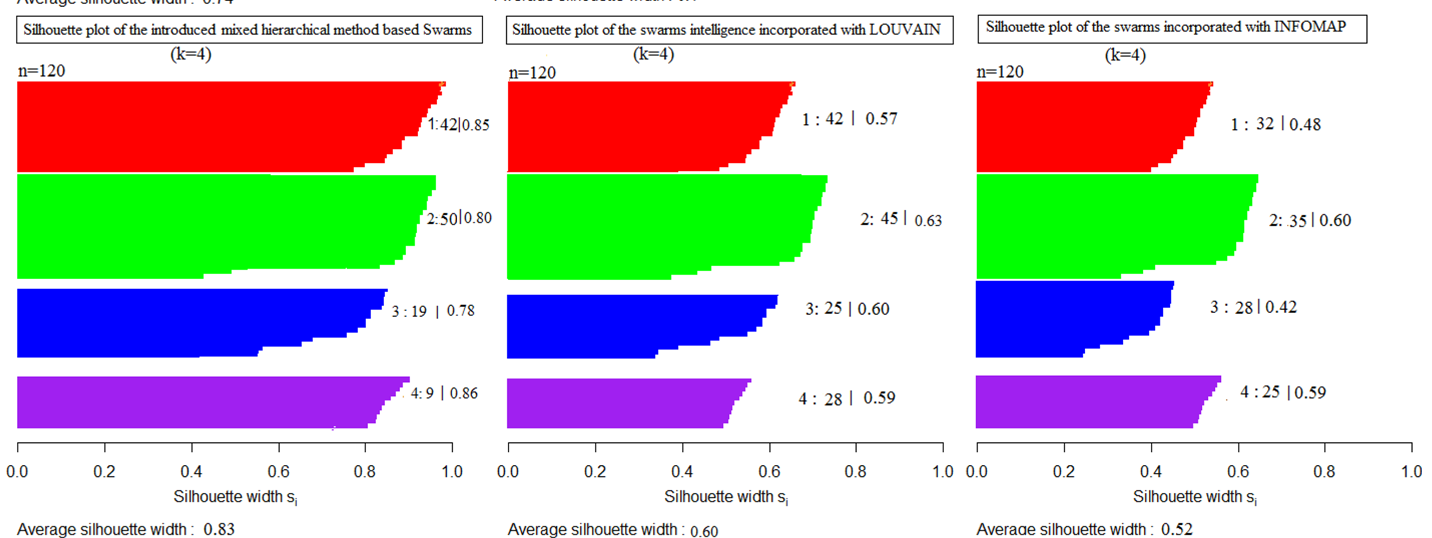 Figure: Silhouette plot comparing clustering quality across different algorithms.
Critical Analysis & Conclusion
Takeaway
The true innovation of this work lies in the bidirectional nature of the clustering. Most algorithms are one-way streets; by building a "stabilization process" between merging and splitting, MHAS corrects for the resolution limit. The use of Swarm Intelligence provides the "randomness" and "exploration" needed to jump out of local optima that trap simpler greedy algorithms.
Limitations & Future Work
- Static Nature: The current model focuses on static snapshots of social networks. In the real world, edges appear and disappear in seconds.
- Hybrid Complexity: While faster than some optimized variants, the complexity of maintaining a swarm-based mixed hierarchy still presents a challenge for "billions-of-nodes" scale graphs (e.g., the full Facebook graph).
- Future Path: The authors intend to apply this to "dynamic community evolution," tracking how these hierarchical lattices morph over time.
In conclusion, MHAS represents a significant step toward "globally hierarchical" community detection, ensuring that neither the "trees" (small clusters) nor the "forest" (large partitions) are lost in the analysis.