
Disentangling the Web: Using Mixed-Mode Networks to Parse Social Influence
Using Mixed-Mode Networks to Disentangle Multiple Sources of Social Influence
This paper introduces a mixed-mode network decomposition method to disentangle multiple sources of social influence. By integrating one-mode friendship networks with two-mode affiliation networks, the approach identifies whether peer influence stems from close social ties or shared organizational memberships.
TL;DR
Social influence is often a "black box" where we struggle to see if we are influenced by our close friends or by the activities we join. This paper introduces a novel Mixed-Mode Network Decomposition method that mathematically separates these forces. By layering friendship data onto participation data, the research reveals that different social settings (like sports vs. clubs) drive behavior through fundamentally different interpersonal channels.
Contextual Positioning
In the landscape of Social Network Analysis (SNA), most researchers operate in either "one-mode" (who is friends with whom) or "two-mode" (who attends which event) silos. This work acts as a methodological bridge, providing a formal framework to decompose these overlapping structures. It moves beyond simple "exposure" to a granular "source-specific" influence model.
The Problem: The Confounding of "Who" and "Where"
Why do adolescents start drinking or smoking? Is it because their best friend does it, or because they are part of a sports team where "everyone does it"?
Existing models typically look at one or the other. If you only look at sports participation (two-mode), you might miss that the influence is actually only coming from the two friends on that team. If you only look at friendship (one-mode), you miss the environmental context of the locker room. The Inductive Bias of prior work assumes these are independent, but in reality, they are deeply confounded.
Methodology: The Logic of Decomposition
The core innovation lies in the Element-wise Matrix Product (Hadamard product) used to partition influence.
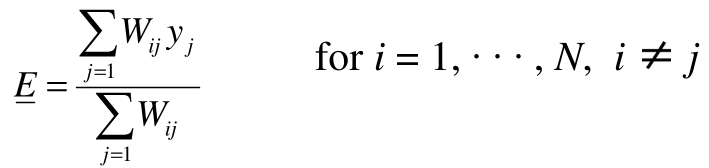
1. The Standard Exposure Model
The baseline is the general network exposure formula, where influence () is the weighted sum of peers' behaviors ():
2. The Partitioning Insight
The author suggests that the co-participation matrix (derived from two-mode data) can be split into two mutually exclusive parts using the friendship matrix :
- (The Proximity Effect): Co-participants who are also friends.
- (The Structural Effect): Co-participants who are not friends.
The mathematical beauty here is simple but powerful: . This allows a regression model to assign different weights (coefficients) to different types of peers within the same organizational boundary.
Critical Results: Sports vs. Clubs
The empirical applications provided in the paper offer a fascinating look at the "social physics" of school life:
- Sports are Interpersonal: In sports teams, behavioral influence was only significant if the teammate was also a friend. This suggests that sports influence relies on interpersonal bonding.
- Clubs are Normative: In school clubs, participants were influenced by drinking peers regardless of whether they were friends. This suggests a normative environmental influence where the setting itself dictates behavior.
Note: The study utilized cumulative logit models across 106 schools, showing that shared "crowd identity" (e.g., being a 'Jock' or 'Brain') significantly changes the impact of peer exposure.
Critical Analysis & Conclusion
The Takeaway
The value of this method is its ability to reveal the social mechanism at play. It tells us not just that a network matters, but how it matters. For policymakers, this means an intervention in a sports team should focus on friend groups ("focal peers"), while a club-based intervention should target the general group culture.
Limitations
The primary limitation is the requirement for high-quality, overlapping data. Collecting both relational (friendship) and affiliation (activity) data is labor-intensive. Furthermore, the paper focuses on a Cross-sectional view; the next frontier for this method would be applying it to Longitudinal data to see how these influences evolve over time.
Final Thought
This work provides the mathematical tools to finally answer the "nature vs. nurture" equivalent in social networks: Is it the person or the place? The answer, as Fujiomoto demonstrates, is likely a decomposed version of both.